Glow Plug Timer control units

   / Glow Plug Timer control units #1  

SG51Buss

Member
Joined
Jan 20, 2015
Messages
37
Location
Fredericksburg, Texas
Tractor
New Holland TC35
The glow plug indicator lamp on my New Holland TC35 Boomer would occasionally come on, and now it just stays on.
According to the helpful threads in this forum, the cause is a faulty glow plug timer unit:

http://www.tractorbynet.com/forums/new-holland-owning-operating/110076-glow-plug-problem.html

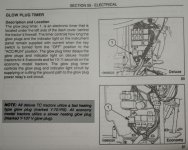
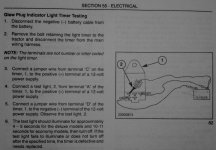
Pulled the unit, bench tested it per this procedure, and sure 'nuff, it's bad.
TC35-TimerTest01.jpg TC35-TimerTest02.jpg
 
   / Glow Plug Timer control units
  • Thread Starter
#2  
The replacement timer was going to run me close to $120 from the local dealer.
So, I opted to get a couple of the Kubota timers off eBay, for $35.

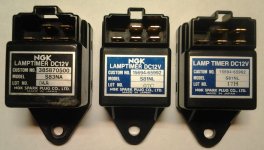
Now I've got 3 timers.
3-GlowPlugTimers.jpg
 
   / Glow Plug Timer control units
  • Thread Starter
#3  
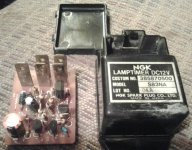
Let's see what's going on in here.
The boxes are easy to open, just pry off the back.
TC35-GlowPlugTimer02.jpg

This is where the surprises appear. The printed circuit boards inside the boxes are all different.
The board inside my original timer box doesn't even match the model number labeled on the box.
This is what I found:

New Holland P/N SBA385870500 Model# S83NA, Lot#04A - contains S81NF-1
Kubota P/N 15694-65992 Model # S81NL, Lot#07C - contains S81NL-1
Kubota P/N 15694-65992 Model # S81NL, Lot#17H - contains S81NL-2

The Kubota timers are supposedly interchangeable with New Holland's SBA385870301, the faster timer.

Why my box has a different board, I haven't a clue.

So, I've decided to reverse-engineer the circuits, to see how they work, if they can be diagnosed, and if they're repairable.
 
   / Glow Plug Timer control units
  • Thread Starter
#4  
This is what the NGK S81NF-1 LampTimer PCB looks like:
(Please ignore the unsoldered transistor)
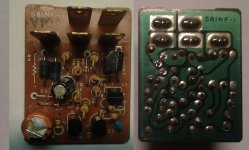
NGK-S81NF-1-pcb.jpg

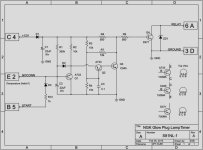
This is the NGK S81NF-1 LampTimer circuit schematic:
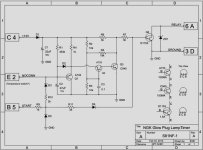
NGK-S81NF-1-sch.jpg


General description:

The region around transistor Q1 is the timing circuit, defined by charging rate of the resistor/capacitor pair R1 & C2.
Initially, their voltage is low, so the base of Q1 drains into this R/C pair, pulling the output of the pull-up resistor R4 low. After sufficient time has elapsed for C2 to charge, Q1 is turned off, and the output of this timing section (emitter of Q1) goes high, triggering the sense/latch section.
Pin #2 (or E) goes directly to Q1's base. It isn't used on the New Holland Boomer schematics. But, I found a Kubota schematic showing that pin wired to a temperature switch, so it would influence the timer section. Which way, I don't know.

The region around transistors Q2 & Q3 is the sense/latch circuit.
Q2 will only pass current to Q3's base when its emitter voltage (controlled by the output of the timing section) goes higher than its base voltage (defined by voltage dividers R2 & R3). When that occurs, current is passed to the base of Q3, turning it on.
Q3 is initially off, allowing its collector voltage to be high, which keeps driver transistor Q4 turned on. When Q3 turns on, it pulls its collector voltage low, pulling voltage from Q4's base, turning it off. Q3 also drains current through R5, pulling the threshold voltage of Q2's base low, forcing it to latch 'on', keeping Q3 turned on, which keeps Q4 turned off.

The transistor Q4 is the output relay driver.
Initially, it is turned on, because it's receiving current through the R6/R7 resistor pair. When Q3 turns on, it sinks current away from the R6/R7 pair, turning Q4 off.
Q4 is the grounding driver for the Glow Plug relay. When Q4 is 'on', the glow plugs and indicator lamp receive power. Q4 is protected from the relay's inductive kickback by zener diode ZD1. I measured the resistance of the glow plug relay solenoid coil, and got about 72 ohms. That means that Driver Transistor Q4 will need to sink about 150-200 mA current to energize the relay. The Q4 D1153 Darlington transistor is rated for 1.5 amps, plenty for this.

When the starter is engaged, current rushes through R9, and does 2 things.
First, current rushes through R10/D3 to charge the timer cap C2, ending its cycle.
Second, current rushes through R11/D4 to the base of Q4, forcing it to come (or remain) 'on', overriding the output of the sense/latch section.
This causes the glow plugs to come (or remain) 'on' during starting.

Failure mode:
Occasionally, the glow plug relay will energize, or just remain 'on', as seen by the indicator lamp. When I bench-tested my timer, I found a residual/varying 3-4 volts at Q4's base, keeping it turned 'on'. So, either the Q2/Q3 latch circuit failed, or timer Q1 shorted. I'm not sure if the current inrush from the starter input may be damaging these sections. The timer capacitor C2 (big orange thing) is only rated for 10 volts. Maybe it's underrated and failing.
 
   / Glow Plug Timer control units
  • Thread Starter
#5  
This is what the NGK S81NL-1 LampTimer PCB looks like:
(For the Kubota)
NGK-S81NL-1-pcb.jpg

This is the NGK S81NL-1 LampTimer circuit schematic:
NGK-S81NL-1-sch.jpg


General description:

The NGK S81NL-1 LampTimer is quite similar to the previous NGK S81NF-1, with a few differences:

1. The timers R1/C2 are different, a faster timebase. C2 is now rated for 25v.
2. Some of the designators for the resistors have changed, not important here.
3. The R8/R9 current control resistors are much smaller, Q3 will need to sink about 20mA now.
4. Driver transistor Q4 is now a regular NPN, with half the current rating. Still enuff though.
5. Big difference is the 'start' circuit. This one doesn't turn on the glow plugs during start.

Bench test:
Ran the lamp test on the unit, found that it stays on for 6 seconds.
Then the lamp flickers rapidly for another 1-2 seconds before staying off???
This could wreak havoc on the glow plug power relay, needs further investigation...
 
   / Glow Plug Timer control units
  • Thread Starter
#6  
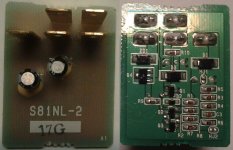
This is what the NGK S81NL-2 LampTimer PCB looks like:
(For the Kubota)
NGK-S81NL-2-pcb.jpg

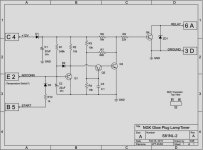
This is the NGK S81NL-2 LampTimer circuit schematic:
NGK-S81NL-2-sch.jpg


General description:

This NGK S81NL-2 LampTimer is functionally similar to the previous NGK S81NL-1, with some big differences:

1. The Printed Circuit Board now uses Surface Mount technology. Harder to fix.
2. As such, only the resistor values can be read. No discernable markings for the diodes and transistors.
3. The designators for the components are the same. Handy, but not important here.
4. The R8/R9 current control resistors are now much larger, Q3 won't need to sink as much current now.
5. The latch drain resistor R7 is much smaller now. Q2's base will be aggressively pulled low.


Bench test:
Ran the lamp test on the unit, found that it stays on for 5 seconds.
The lamp goes out quickly without any flickering.
 
   / Glow Plug Timer control units #7  
Well now THAT was interesting


I also have a NGK glow plug timer on my Yanmar built JD. I searched numerous electronic parts distributors for a replacement one with no luck

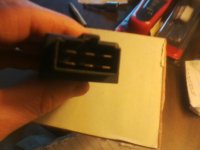
This one is even different yet S83NT-O1A and it has 6 blades.

0208150733-00.jpg


And according the shop manual schematic the Deere starting circuit also energizes the glow plug when the key switch is turned to start independent of the module operation. By overriding the starting circuit using a safety relay cutout switch (I pull out my dash mounted PTO switch) and holding the key I can activate my glow plugs for as long as I need.

When my module failed it caused a steady current draw and the charging system didn't operate right.

So I just unplugged it

It is about $90 part from Deere. Still I would like to replace it for less.
 
   / Glow Plug Timer control units #8  
Interesting, there's about 10 bucks of parts in there.
DFB, open yours up like SG51Buss did, we can take a look inside,
you could always bring it to a "computer", "TV", repair shop for an estimate to replace the defective parts.
Theres not much to them, I figure around $25 bucks to fix it.
 
   / Glow Plug Timer control units #9  
Interesting, there's about 10 bucks of parts in there.
DFB, open yours up like SG51Buss did, we can take a look inside,
you could always bring it to a "computer", "TV", repair shop for an estimate to replace the defective parts.
Theres not much to them, I figure around $25 bucks to fix it.

Yep $10. of parts but that is normal factory mark ups to be a profitable enterprise.
Rule of thumb is 10X cost of components = retail $
 
   / Glow Plug Timer control units #10  
Althought I am clueless about electronics, I have great pleasure to follow your thread.
You have just given out a great idea to get some electronics repaird at a fraction of the new part price: Go to a TV/Computer repair shop to get it fixed! Thank you.
In this regard you help other electronics clueless members!:thumbsup::)
 
   / Glow Plug Timer control units #11  
Althought I am clueless about electronics, I have great pleasure to follow your thread.
You have just given out a great idea to get some electronics repaird at a fraction of the new part price: Go to a TV/Computer repair shop to get it fixed! Thank you.
In this regard you help other electronics clueless members!:thumbsup::)


I tried to do that with a circuit board for a geothermal heating unit. I forget the name of the component, but I believe it limits the starting current. Anyway, there was no way I could find to buy a new replacement component without going through Warefurnace. Let's hope that there are replacement parts available in the open market - I didn't have any such luck at the time. I guess you win some and lose some.
 
   / Glow Plug Timer control units
  • Thread Starter
#12  
Hey guys, thanx so much for your interest and comments. Wasn't sure how this would be received, but I knew there were plenty of fix-it-yerself folks on here. DFB, yeah, kinda figured that there were other/different configuratons of glow plug timers out there. Hope this thread helps others diagnosing all those other types.

The saga continues:

Examining and probing my original NGK S81NF-1 LampTimer showed that the suspect capacitor C2 is okay.
The problem turned out to be the latch section transistors Q2 & Q3 failed. Will try fixing later.

So, I decided to use the new NGK S81NL-1 for my tractor.
But, I wanted to extend the 'on' time a little, and get rid of that flickering problem.

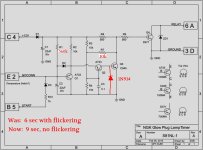
Replacing the timer resistor R1, from a 390k to a 560k, extended the 'on' time to 9 seconds.
Replacing latch resistor R7, from an 18k to a 10k, got rid of that unstable flickering.

During probing, I noticed that the voltage of the single connection between latch transistors Q2's collector and Q3's base would drop to around -3v to -4v during the initial delayed 'on' time. I don't like this. Having the base of an NPN transistor going to a lower voltage than its emitter isn't good. So, I decided to protect Q3 by adding a 1N914 diode between that line and ground. It still goes negative, by a small fraction of a volt, but stays well within NPN transistor safety margins.

I'm familiar with emitter-follower and darlington configurations, but this is the first time I've seen this collector-base setup.

Maybe this is why these things fail so much.

This is what the MODIFIED NGK S81NL-1 LampTimer PCB looks like:
(old/replaced resistors at bottom of picture)
MOD-NGK-S81NL-1-pcb.jpg

This is the MODIFIED NGK S81NL-1 LampTimer circuit schematic:
(Annotations in red)
MOD-NGK-S81NL-1-sch.jpg
 
   / Glow Plug Timer control units #13  
I like your MODIFIED thinking - that's why my FIL's faulty glow plug controller (timer plus an engine temp cutout circuit) is going to be modified by replacing it with a momentary-contact switch on the dash. Might cost $10 including a couple of connectors and a bit of scrap wire.

I used to like tinkering in the circuitry but it has gotten to where so much of it is SMD that its impossible to troubleshoot or repair, and even when there's discreet components, suitably-spec'ed replacements are hard to find. Nice that Digi-Key has a lot of no-minimum order items and reasonable shipping prices.

- Jay
 
   / Glow Plug Timer control units
  • Thread Starter
#14  
JRobyn, ditto on the modern electronics. That's why I was pleasantly surprised to find a vintage '80s circuit in there. Found that this NGK design originated in the 80's, when things like this used simple Resistor/Capacitor timing circuits, like windshield wiper timers, headlight/domelight delays, flashing LEDs, and such. The transistors in my broken unit are very common, no special features, and I think I can fix it using some typical grab-bag stuff in my shop...
 
   / Glow Plug Timer control units
  • Thread Starter
#15  
Something I should've mentioned in the other posts:

Some sections of the tractor manual use letters to identify the timer's pin-outs, other sections use numbers, and some of the timers have numbers to identify the pins. To avoid confusion, I've used both letters and numbers to identify the pins. For example, the +12v power pin may be referred to as 'C' or '4', so I've labelled it as 'C4'.


So, I've fixed my original NGK S81NF-1 LampTimer.
The suspected latch section transistors Q2 & Q3 were okay afterall.

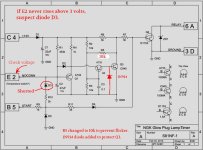
The problem was: Diode D3 was shorted.
This allowed the the timing charge to drain, through resistors R10, R11, and diode D4, into Q4's base.
The timer wouldn't complete its cycle, leaving the glow plugs turned on.
My guess is that the current inrush from the start override pin B5, into cap C2, damages the diode.
Also found, like with the other timer, that there was a flickering problem, and Q3's base would drop to around -3v to -4v.

So, here's an addendum to the LampTimer bench test:
(Specific to the NGK S81NF-1 with starter override only)

1. Connect a voltmeter's negative lead to the ground pin, 3D.
2. Connect the voltmeter's positive lead to the NoConnect (Temp sensor) pin, E2.
3. During test, the voltage should slowly rise to about 4.5-5.0 volts, then the test lamp goes out.
4. If the voltage never rises above about 3 volts, suspect diode D3.

Now for the mods:

1. Replaced latch resistor R7, from an 18k to a 10k, to stop the unstable flickering.
2. Added a 1N914 protection diode between Q3's base and ground.

This is what the REPAIRED/MODIFIED NGK S81NF-1 LampTimer PCB looks like:
FIX-NGK-S81NF-1-pcb.jpg

This is the REPAIRED/MODIFIED NGK S81NF-1 LampTimer circuit schematic:
(Annotations in red)
FIX-NGK-S81NF-1-sch.jpg
 
   / Glow Plug Timer control units #16  
I have a small Volvo excavator with Mitsubishi S3L2 engine and I have a issue with glow relay timer. Timer works ok when I power it up, but problem is that timer doesn't shutdown glowing att all (glow time should be ~6,2 seconds according workshop manual). Timer is looking like this:


I didn't found any reasonable price direct replacement sparepart from Europe, does anyone know can I replace my timer with this: http://www.ebay.com/itm/NGK-Lamptim...632780957?&clk_rvr_id=892938497681&rmvSB=true . One thing I noticed that S81-NL has 5 pins (extra pin is for engine temperature sensor?) and my old S85-NC has only 4 pins.

Of course if someone has some ideas how to fix that old one? I already tried to solder all again, but with no success.

Thanks
 
   / Glow Plug Timer control units #17  
If my experience (Mitsubishi 3cyl in Cub Cadet 7260) holds true, even if you find a substitute, it will be pricey. As in $75USD+. It was a really simple and cheap alternative to wire up a momentary contact pushbutton. The dash even had a pre-punched hole for a switch.

If you do, check the schematic to be sure to wire your pushbutton in the circuit for the existing glowplug relay coil, and not in place of the actual relay contacts. The coil is low amperage, the contacts are HIGH amperage and would require a much larger and more expensive switch.

- Jay

p.s. - You probably already noticed that it looks like the larger blue resistor shows some signs of heat, so it might be worth pulling and checking/replacing that. And interesting that your old housing says it's a S85-NC but the actual circuit board says it's a S81-NJ. I'm pretty sure you are correct about the 5th terminal being engine temp sensor connection. That's what's on the one for the Mitsubishi/Cub and what SG51 noted in previous posts.

p.p.s. - and in re-reading SG51's excellent posts, I note that his failure mode (staying on) is the same as yours, so quite likely that your latch diode D3 is knackered.
 
Last edited:
   / Glow Plug Timer control units
  • Thread Starter
#18  
Hi dippa and JRobyn. Been awhile since I've been on here. This site's interlinked advertizing does things that crash my tablet, so I can't get on here much. Experienced 4 crashes already just reading this thread.

There's some signs of overheating on that PC board, so a component or several have failed.
For this particular issue, I'd need to have the old timer unit in-hand, the schematic for the Volvo/Mitsubishi glow plug circuit, and the new timer unit in-hand.

From what I was able to determine from my New Holland issue, is that the main connector pinouts seem to be common, but the differences are in the features (temp switch) and timing value. I was able to repair mine, but had to replace a few components. The fact that it's similar to the Kubota timer is interesting.

The timer you're considering may easily interchange, but I'd recommend a close examination and comparison with the original unit first. Be prepared for unusual variations.

I guess what I'm trying to say here is: "I haven't a clue."

If any other members have particular knowledge of dippa's timer issue, please chime in...
 
   / Glow Plug Timer control units
  • Thread Starter
#19  
I just re-read this thread and most of the imbedded pictures don't come up.
Were they deleted?
 
   / Glow Plug Timer control units #20  
All the pics are still there for me (using Chrome). That sux having crashes. Sounds like maybe you need to install "Ad Blocker Plus"?

- Jay
 

Tractor & Equipment Auctions

Jack Daniels Miniature Decorative Truck (A59231)
Jack Daniels...
1998 MACK DUMP TRUCK (A60430)
1998 MACK DUMP...
CASE INTERNATIONAL 5140 TRACTOR (A52707)
CASE INTERNATIONAL...
2021 BOBCAT T870 SKID STEER (A60429)
2021 BOBCAT T870...
2019 Dodge Charger Sedan (A59231)
2019 Dodge Charger...
SKID STEER ATTACHMENT PACKER (A58214)
SKID STEER...
 
Top