Hanging Trailer Chains

   / Hanging Trailer Chains #21  
Twisting the chain works, but if you have a low trailer, and you twist them to get them off the ground, and you have to take a sharp corner, you can run out of chain if you have shortened them too much. Plus if you leave them hanging and then load the trailer or get into some whoop de dos you can still drag twisted chains. Plus I can hook up a bungee in a lot less time than you can twist one chain, much less two.
People that haul a lot usually figure out what works, but those that just do it every now and then are the ones I usually see with dragging chains. I would hate to know just how much money U-haul charges for damaged chains caused by dragging, and they are the worse culprits, as they put way too much chain on their trailers for the most inexperienced.
David from jax

Make sure to CROSS your safety chains as well. This actually allows you to twist them up a hair (not too much! Just enough to get them about as high off of the ground as the jack) Plus, it is the law. As long as you have a good 4-6" 'droop' in your chains in most cases, you won't ever get them too tight while turning, even in really tight turns or while backing up.

Hope this helps!
 
   / Hanging Trailer Chains #22  
Never seen that way before, ok for smaller trailers, I wouldn't want it for a 5 ton or up though.

JB.

Actually, i have seen a trailer with the bigger chains mounted this way that come loose when a tow ball broke on a truck. Held 19,500lbs all the way. Seriously strong, as long as you weld it correctly.
 
   / Hanging Trailer Chains #23  
That's actually a well written law. I'm not talking about the intent, but about how it's worded so a regular person can actually understand what is being said. I do some work on the planning and zoning commission in our city, and it's hard to write a law so that it's robust but still understandable to a layman.

I digress.

I guess that in Washington there's no welding the chain to the trailer. That makes sense from a standpoint that the welding may change the properties of the metal the chain is made from.

I don't know exactly why, but I'm not real keen on drilling holes through this frame to bolt the chain on. It seems the other option is to weld some kind of bracket onto the trailer frame that holds the chain on.

Actually, it is federal law. Welding the chain can weaken the heat treatment, so you have to mount the chain without actually welding on the chain itself.
 
   / Hanging Trailer Chains
  • Thread Starter
#24  
The best way to mount safety chains are to create a weld on mount. Hang the end link of the safety inside of it and then permanently weld it to the trailer.. photo shown below .

I think this is my favorite idea.
 
   / Hanging Trailer Chains #26  
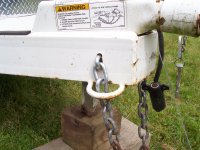
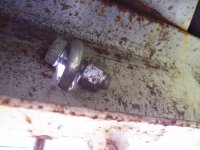
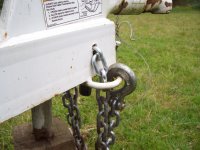
What they did on our horse trailer is cut a small slot in the frame and stick the last link of the chain (they used 5/16") through.
attachment.php

They then put the biggest bolt that fit through that link and used a nylock nut.
attachment.php

On the bottom of the frame they welded a hoop that the chain goes down through and it makes a great place to hook the chains when the trailer is unhooked.
attachment.php


I like how it works and if I ever build a trailer this is how I would do it. Depending on how thick your frame is I might reinforce it with some 1/8" plate.

Ed
 

Attachments

  • 106_8297.JPG
    106_8297.JPG
    754 KB · Views: 2,588
  • 106_8300.JPG
    106_8300.JPG
    748.1 KB · Views: 1,959
  • 106_8301.JPG
    106_8301.JPG
    718.2 KB · Views: 3,334
   / Hanging Trailer Chains #27  
I think this is my favorite idea.

I don't like it, I agree you shouldn't weld the chain, but with the welded loops you can't replace the chain easily. My equipment trailer has the welded loops and I need to replace the chain with a heavier one. now I have to cut it off and I'm back at square one, "what's the best way to hang a chain"
Maybe I could use a threaded repair link or a double clevis on the loop.
The integrity of the welded loop is not the issue for me, it's the permanency of welding a captured link in it.


What they did on our horse trailer is cut a small slot in the frame and stick the last link of the chain (they used 5/16") through.then put the biggest bolt that fit through that link and used a nylock nut.
I like how it works and if I ever build a trailer this is how I would do it. Depending on how thick your frame is I might reinforce it with some 1/8" plate.

Ed

Not crazy about this way either, just does not look kosher, plus you can't visually inspect it with out climbing under.

I'd prefer the u-bolt or double clevis. If you build your trailer, I think it would be easier to drill 2 holes for a u-bolt than cut the slot for the link.

JB
 
   / Hanging Trailer Chains #28  
How can that be legal when you're supposed to have two chains? If the link in the keyhole, or the one on either side of it breaks, you have nothing.

I don't know. It was factory built in 2008 and has all kinds of official decals on it to prove it. It has also passed three annual motor vehicle safety inspections, as required here by law.
 
   / Hanging Trailer Chains #29  
Not crazy about this way either, just does not look kosher, plus you can't visually inspect it with out climbing under.

I'd prefer the u-bolt or double clevis. If you build your trailer, I think it would be easier to drill 2 holes for a u-bolt than cut the slot for the link.

JB

K, but it you used a u-bolt, wouldn't you have 2 nuts on each side that you would need to clime under the trailer to check? I'm not sure how the double clevis works.

Ed
 
   / Hanging Trailer Chains #30  
K, but it you used a u-bolt, wouldn't you have 2 nuts on each side that you would need to clime under the trailer to check? I'm not sure how the double clevis works.

Ed


Yeah I know, I thought someone might say that, but with the u-bolt it would be tight. you would be able to see/ feel that from the outside. with the bolt thru the link it is always loose and moving so no way to tell what's really holding it.
I'm not saying you should change it, just not something I would plan on doing if I were designing a trailer.
The double clevis would require a plate or a loop welded on, so for simplicity a u-bolt would seem to be the way to go, provided you can find a stout stubby ubolt, like what's used on a cable clamp.

One problem I can think of with clamping a link tight though would be how to position it so when a shock load came on, it wouldn't be the weakest link because it can't move. Then I suppose you could leave the ubolt loose by using the nylocks, but now your back to climbing under or at least feeling underneath to check their condition/position.

I guess OP had a legitimate/ good question :)

JB
 
   / Hanging Trailer Chains #31  
What I do when they need replace is drill 2 5/8" holes though the frame then use threaded link and safety cables instead of chains. Takes care of the slack issue and chains dragging also.

Chris
 
   / Hanging Trailer Chains #32  
wouldn't twisting the chains lower the rating of the chain if the trailer came disconcted?

I don't see how it can. Chain is same strength before/after twisting chains. You are not physically twisting each link, you are twisting the whole chain.
 
   / Hanging Trailer Chains #33  
That's what you have to love about this world. Everybody is coming up with something different every day.

Craig
TheTrailerGuy
 
   / Hanging Trailer Chains #34  
I wonder if there is a regulation on welded loops and such? There is not one for stake pockets. You know, the quality and strength of the steel, certified welder, etc.

I attached a photo of the Bri-Mar dump I used to have. Wish I had a photo from the backside but you can somewhat see the double tabs the factory welded on with bolts holding the chains in place.

Don't know if anyone mentioned it but gooseneck chains are supposed to be crossed as well.
 
   / Hanging Trailer Chains
  • Thread Starter
#35  
Maybe I could use a threaded repair link or a double clevis on the loop...
The integrity of the welded loop is not the issue for me, it's the permanency of welding a captured link in it.

I had considered the quick link or clevis option. What would be the problem with either of those options?

My thought was to weld the captured link at first. Then if I needed to change it ever, I could cut the old chain off and use the quick link or the clevis as a repair.
 
   / Hanging Trailer Chains #36  
Yeah I know, I thought someone might say that, but with the u-bolt it would be tight. you would be able to see/ feel that from the outside. with the bolt thru the link it is always loose and moving so no way to tell what's really holding it.
I'm not saying you should change it, just not something I would plan on doing if I were designing a trailer.
The double clevis would require a plate or a loop welded on, so for simplicity a u-bolt would seem to be the way to go, provided you can find a stout stubby ubolt, like what's used on a cable clamp.

One problem I can think of with clamping a link tight though would be how to position it so when a shock load came on, it wouldn't be the weakest link because it can't move. Then I suppose you could leave the ubolt loose by using the nylocks, but now your back to climbing under or at least feeling underneath to check their condition/position.

I guess OP had a legitimate/ good question :)

JB

Hmmmmmm, you do have a point. Ours has no play in it but without looking under there you don't really know if the nut is on like it should be or if the bolt is just barely through the chain link and ready to fall out.

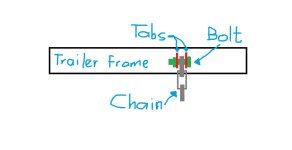
Maybe weld two rounded tabs 3/8" appart where the slot is on our trailer with a hole in them and you could put the bolt through the one side, the last chain link, and the the other side? Like this you could see if the nut was still on the bolt and the chain could move.
I made a pretty crude drawing but it should show what I mean.
attachment.php


Ed
 

Attachments

  • Trailer chains.jpg
    Trailer chains.jpg
    40.3 KB · Views: 959
   / Hanging Trailer Chains
  • Thread Starter
#37  
Hmmmmmm, you do have a point. Ours has no play in it but without looking under there you don't really know if the nut is on like it should be or if the bolt is just barely through the chain link and ready to fall out.

Maybe weld two rounded tabs 3/8" appart where the slot is on our trailer with a hole in them and you could put the bolt through the one side, the last chain link, and the the other side? Like this you could see if the nut was still on the bolt and the chain could move.
I made a pretty crude drawing but it should show what I mean.
attachment.php


Ed

How do you think that set up would do if the chains were needed? Would it twist those tabs? I wonder if rotating that bolt 90 degrees would be better.
 
   / Hanging Trailer Chains #38  
How do you think that set up would do if the chains were needed? Would it twist those tabs? I wonder if rotating that bolt 90 degrees would be better.

I was thinking it would still have the loop at the bottom of the frame like our horse trailer has so that would make the pull mostly down. If you didn't do the loop then it probly would be better to rotate them so if they were needed it would be a straight pull on them. You could use what ever size plate you wanted but I was thinking either 1/4" or maybe even 3/8" for the tabs.

Ed
 
   / Hanging Trailer Chains #39  
How do you think that set up would do if the chains were needed? Would it twist those tabs? I wonder if rotating that bolt 90 degrees would be better.

Here is my LAST opinion on this.... look at the chain itself. How is the chain built... it is resistance welded together. Look at the size of the steel wire used to make the chain... 5/16" maybe 3/8".. even with heat treatment it will only gain so much tensile strength.

Ok... now think about this. Take a 1/2" cold rolled steel rod, bend a little 'crook' in it, so that the chain link can swing unhindered, then weld this rod to a 6.2lb per foot A36 steel channel (otherwise known as the tongue of the trailer) with .045 wire in a 400 amp wire welder using Stargon gas and make sure to put on FOUR 1.25" welds (each side of the rod on either end).

do you think that you could pull that rod back off of that tongue without breaking the chain? We had the design lab tested (as required to obtain a $2 million liability policy) and in all 14 tests, the chain broke long before this mount design did. In fact the lab guys said that the design didn't even MOVE before the chain broke.... we're talking about 15,000psi of yank strength. Every trailer has two chains which means that you would need to exert 30,000lbs of total force to snap the chains anyway, which is an insane number by any measure on a trailer.

it swivels easy, doesn't bind up and is stronger than the chain itself. Get your wire welder out and get-r-dun.

by the way... why are you changing safety chains? never seen it done unless the trailer was in a crash. Just curious.

Now... on with our lives.
 
   / Hanging Trailer Chains #40  
Maybe weld two rounded tabs 3/8" appart where the slot is on our trailer with a hole in them and you could put the bolt through the one side, the last chain link, and the the other side? Like this you could see if the nut was still on the bolt and the chain could move.
I made a pretty crude drawing but it should show what I mean.
attachment.php


Ed

I like this idea, turned 90 as mentioned even better.

My dump trailer uses a single plate tab with a 3/8" hole, for use with the double clevis connector Like I showed a few post back.


Here is my LAST opinion on this.... look at the chain itself. How is the chain built... it is resistance welded together. Look at the size of the steel wire used to make the chain... 5/16" maybe 3/8".. even with heat treatment it will only gain so much tensile strength.

Ok... now think about this. Take a 1/2" cold rolled steel rod, bend a little 'crook' in it, so that the chain link can swing unhindered, then weld this rod to a 6.2lb per foot A36 steel channel (otherwise known as the tongue of the trailer) with .045 wire in a 400 amp wire welder using Stargon gas and make sure to put on FOUR 1.25" welds (each side of the rod on either end).

do you think that you could pull that rod back off of that tongue without breaking the chain? We had the design lab tested (as required to obtain a $2 million liability policy) and in all 14 tests, the chain broke long before this mount design did. In fact the lab guys said that the design didn't even MOVE before the chain broke.... we're talking about 15,000psi of yank strength. Every trailer has two chains which means that you would need to exert 30,000lbs of total force to snap the chains anyway, which is an insane number by any measure on a trailer.

it swivels easy, doesn't bind up and is stronger than the chain itself. Get your wire welder out and get-r-dun.

by the way... why are you changing safety chains? never seen it done unless the trailer was in a crash. Just curious.

Now... on with our lives.

No doubt this is an economical, safe effective method. that's why it's seen on so many trailers.
I need to change the chains on my equipment trailer cause I believe they are undersized.
I'm sure there are other reasons to need to change a chain. Cutting them off is easy enough, and if you can find a rated repair link I guess all would be good. If you had to cut the loop and reweld that would not be good.

JB.
 

Tractor & Equipment Auctions

Bobcat T590 (A53317)
2012 Mini Cooper Coupe (A59231)
2012 Mini Cooper...
2012 DOOSAN G25KW GENERATOR (A55745)
2012 DOOSAN G25KW...
Honda EM3500SX Portable Gasoline Generator (A59228)
Honda EM3500SX...
1996 FORD F-SERIES FLATBED TRUCK (A52706)
1996 FORD F-SERIES...
8ft Flatbed Truck Body with Axle (A55851)
8ft Flatbed Truck...
 
Top