Lean to Shed

   / Lean to Shed #1  

kjg26

Silver Member
Joined
Sep 2, 2017
Messages
114
Location
Buford, GA
Tractor
2013 Kioti DK55
On our property we have an old house that had a fire in a portion of it. The house is unusable and will eventually be torn down. I am looking for some additional covered storage out there. I was planning to put a lean to on one side of it. I am new to this type of building but am good with my hands and love to learn.

Something like this that I will close in 2 sides

lean to framing terms with pictures - Google Search

First question I need to have clarified is terminology. Please correct anything I have wrong. In the picture the board going along the house and the board going along the posts is called a nailer. Is this called anything else? Ledger? Posts are posts. Rafters are the pieces going from the house to the post. What are the pieces between the rafters? Do they go flush between the rafters or do i put them on top the rafters and nail the roofing material to those?


The length of the structure will be about 20 ft and the height of the outside post will be about 8 ft although that is negotiable. The length is dictated by the roofline of the house. I could lower it a little on the house side to get a little more length but that will affect the height of the exterior wall/posts. What size nailers/ledgers are needed for the house and post side? Rafters sizes? Post sizes?


Thanks in advance.

Keith
 
   / Lean to Shed #2  
I would call the board along the existing wall a ledger board and the one along the posts a header. The ledger and header should be fastened with lag screws or bolts, not nailed. For best strength put blocking under them or notch them into the posts. The rafters should either set on top of the ledger and header or you should use metal hangers to attach them. That didn't seem clear in the linked diagrams. What kind of roofing are you using? If you are putting on metal, you run 2x4 purlins across (on top of) the rafters and fasten the metal to those. If you are using shingles, you sheath with plywood or OSB and shouldn't need anymore structure. If you did install "blocking" between the rafters, it would be flush but I don't see why you would need them.
 
   / Lean to Shed
  • Thread Starter
#3  
Roofing material will more than likely be sheet metal. So the blocking under the ledger...would that go from the ground up to the ledger? I had planned on notching the posts to hold the header. Those posts should be 6x6, 4x4, or 4x6? Also what size should the header and ledger be? Rafters? Purlins I see you recommend 2x4. I'm thinking 2x6 but don't know about the header and ledger.
 
   / Lean to Shed #4  
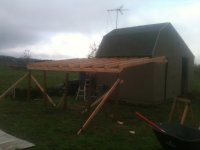
Here's a construction picture of what I built for my tractor, it's 12x20. lag bolted the 2x6 to the existing shed, other end is two 2x6's nailed together with hurricane ties holding that to the posts. The perlins I think they're called are held to both with Simpson brackets instead of notching. I think it just took a weekend to build and I had around $500 in it total with used roofing...
 

Attachments

  • Phone Pics 724.jpg
    Phone Pics 724.jpg
    866.6 KB · Views: 590
   / Lean to Shed #5  
I would call the board along the existing wall a ledger board and the one along the posts a header. The ledger and header should be fastened with lag screws or bolts, not nailed. For best strength put blocking under them or notch them into the posts. The rafters should either set on top of the ledger and header or you should use metal hangers to attach them. That didn't seem clear in the linked diagrams. What kind of roofing are you using? If you are putting on metal, you run 2x4 purlins across (on top of) the rafters and fasten the metal to those. If you are using shingles, you sheath with plywood or OSB and shouldn't need anymore structure. If you did install "blocking" between the rafters, it would be flush but I don't see why you would need them.

Solid advise!!

You said that you are going to use metal for the roof. There are a couple type of metal out there, but they all install about the same. With metal, you do not need as many rafters. Spacing of the rafters is dictated by the purlins. My rule of thumb is the space my rafters 4 feet apart on center, if using 2x4's on the flat for purlins, which gives you a lot of wood to screw into. If you space your rafters 6 feet apart, you use 2x6 purlins on the edge. 8 foot spacing means 2x8's on the edge. Purlins should be every 4 feet or less.

The other thing to factor in is how far out will your roof extend? For me, I use 2x6's for 12 feet of span, 2x8's for less then 16 feet and 2x10s for more then 16 feet. After that, I'm going to use trusses or add a beam with a post. This is not for snow loads, and it's just how I like to build things.

For posts, a 4x4 is plenty strong enough to carry the load, but with modern pressure treatment, they are unreliable and very likely to bow or twist on you fairly quickly. 4x6's will give you a better chance of remaining straight, but I recently saw a few that had bowed significantly in just a year at a clients house. I use 6x6's for all my jobs because I never have to come back and fix anything. They are heavy, but well worth the effort once you have them in the ground.

Flashing is also really important and something that takes a little effort at the beginning to avoid long term headaches down the road. Ideally, you want your flashing to be under your siding of the existing building so water runs down the building wall, over the flashing and then over the metal roof and then out over the building. This sounds simple, but it's often the source of a lot of issues.

Since you are new to this, you might want to get some graph paper and draw out your framing. Then take a picture of it and post it on here for everyone to review. This is very basic framing, but it's also where a lot of the DIYers skip a step to get it done quickly that they really shouldn't have skipped.
 
   / Lean to Shed
  • Thread Starter
#6  
Here's a construction picture of what I built for my tractor, it's 12x20. lag bolted the 2x6 to the existing shed, other end is two 2x6's nailed together with hurricane ties holding that to the posts. The perlins I think they're called are held to both with Simpson brackets instead of notching. I think it just took a weekend to build and I had around $500 in it total with used roofing...


What is the height of the barn side and the pole side? Trying to see if i'll have enough clearance and pitch. My issue is the side of the house i'm bolting to is the gable side and i'm dealing with the roofline.


Shared album - Keith Gonyea - Google Photos
 
   / Lean to Shed
  • Thread Starter
#7  
Solid advise!!

You said that you are going to use metal for the roof. There are a couple type of metal out there, but they all install about the same. With metal, you do not need as many rafters. Spacing of the rafters is dictated by the purlins. My rule of thumb is the space my rafters 4 feet apart on center, if using 2x4's on the flat for purlins, which gives you a lot of wood to screw into. If you space your rafters 6 feet apart, you use 2x6 purlins on the edge. 8 foot spacing means 2x8's on the edge. Purlins should be every 4 feet or less.

The other thing to factor in is how far out will your roof extend? For me, I use 2x6's for 12 feet of span, 2x8's for less then 16 feet and 2x10s for more then 16 feet. After that, I'm going to use trusses or add a beam with a post. This is not for snow loads, and it's just how I like to build things.

For posts, a 4x4 is plenty strong enough to carry the load, but with modern pressure treatment, they are unreliable and very likely to bow or twist on you fairly quickly. 4x6's will give you a better chance of remaining straight, but I recently saw a few that had bowed significantly in just a year at a clients house. I use 6x6's for all my jobs because I never have to come back and fix anything. They are heavy, but well worth the effort once you have them in the ground.

Flashing is also really important and something that takes a little effort at the beginning to avoid long term headaches down the road. Ideally, you want your flashing to be under your siding of the existing building so water runs down the building wall, over the flashing and then over the metal roof and then out over the building. This sounds simple, but it's often the source of a lot of issues.

Since you are new to this, you might want to get some graph paper and draw out your framing. Then take a picture of it and post it on here for everyone to review. This is very basic framing, but it's also where a lot of the DIYers skip a step to get it done quickly that they really shouldn't have skipped.

Will do. I will be up there tomorrow and I'll get some solid measurements. The picture i posted in my last post shows the area I'm working with. the land has a very gradual slope up and away from the structure and will decreased my working height on that end. The higher I go on the structure side will mean my length will have to be shorter. The lower I go the shorter the lean to will be. The current siding is asbestos shingles, so caution will be used.
 
   / Lean to Shed #8  
On our property we have an old house that had a fire in a portion of it. The house is unusable and will eventually be torn down. I am looking for some additional covered storage out there. I was planning to put a lean to on one side of it.

The current siding is asbestos shingles, so caution will be used.

Personally, I would not even consider attaching anything to a building that is to be demolished. What will you be left with?

I would either do a full 4 sided post building, or have one of those free standing metal carports brought in and installed. For clearance, I would recommend a minimum of a foot above the highest point on the machine. I think my ROPS height is 84", but I'm going closer to 9 foot above floor for the rafters which will allow me around an 8 foot door height.
 
   / Lean to Shed
  • Thread Starter
#9  
Demolished....maybe in the long run. For now its what i'm working with. Looking for cheapest option to get some shelter for lawn mower, tiller, farm truck, etc.
 
   / Lean to Shed #10  
I don't remember the details, built it about 4 years ago, I think the roof line of the original shed was around 8' and I think the other end is 6' so 2' drop over 12' width. It's wide enough for my tractor and the riding mower and tall enough for the tractor with head room (no ROPS, it's too old)
 
   / Lean to Shed #11  
You could add posts to the house side not supported by the house but the provides a temporary wall. Then when the house goes add the second half of a shed.

Check out your local lumberyard. They should have all the information you require. Eg. Fasteners, rafter sizes/spacing, purlin sizes/spacing and what is required for different roofing material. They should also have information on where and how diagonal bracing is placed and what is required for wind loading.
 
   / Lean to Shed
  • Thread Starter
#13  
Truck under cover isnt a necessity.
Just a want
 
   / Lean to Shed
  • Thread Starter
#14  
Used sketch Up Make to draw is out. Please someone take a look at tell me your thoughts. One was set with a 24' long, max height 11'3" shed and the other was set with a 32' long, max height 9' shed. The pitch was calculated at 2:12.

Posts are going to be 6x6. What size rafters? Ledger and header boards? Anything doubled up? Will my rafters have to be doubled because of the length? Is that length doable without a midpoint support?

9ft shed Shed at 9ft.skp - Google Drive

11ft shed Shed at 11 ft 3.skp - Google Drive

Sketch up maker is a free app. ANY help is greatly appreciated.
 
   / Lean to Shed #15  
Not available for me to see on ipad.
 
   / Lean to Shed #17  
Solid advise!!

You said that you are going to use metal for the roof. There are a couple type of metal out there, but they all install about the same. With metal, you do not need as many rafters. Spacing of the rafters is dictated by the purlins. My rule of thumb is the space my rafters 4 feet apart on center, if using 2x4's on the flat for purlins, which gives you a lot of wood to screw into. If you space your rafters 6 feet apart, you use 2x6 purlins on the edge. 8 foot spacing means 2x8's on the edge. Purlins should be every 4 feet or less.

The other thing to factor in is how far out will your roof extend? For me, I use 2x6's for 12 feet of span, 2x8's for less then 16 feet and 2x10s for more then 16 feet. After that, I'm going to use trusses or add a beam with a post. This is not for snow loads, and it's just how I like to build things.

For posts, a 4x4 is plenty strong enough to carry the load, but with modern pressure treatment, they are unreliable and very likely to bow or twist on you fairly quickly. 4x6's will give you a better chance of remaining straight, but I recently saw a few that had bowed significantly in just a year at a clients house. I use 6x6's for all my jobs because I never have to come back and fix anything. They are heavy, but well worth the effort once you have them in the ground.

Flashing is also really important and something that takes a little effort at the beginning to avoid long term headaches down the road. Ideally, you want your flashing to be under your siding of the existing building so water runs down the building wall, over the flashing and then over the metal roof and then out over the building. This sounds simple, but it's often the source of a lot of issues.

Since you are new to this, you might want to get some graph paper and draw out your framing. Then take a picture of it and post it on here for everyone to review. This is very basic framing, but it's also where a lot of the DIYers skip a step to get it done quickly that they really shouldn't have skipped.
Eddie is spot on.

I emphasize the use of 6x6 posts (yeah overkill strengthwise but it will look better, and use flashing... wetter around these parts to the point where if you don't flash it won't last. Snow loads aren't a factor here though so Eddie's 2 by X recommendations based on length are good. Basically what I have done for a few lean to's.
 
   / Lean to Shed #18  
Just remember the rafters have to be designed to support the purlins as well as the roof loading.

Wider the rafters are spaced the more weigh each must carry. The same goes for the purlins.
 
   / Lean to Shed #19  
I used 2x6 for a 12' span, I'd let others chime in but for a 20' span 2x6 might work or 2x8.

My lean to is stable as anything and every summer we get 15mph winds in the evenings and sometimes it seems like 50mph gusts and it's been up for 4 years now but it is set up so wind blows through it...
 
   / Lean to Shed #20  
You can search for "Rafter span tables" and get the table that shows the size of lumber and spacing required for the span (based on snow loading, etc). These are what you would have to use if you were building to a code. If you don't have to get permits, be aware that the tables have a good bit of margin in them. Even with light loads, a 20 foot span would probably only be OK with 2 x 6 at 12 inch spacing. If I were doing it with metal roofing, I would probably push it a little and use 2x8s at 24 inch spacing but it wouldn't quite meet code.
 

Marketplace Items

2019 DRAGON ESP 150BBL ALUMINUM (A58214)
2019 DRAGON ESP...
2012 INTERNATIONAL 4300 26 FT BOX TRUCK (A59904)
2012 INTERNATIONAL...
30 INCH TOOTHLESS BUCKET FOR MINI EXCAVATOR (A58214)
30 INCH TOOTHLESS...
2017 FORD EXPLORER (A59823)
2017 FORD EXPLORER...
2019 Jeep Grand Cherokee SUV (A59231)
2019 Jeep Grand...
2006 Freightliner M2 106 T/A Dump Truck (A59230)
2006 Freightliner...
 
Top