Rear ballast box

   / Rear ballast box #1  

coolbrze

Gold Member
Joined
Sep 23, 2003
Messages
256
Location
VA
Tractor
Kubota MX5800
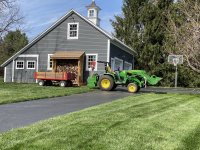
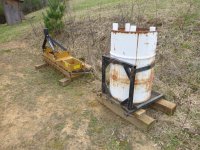
I've been thinking of making a rear ballast box for my MX5800. I'd like something relatively small / maneuverable but not too small. I was thinking a 55 gal. drum filled w/ concrete. I could stick a few 2" & 4" PVC pipes in there to hold misc. shovels, rakes, etc. & a chainsaw scabbard for a saw. Any idea roughly how much weight this would give me & would it make a noticeable difference on my tractor? I've got the rear tires filled already :) I realize it's not going to stick out too far so it's less 'leverage' in terms of ballast. Any tips would be greatly appreciated also!
 
   / Rear ballast box #2  
Well - lets talk about a "standard" 55 gallon drum. 23" in diameter - 35" high. Concrete = 150 pounds per cubic foot. There will be a tad over nine cubic feet of concrete in the barrel. Weight BEFORE you start poking pipes and tubes into the concrete - 1370 pounds.

In my case - I thought about a ballast box of some kind. The down side - that's all a ballast box will do - add ballast. I went with a 1100 pound Rhino rear blade. At least, it will do several things other than just ballast.

I also have 1550 pounds of Rim Guard in the rear tires.

Ballast, of some type, is absolutely necessary if you have a FEL with grapple, pallet forks or bucket.

I have 80 acres of open range land. That big 'ol rear blade seldom gives me any problems. If your property is more like a jungle - a rear blade can become a constant nuisance.
IMG_0009.jpeg
 
Last edited:
   / Rear ballast box #3  
The guy I bought my tractor from had a bush hog on it all the time for ballast. Man, was that a miserable experience. It swung up and down, making the tractor buck like a mule. It hit the ground a lot when it swung. When I backed up, it was always in the way.

I now have a Titan ballast box full of sand. I put a piece of tool box drawer liner on top of the sand, and now I throw stuff in there, like chainsaws and gloves. Way better than a bouncing bush hog.
 
   / Rear ballast box #4  
I've been thinking of making a rear ballast box for my MX5800. I'd like something relatively small / maneuverable but not too small. I was thinking a 55 gal. drum filled w/ concrete. I could stick a few 2" & 4" PVC pipes in there to hold misc. shovels, rakes, etc. & a chainsaw scabbard for a saw. Any idea roughly how much weight this would give me & would it make a noticeable difference on my tractor? I've got the rear tires filled already :) I realize it's not going to stick out too far so it's less 'leverage' in terms of ballast. Any tips would be greatly appreciated also!

The best tip I can give is to not spend a lot on a ballast box, use something inexpensive as a form to make a concrete block of a suitable size and weight. A 55 gallon drum would be fine, so would a homemade plywood box. All the box really has to do is hold the concrete until it cures as you can use a 3 point drawbar stuck through the box/barrel/form to actually carry the weight.

A 3 point implement can work, like oosik's blade or a bush hog, but they can stick out a ways depending on what it is. Putting something heavy a carry-all or 3 point forks can work too, casting a concrete block that has a center section that fits down below the forks/carryall angles so you can set it down and pull away, and then back up to it and pick it up with the forks/carryall is a great idea. Even something like a round bale on a 3 point spear or bale forks is also a good counterweight as they are decently heavy and not obnoxiously bulky. The only thing about bales are that they aren't real durable.
 
   / Rear ballast box #5  
mo1 is right about a cast concrete block. I have one with a center loop. Molded with scrap lumber. It's 22" x 22" by 14" tall. Weighs around 400#. The few times I use my disk harrow - set this block in the dead center. Added weight really improves performance.

Unfortunately - I just checked and I've deleted the pic of the concrete block. Wasn't a very good pic anyway. Kind of hard to see as it was sitting in/amongst a large weed patch.

Hey - I found a pic of the concrete block. Must be a newer pic. You can actually see it.
IMG_0019a.jpeg
 
Last edited:
   / Rear ballast box #6  
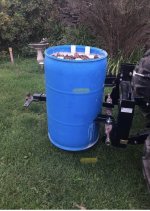
I made mine out of a plastic 55 gallon drum. Made so I can use it with my 3 point quick hitch and also added a 2” hitch receiver on the back. I use the receiver all the time for moving trailers around. I should have used larger tubes.
 

Attachments

  • IMG_1596.jpeg
    IMG_1596.jpeg
    1.1 MB · Views: 249
Last edited:
   / Rear ballast box #7  
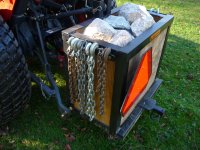
I made a ballast box out of 2x2x1/4 angle iron, welded into a box frame, with part of an old trailer hitch frame/receiver for the backside bottom, which gives me a nice place to pull trailers from. I used ext. 1/2" plywood for the sides and bottom, and fill the box with dense stones, which I can add to or remove, if desired. I have some bars on each side which work well for hanging chains. I used to just have a back blade for ballast, but having to be wary of a weapon/obstacle back there got old fast. The weight is about right for my L3400 tractor- I'm not pulling any ground engaging equipment, and my loader maxes out at 1000 lbs or less.

Attachments

  • P1010909.JPG
    P1010909.JPG
    3.6 MB · Views: 317
 
   / Rear ballast box #9  
I made mine using concrete with attachments to carry my chainsaws and other tools. It was sized to weigh 1600 lbs.
That's too heavy for a 37 or 45hp tractor, maybe even a 60hp one! What made you want it that heavy?
I do like all the attachments and provisions though, Nice work!

This one weighs ~980lbs and is all the ballast my tractor needs.
20210717_142103sm.jpg
 
   / Rear ballast box #10  
That's too heavy for a 37 or 45hp tractor, maybe even a 60hp one! What made you want it that heavy?
I do like all the attachments and provisions though, Nice work!

This one weighs ~980lbs and is all the ballast my tractor needs.
View attachment 807942

How much ballast is needed depends on the tractor and loader and varies widely. For example, a 60 HP cabbed MFWD Deere 5055E/5060E with the 520M self-leveling loader is recommended to have at least 3087 pounds on the 3 point as ballast if there is no rear axle weight. This decreases to "only" 2867 pounds on the 3 point if there is at least 441 lbs on the rear axle. If the tractor was an open station instead of cabbed, the recommendation is a minimum of almost two tons of ballast- 2867 pounds on the 3 point and 1213 pounds on the rear axle.
 
   / Rear ballast box #11  
That's too heavy for a 37 or 45hp tractor, maybe even a 60hp one! What made you want it that heavy?
I do like all the attachments and provisions though, Nice work!

This one weighs ~980lbs and is all the ballast my tractor needs.
View attachment 807942

Well, I would agree that it seems like a lot of weight but it’s really not. Remember that it is not just the weight of the ballast but how far back it is ( the center of gravity)from the attachment pins. My 1600lbs ballast block with a center of gravity at 12” from the pins is no different than a 533lbs bush hog that has a center of gravity 36” from the pins.
My New Holland TC45D has a 3pt rating of 3275lbs at the pins and 2330lbs at 24” behind the pins. As previously mentioned, the ballast weighs 1600 lbs with a center of gravity at 12” behind the pins. Well within the tractor’s 3pt capacity. Equally important for me is that it had to be within the capacity of tractor’s loader (NH 16LA) so it can be moved around with pallet forks (and it is with no ballast on the back of the tractor).
So, when you have a 700lbs grapple and a 1000lbs log hanging off the front loader your expensive front axle will be glad you loaded up the 3pt with enough ballast to remove that load on the front axle and keep things from breaking.
 
   / Rear ballast box #12  
I made mine using concrete with attachments to carry my chainsaws and other tools. It was sized to weigh 1600 lbs.
I think you win the ballast wars. That looks so good, I feel like making one and getting rid of my box of sand.

What are those things on the back?

I don't have any idea how much weight I need for a Kubota L3710. When I got my box, I filled it with sand and figured it would have to work.
 
   / Rear ballast box #13  
I think you win the ballast wars. That looks so good, I feel like making one and getting rid of my box of sand.

What are those things on the back?

I don't have any idea how much weight I need for a Kubota L3710. When I got my box, I filled it with sand and figured it would have to work.

They are for holding chainsaws.

IMG_0260.JPG


Here is the thread I did on it.

 
   / Rear ballast box #14  
Adding to what others have already said:

  1. Steel weighs more than concrete, so if you want the absolutely smallest footprint, you know which way to go.
  2. A tool carrier is priceless. Like inpo44, mine has tubes for carrying rakes and shovels, which I use constantly. I also have a tray on top for carrying chains, saws, gloves, other stuff.
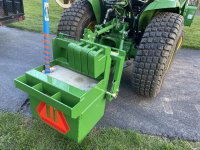
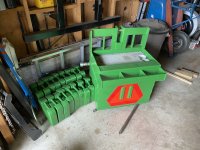
  3. Adjustable weight is ideal. I have a fixed 750 lb. of concrete in a steel box, but bars mounted above and aft to carry an additional 17 suitcase weights. Those suitcases can be the 42 or 70 lb. variety, meaning I can vary the weight of my box from 750 lb. all the way up to 2000 lb., although I might start to worry about the welds on the lower link pins at the top of that range. I usually use it between 750 and 1500 lb., for my needs.
  4. A hitch receiver on the back of your box is mandatory, IMO. You don't want to have to ditch the ballast to pull a trailer, in fact that's often when it's most useful. This has the added advantage of shifting your hitch farther aft of your rear axle, which provides better maneuverability when backing trailers, especially steerable-axle farm wagons. I just welded a pair of 1" x 1/2" steel bars to the back of mine and tapped 1/2" UNF, to bolt on a surface-mount hitch receiver, quickly removable when I want it out of my way.
IMG_1827.JPGIMG_2076.JPG IMG_6339.JPG
 
Last edited:
   / Rear ballast box #15  
Well, I would agree that it seems like a lot of weight but it’s really not. Remember that it is not just the weight of the ballast but how far back it is ( the center of gravity)from the attachment pins. My 1600lbs ballast block with a center of gravity at 12” from the pins is no different than a 533lbs bush hog that has a center of gravity 36” from the pins.
My New Holland TC45D has a 3pt rating of 3275lbs at the pins and 2330lbs at 24” behind the pins. As previously mentioned, the ballast weighs 1600 lbs with a center of gravity at 12” behind the pins. Well within the tractor’s 3pt capacity. Equally important for me is that it had to be within the capacity of tractor’s loader (NH 16LA) so it can be moved around with pallet forks (and it is with no ballast on the back of the tractor).
So, when you have a 700lbs grapple and a 1000lbs log hanging off the front loader your expensive front axle will be glad you loaded up the 3pt with enough ballast to remove that load on the front axle and keep things from breaking.
Understood, but I'm thinking about what is the maximum loader lift capability (of the New Holland TC45D or the Workmaster 37, I don't know what a TN60DA is!) and having enough weight to counter it and keep the rear wheels planted but not carrying excess weight needlessly.
My MT240 has about 2150 lbs loader lift capacity and even with the heaviest loads it would lift (pallet fork under concrete slab barely lifting it off the ground, grapple of logs/etc) the 1000lbs of weight on the 3pt was always plenty. I could if needed add substantial weight using the receiver tube and a weight bar but never needed to.
 
   / Rear ballast box #16  
Do remember that the loader is lifting a weight a good bit farther from your front axle, than the ballast box typically extends from the rear axle. It's a complex problem, but a good starting point is to treat it like a torque arm, multiply the weight x extension from nearest axle, and aim to get the lb·ft of your ballast at least close to that of what you're putting on the loader + the loader and implement itself.
 
   / Rear ballast box #17  
Look around for a good box blade and some old suitcase weights. I run a 6 ft box blade with 4 weights hung on tue inside and it works fine I don’t have $200 in it but it was all auction finds
 
   / Rear ballast box #18  
I used a 55 gallon drum, Set it away from your tractor will give you more counter balance to the FEL. Friend had several bags of harden concrete bags that he wanted to get rid of. Broke them up and dumped them in... Old photo but I've since removed the pipes (or rain collectors as I called them and filled it to the top and placed a Manhole cover on top of it. Fit like a glove.

About 800 to 900 pounds, Manhole cover felt like 100 by itself!!
 

Attachments

  • weight box pulverizer.jpg
    weight box pulverizer.jpg
    763.1 KB · Views: 139
Last edited:
   / Rear ballast box #19  
Here's mine (Post 208) on a 21 page thread:


   / Rear ballast box #20  
I'd like to make a ballast box for my Kubota BX2350, and have a place on top for a chainsaw box. Any suggestions for how much the ballast should weigh? Thinking of a concrete ballast box that will hook to my quick-hitch.


Marketplace Items

ALLISON TRANSMISSION (A55745)
ALLISON...
Kubota SVL 97-2 (A53317)
Kubota SVL 97-2...
(2) UNUSED 31" X 8 MM EXCAVATOR TRACKS W/ PINS (A60432)
(2) UNUSED 31" X 8...
JOHN DEERE 644K WHEEL LOADER (A58214)
JOHN DEERE 644K...
2005 WESTERN STAR DUMP TRUCK (A60430)
2005 WESTERN STAR...
2018 Toro Workman HDX Diesel Utility Cart (A59228)
2018 Toro Workman...
 
Top