This Old Barn

   / This Old Barn
  • Thread Starter
#41  
So I decided to leave it for a couple days. When I came back, I tried again and the wrench turned easily -- for about 3/4 turn -- then nothing doing. So I came back a few days later, and I repeated the process. Over about a year and a half I turned it a little bit every few days, over and over until I had lifted the beam 6 or 8 inches and it looked level and straight. I'm still not sure if it's exactly straight or level, all I have is a 4' level and the wood is rough enough that it's hard to tell. But when I stand back and eyeball it against the top of the foundation it looks pretty good.

Would some clear tubing work to make a water level?

Measuring level over distance is a problem that I have yet to solve.

I was actually messing around with a water level a few weeks ago. Maybe I'm just an idiot but I couldn't get it to work. To reach from one corner of the barn to the other I needed 50+ feet of tubing, and I had a really hard time filling the tubing with water. Once I got it filled I found that the tubing offered significant resistance to the flow of water, so it took a while for the level to stabilize. The bucket won't fit at the height of the beam I was trying to level, so I had to mark the level and measure down. The whole thing was so imprecise I just didn't have confidence I was getting accuracy better than about a quarter or even half an inch. At that level of accuracy it just didn't seem worth the hassle.

I also have a laser level that I've been using, it wasn't expensive but not cheap either, I think I paid about $150 for it. It has a bubble level and sits on a tripod. I don't have faith that it gets me within acceptable accuracy either. What it is good for is getting straight lines. The way I use is I set it up on the tripod at one end of the beam, and measure the height off of the beam of the laser. At the other end I make a mark on the wall the same height off the beam. Then I go along the beam and measure the height of the laser. This won't get me level but it will get me straight.

I thought about just using a chalk line but it seems it would sag over 30' no matter how tight I pulled it.

I would like to hear people's suggestions. Although for the most part I have to play the hand I'm dealt.
 
   / This Old Barn #46  
They had very little in the way of what we could now call necessities! They were living in New England in the winter, heating with wood. They were producing milk with no running water or electricity. In the winter they would milk in the dark with no electric light.

About 100 yards to the east of the barn there is a pond. I have a neighbor who is 83 and farmed in the area his whole life. He believes the pond was hand dug, for ice. This area didn't get electricity until the 1930's but people were in the commercial dairy business in the 1850's. For decades they kept their milk cool with ice that they cut in the winter.

Last summer my teenage son helped me put up a few hundred bales of hay. When we were done, I said to him, "How would you like it if every year you spent July and August putting up hay and January and February putting up ice?" He thought about it for a moment and said, "I bet you'd get really good at stacking things."

Hundred miles East of you we didn't get electricity until 1947.
I do remember the big day ......I was 7!
 
   / This Old Barn
  • Thread Starter
#47  
Hundred miles East of you we didn't get electricity until 1947.
I do remember the big day ......I was 7!
A hundred miles east of me is the Georges Bank, I'm in the southeast corner of the state. I can see Westport, Ma from my barn.
 
   / This Old Barn
  • Thread Starter
#48  
OK, I'm getting almost caught up now.

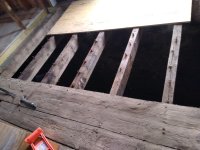
Once I got the beams all squared away, the next step was to work on the east bay of the barn. This was the milking parlor. The flooring was completely rotted from decades of manure, and the joists underneath were gone as well, I couldn't save a single one of them. So the next step was to put replacement joists in.

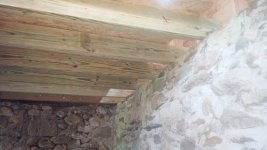
Here are two pictures you've already seen and one new one:
barn.jpg


The original joists were 3x7's on about 22" centers (it varies somewhat). They run from the east floor beam to the east sill. The sill is mortised to receive them and the ends of the joists are tenoned, the joists sit with their tops flush with the top of the sill.In the background of the middle picture you can see the sill and the mortises in it. The floor beam sits about 4 1/2" below the level of the sills and the joists are notched at that end. Along the top of the beam there was a piece of wood that functioned like a rim joist, holding the ends of the joists. I don't know what it's properly called but I'm going to call it a rim joist. It had to be replaced so the first step was to replace it.

When I went to measure the rim joist thing I found it was 4 1/2" inches at one end and 5 1/2" at the other, due to settling. That got me thinking I wouldn't be able just to rip a piece. The joists in the middle bay of the barn run perpendicular to the bay that I'm working on, or parallel to this rim joist, and I realized that there would be a jump in the floor if it wasn't at least close to the height of the first joist in that bay. So I cut two pieces of 2x6 to length, and tacked them to the stanchions. Then I did my best to scribe them to the first joist of the middle section. The floor is still on the middle section, so I had to go down to the basement and stand on a step-ladder. I made a little jig from pieces of 2x4 that allowed me to hold one end against the existing joist with a short level, and then scribe the other end against the jig. I marked at every stanchion, then used a straight edge to connect the marks. I took up the pieces and cut them with a circular saw, then put them back and nailed them to the stanchions.

Then it was time to work on the joists. The originals were 3x7, so I used doubled 2x8's. At the sill end they fit into a mortise, and at the beam end they rest on the beam and sit flush to the rim joist. First step was to measure the length from the bottom of the mortise to the rim joist, and cut them to length. The sill is 7" high and sits on the foundation, which is about 24" thick and made of fieldstone. The replacement joists are nominally 7 1/4" so they needed to be trimmed to clear the foundation, I took about 3/8" off of the last 24" to be sure. Then I measured the depth and width of the mortise and cut a tenon on the end of the replacement joist.

Fitting the tenons ended up being quite time-consuming. I'd measure and get close, and then try to fit them and adjust. Depending on how close the fit was I'd use smaller and smaller saws, and then a palm sander, to make incremental adjustments. A complication was that the top of foundation wasn't smooth, in parts there were stones sticking up. The original joists had been scribed around the stones and I did the same thing. Once I got one piece of the joist to fit in the mortise I would set it down on the beam at the other end and measure how much it stuck up above the rim joist and how far it sat on the beam. These were different for every joist. I'd cut a notch so that the top sat flush with the top of the rim joist. I would usually have to make a few adjustments to get it to sit flush and tight.

Once one piece of the pair of joists was cut I used it as a template to cut the other piece. Then there would be more fitting as I had to get the width of the tenon so it fit in the mortise. Once everything fit I nailed through the rim joist into the ends of the new joist pieces, and nailed the two pieces to each other. This process was pretty time-consuming, I figure I averaged about two hours per joist piece, or four hours per pair. The first one was the toughest as I had no place to sit, I had to do all of the fitting from a stepladder from below. Once the first one was in I put a piece of plywood on it, and as I've worked I've moved more sheets of plywood out to make a pretty good platform. But it's still hard. The joist pieces are heavy, and the 22" spacing means I have to reach pretty far from where I'm sitting and it's awkward. During the fitting process I have to lift the new joist pieces into place repeatedly, and my arms take a beating. One thing that I've found helps is to put a c-clamp on the middle of the piece so I have something to grab onto.

So far I have done seven of the fourteen joists. I figure I have about 28 hours left to go, so three and a half days, or more likely, about ten evenings.
 
   / This Old Barn
  • Thread Starter
#49  
For the replacement floor I'm going with Advantech (3/4" tongue and groove oriented strand board). I thought about doing planking to be faithful to the original, but it really doesn't make a very good floor and I do intend for this to be a working building when I'm done. Advantech takes paint and makes for a surface that is smooth and sweeps well. It can also be the subfloor if I decide to finish further.

I was worried that the floor might be bouncy or sag, I didn't know if the Advantech could span 22" and 2x8's seemed kind of small for the span. As I've worked I've put down pieces of Advantech, and I'm pleased to report it feels very solid underfoot.
 
   / This Old Barn #50  
:thumbsup: Good Thread. Good pictures.
 
   / This Old Barn
  • Thread Starter
#51  
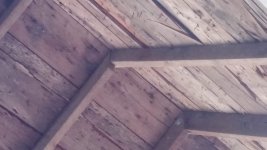
I spent a little time in the barn last week, but it was just replacing more joists, which isn't very noteworthy. But I did snap a few pictures that I thought I'd share.

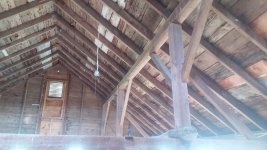
These show the framing of the roof. There is a big beam on each side running the length of the barn, and rafters that rest on the beams. The rafters are a mix of 2x4 and 2x6. I can't see rhyme or reason why some are 2x4 and some 2x6.
624434d1570763824-old-barn-barnroof-jpg


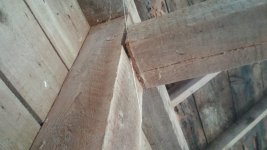
In two spots a 2x4 meets a 2x6. I can only assume that they goofed and then decided it wasn't worth fixing. Since the barn has stood for 170 years they may have been right.


624433d1570763824-old-barn-barnrafters-jpg
 

Attachments

  • barnrafters.jpg
    barnrafters.jpg
    654.3 KB · Views: 667
  • barnroof.jpg
    barnroof.jpg
    1,014.7 KB · Views: 677
   / This Old Barn
  • Thread Starter
#52  
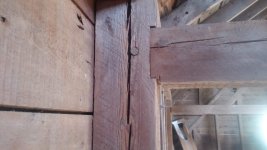
This is a shot of the framing up near the eave, where the big beam that carries the floor goes into the post that frames the side wall.
624436d1570764451-old-barn-sawmarks-jpg


What's interesting about this is that the beams in the picture have saw marks from a circular saw, and the sheathing has straight saw marks. The lumber in the barn was not all cut on the same mill, and even when you have two beams of the same size some of it was cut on a circular saw and some on a reciprocating saw. The circular saw was invented in 1813 but didn't replace the reciprocating saw until after the Civil War. The mixture of cut types supports the construction date in the tax records of circa 1850.
 

Attachments

  • sawmarks.jpg
    sawmarks.jpg
    950.9 KB · Views: 654
   / This Old Barn
  • Thread Starter
#53  
This is a shot of the framing of a section of wall in the loft. The studs that go into the diagonals are nailed, but everything else is mortise and tenon.

attachment.php
 
   / This Old Barn #54  
With the age the barn has, there probably has been repair work done over the decades and they may have used materials on hand, hence the mix of 2x4 and 2x6's,. etc.

Your framing looks roughly like my barn except my timbers are hand hewn and not so consistent. Also mine had been converted to a tobacco drying barn at some point with a lot of extra rails to hang from. Some of what is in my barn is in the way but I'm not sure if any of the added rails are helping structurally.
 
   / This Old Barn
  • Thread Starter
#55  
624595d1570934206-old-barn-sawmarks2-jpg

Here's another one for the construction history nerds. This is the other side from the picture I posted a few days ago. While all the beams in that picture had circular saw marks, these both have straight marks. In fact the vertical beam has round marks on one face and circular on the other. No rhyme or reason so far as I can tell.
 

Attachments

  • sawmarks2.jpg
    sawmarks2.jpg
    719.7 KB · Views: 543
   / This Old Barn
  • Thread Starter
#56  
Today was too windy and wet to do much outside so I spent most of the day in the barn, I replaced three joists, only four to go.

One of the things that interesting compared to modern construction is that there are no standard dimensions. I think that when they did framing they figured out how many joists or studs they needed and then spaced them out evenly. So the floor I'm working on has joists 21 7/8" on center, the stanchions were 36 7/16" on center and the studs on the wall next to the floor are 27 5/16" on center. So I thought it was unusual when I put in one joist and one end lined up exactly with a stanchion and the other lined up exactly with a stud on the wall. I chocked it up to coincidence. Then a few joists later, it happened again. Now I'm really scratching my head. Not only are the distances oddball, but so are the number of pieces -- in the length of the wall there are eight stanchions, fourteen joists and eleven studs. How are those lining up without any common factors?

After some thinking, I figured it out. With eleven studs, there are twelve stud bays. With fourteen joists there are fifteen joist bays, and with eight stanchions there are nine stalls. All of those are multiples of three. So five joists equals four studs equals three stanchions. Every five joists everything lines up. Makes me wonder if they planned it that way for some reason. Since both the studs and the joists are mortised into the sill they have a nifty 3-way joint and the tenon on the joist is cut to accommodate the tenon on the stud.
 
   / This Old Barn #57  
624595d1570934206-old-barn-sawmarks2-jpg

Here's another one for the construction history nerds. This is the other side from the picture I posted a few days ago. While all the beams in that picture had circular saw marks, these both have straight marks. In fact the vertical beam has round marks on one face and circular on the other. No rhyme or reason so far as I can tell.
That one needs a retrofit support for sure
 
   / This Old Barn
  • Thread Starter
#58  
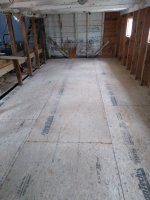
I finally got some time this week to work on the barn. I finished the joists, which is a major milestone, as far as I know the framing is now done. And I put down flooring where i had replaced the joists:
barnfloor.jpg

That flooring was a bigger job than I thought it would be, every single piece had to be cut. There were only two pieces that weren't on an edge, but since the joists are 21" on center they had to be cut for length. All the edge pieces had to be scribed around the vertical framing pieces. I used Advantech, which I like, but the sheets are over 75 lbs each and I feel like I picked up each piece ten times getting it fitted. Plus I didn't really have anywhere to stand because I was building the floor.

The Advantech does make for a nice tight flat floor. I think it's the nicest floor this barn has ever had. Next up is to take up the plank floor in the rest of the barn and put down more Advantech.
 
   / This Old Barn
  • Thread Starter
#59  
What I'm doing now is replacing the floor in the section where the framing didn't need work. The original floor is 2x8 rough-sawn boards. They have rotted from the top down due to exposure to manure. While they have various states of rot, I keep looking for one that has enough usable wood to make something out of and I haven't found one yet.

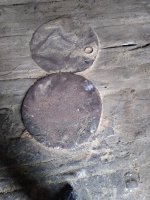
New England farmers are famous for being thrifty. When holes developed in the floor they were patched with whatever was available. Here, two ends from an oil drum were used to cover a hole:
barnfloor2.jpg
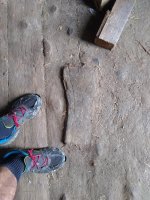
This looks like a piece of firewood was nailed over a hole:
barnfloor3.jpg

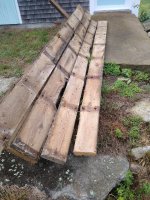
Surprisingly, while the faces of the boards are quite rotten, there is very little rot on the bottoms or the framing. Here's a shot of the backs of a few of the boards:
barnfloor4.jpg

The floorboards are attached with a single nail in each joist. The nails are handmade, about 5" long and tapered, about 1/2" at the head and 1/4" at the tip. A better man than I drove them all in. For the most part it is impossible to get them out, the steel is very brittle and they snap off. Here is a rare one that pulled out:
barnfloor5.jpg

I've been prying the floorboards off with a 6' prybar, the nails mostly pull through the floorboards. The fact that the nails are still so tight after all this time encourages me about the strength of the joists.
barnfloor6.jpg
 
   / This Old Barn #60  
Interesting. Thanks for the update :thumbsup:
 

Tractor & Equipment Auctions

2011 KOMATSU D65PX-16 CRAWLER DOZER (A60429)
2011 KOMATSU...
Year: 2019 Make: Jeep Model: Grand Cherokee Vehicle Type: Multipurpose Vehicle (MPV) Mileage: Pla... (A59231)
Year: 2019 Make...
Case 1083 20ft Corn Head (A56438)
Case 1083 20ft...
Adams Tilt Trailer (A56438)
Adams Tilt Trailer...
207277 (A52708)
207277 (A52708)
2013 Ford Explorer SUV (A59231)
2013 Ford Explorer...
 
Top