Walkout Basement Entrance Re-Do

/ Walkout Basement Entrance Re-Do #21  
That's not at all what I pictured. :)

I would remove the dirt that wraps around the door wall. Looks like you could use retaining walls on each end with good drainage behind them.

This solution should solve your problems.
 
/ Walkout Basement Entrance Re-Do
  • Thread Starter
#22  
View attachment 346627Ok here is what i would do in your place. Sorry about the picture quality but i think you'll get my point. Can't figure out how to make the picture bigger :confused3: Can you guys see it?

Builder, I can see it, although when I first looked at it all I saw was an empty white box! :D

A couple questions:

In order to keep the PT sill off the concrete, is the sill seal all I need? Or should I wrap the bottom and sides of the PT sill with vycor, leaving the top open so the sill can breath?

When attaching the PT framing to the concrete walls, should I use the same method? Sill seal between wood and concrete, with the framing wrapped in vycor? Should I flash this in the same way, with the slot cut to accept the lead flashing?

I have vycor left over from the deck project, and it is cheap enough that I don't mind adding it where it can be of help.

Thanks!
Joe
 
/ Walkout Basement Entrance Re-Do
  • Thread Starter
#23  
This solution should solve your problems.

I agree, this would keep a majority of the water away from the problem area to begin with, along with a few other ideas posted by others on here. I will definitely be regrading the banks and pulling them back away from the door area. Since this is a walkout basement, the foundation should go down in the ground ~4' all the way to the edge of the walls, and then along the walls running perpendicular for a short distance correct? I wish I could confirm that! Pulling the banks back far will get rid of any insulation that they are providing that section.
 
/ Walkout Basement Entrance Re-Do
  • Thread Starter
#24  
Excellent discussion and advice so far in this thread. However, there is another possibility for water access that hasn't yet been mentioned. It's hard to see details in the one picture that shows it, but it appears that the roof covering the space between the house and garage was improperly attached to the house. It looks as though the roof structure was simply attached *through* the existing siding, so the top edge of the flashing at that joint is on the *outside* of the siding. There are gaps at every joint in the siding, and it's impossible to see how (or even if) those gaps were sealed. If water were able to get through between the siding and the flashing, run down the wall to the ceiling, which is right about the top of the T-111, it could enter the *top* of the wall, run down and collect at the bottom where the mold is forming. You should make sure the joint between the top edge of the flashing and the siding is well sealed (the top edge of the flashing should really be *under* the siding, but to fix that would mean taking the entire roof over the walkway down and rebuilding it properly). I would also take down at least a small strip of the ceiling so water could escape by running down the outside of the wall instead of finding an easier route *inside* the wall. Hopefully the main structure of the house has not been compromised and there's no rot there. Probably should check just to make sure. Personally, I would remove all of the ceiling material. It conceals a large void, inhibiting ventilation, but also creating an unseen path for fire between the garage and the house. Even if it was noticed, it takes a few minutes to tear down enough of the ceiling to get water throughout the the entire void, and that could be a couple of minutes too many. If you want to keep it, I would advise cutting a scuttle hole near the center, fairly easy for humans to open (but not for raccoons, etc.), easy to get a ladder through, and big enough for a large firefighter in full gear including breathing apparatus to turn around in. It comes in handy if you ever want to run wires, etc., through there, too.

Sorry to run on so long, hope it's been some help. (Disclaimer: I have never been employed in the construction trades. In fact, with 20+ years in the fire service, I've done a lot more un-construction (or would it be de-construction, or maybe just destruction?) than construction.)

I can get better pictures of this, but I believe that it is connected directly to the house, and not with a layer of siding sandwiched in between. I do not notice any water running down the T111 directly from the roof.

When I installed my coal boiler, I went through and looked at all the plumbing lines, and found a leak directly above the area in question. In the first picture I posted, you can see a small section of pipe insulation and tape in the top left corner. There was a joint here that was slowly leaking and dropping directly into the cavity where the mold now is!!! I fixed that leak, and also inspected the top of the framing, and rim joist area for any rot. Luckily, there is no rot, and there was no water sitting on the structural members of the house.

Another project that had me looking in this area, is that I mounted an antenna in the rafters of the garage (reception is great up here on the hill). I then ran the cable through the garage, through the breezway roof, and into the house. I had dropped sections of the soffit and had to drill holes in the house and garage framing to run the cable through. The electric for the garage is also ran through holes in this area.

In other words, I have been working in the area you mentioned a few times, and have noticed no rot or moisture issues. That being said, thanks for bringing it up and I will be sure to look that area over very closely when this project begins.

Joe
 
/ Walkout Basement Entrance Re-Do
  • Thread Starter
#25  
The grade of the grass banks on either side of the doors needs to change, and the grade needs to be pulled back from along the walls too. There should be a stone lined ditch about 1.5' or more running alongside the walls sloped away from the wall allowing water to get away from the wall and away from heading to the doors area. The siding should not come to grade as it does now. The lowest portion of the siding could be trimmed with a piece of Kleer or other solid PVC material, impervious to water. T111 is not impervious to water or mold or outdoor elements. Same with the door trim, (called brickmoulding)- use PVC or nothing.
I would excavate out the grade from the side walls, seal it, after thoroughly cleaning the concrete with a Muriatic acid solution, then coat it with a bituthane sealer and use landscape fabric to line what will be your perimeter ditch, then stone to keep the water from contacting the house walls.
Water must be directed away from the entire area; both walls and doors must be isolated from water runoff and constant moisture.
Slope the remaining grade to have enough pitch to carry any remaining water away from the target area.
It seems you have a overhang of some sort above the doors? I can't tell from the pics too well, but if it's there it too must allow the water to be taken away from the doors with gutters, flashing, whatever it takes to keep the area underneath dry.

Thanks for the information on grading/materials/etc. What is your suggestion on a material to replace the T111? I will definitely be going with pvc trim around the door, as well as a section of PVC as the lowest portion of the siding.

Can you give me more detail on coating the concrete with bituthane sealer? Would this get covered by something in the end? I am not entirely clear where this sealer would be placed.

Thanks,
Joe
 
/ Walkout Basement Entrance Re-Do #26  
I agree, this would keep a majority of the water away from the problem area to begin with, along with a few other ideas posted by others on here. I will definitely be regrading the banks and pulling them back away from the door area. Since this is a walkout basement, the foundation should go down in the ground ~4' all the way to the edge of the walls, and then along the walls running perpendicular for a short distance correct? I wish I could confirm that! Pulling the banks back far will get rid of any insulation that they are providing that section.

The wall that used to be for the garage door, should have a frost wall foundation going down 4', you are correct. To be really well done, that frost wall should wrap around the corners for 8' or so with the basement wall poured on top of that. That's difficult concrete forming for residential builders, so my guess is it wasn't done that way.

Since your walk-out basement is heated, I wouldn't worry too much about frost depth. For extra protection, when you remove some of the soil at the corners, you can utilize the "shallow frost protected foundation" techniques using closed cell foam boards used for foundation insulation. Foam boards can provide a good frost barrier at shallow (18"-24") depths.

Here are some reference articles for shallow frost-protected foundations:
https://www.google.com/search?q=sha...NKsnEsAT4yICwBQ&ved=0CCsQsAQ&biw=1440&bih=798

Design Guide for Frost-Protected Shallow Foundations

All things considered, I would worry more about getting good drainage on those corners than anything else. If the water in front of the door disappears quickly as you described, I'll bet there is a foundation drain running along that wall, and the stone goes all the way down to that drain next to the wall. If so, do you know where that drain exits? If it is there and working well, maybe you could tie some additional corner drainage into that.
 
/ Walkout Basement Entrance Re-Do #27  
Ok here is what i would do in your place. Sorry about the picture quality but i think you'll get my point. Can't figure out how to make the picture bigger :confused3: Can you guys see it?
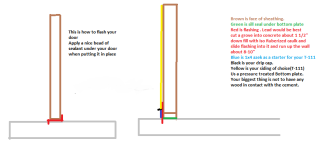
Something like this?
flashing.png

Aaron Z
 
/ Walkout Basement Entrance Re-Do #28  
A couple questions:

In order to keep the PT sill off the concrete, is the sill seal all I need?


That should be fine.


Or should I wrap the bottom and sides of the PT sill with vycor, leaving the top open so the sill can breath?


Joe


I would not do this. You are creating a bath tub to hold water around the wood.


.
 
/ Walkout Basement Entrance Re-Do #29  
Builder, I can see it, although when I first looked at it all I saw was an empty white box! :D

A couple questions:

In order to keep the PT sill off the concrete, is the sill seal all I need? Or should I wrap the bottom and sides of the PT sill with vycor, leaving the top open so the sill can breath?

When attaching the PT framing to the concrete walls, should I use the same method? Sill seal between wood and concrete, with the framing wrapped in vycor? Should I flash this in the same way, with the slot cut to accept the lead flashing?

I have vycor left over from the deck project, and it is cheap enough that I don't mind adding it where it can be of help.

Thanks!
Joe[/QUOTE]

1)If you have the Vycor just use that and don't worry about the sill seal. Lay the vycor down even with the inside edge of your sill plate, frame your wall do the sheathing and fold the vycor up onto your sheathing basicly creating an L-shape with the vycor. You can do the same with your stud running up along the foundation wall.
2) You don't need to to flash your sides the same as you do the bottom as water will not sit there. You might want to run a piece of Azek 1x4 or whatever size you like along the edge of your foundation wall so your siding(T-111) will not come into contact with that as well. Then apply a nice bead of sealant inbetween your Azek and foundation wall.

Your door you can get with composite jambs along with the exterior casing.
Want to know anything else just ask i'll help if i can.
 
/ Walkout Basement Entrance Re-Do
  • Thread Starter
#33  
I am getting close to starting this project...I am building a second deck at the back of the house currently.

The more I think about it, the more I think I would like the look of "something" else around the door than T1-11 siding. I did some googling on stone veneer, and it looks easier than laying tile as lippage isn't really a concern as the thicknesses of the blocks aren't totally uniform. As the surrounding wall is concrete and painted gray, I think this could look pretty good. I really wish that this was designed as a walkout basement and not as a garage, as I would prefer poured concrete all the way to the door opening, but that ship sailed long ago. Since I plan on doing a retaining wall on the left hand side of the door in the future...maybe stone around the door would be a nice look as well.

Anyone got any good ideas for alternatives to T1-11 or vinyl siding around the door? Vinyl would just look too odd in that location.

I also considered building a wall, putting up plywood sheathing, then trimming everything in cedar and doing some cedar shake. I have cedar shake around the front door entrance and like the look, but I think I would need a gray stain around this basement door to look good.

Final thing going through my head is build wall, sheathing, then do stucco around the door to give the illusion that it is all one solid concrete wall. Problem with this is...I have never done stucco and I wouldn't know what to do at the door frame.

Decisions, decisions...I'm driving my fiance nuts with all these ideas :thumbsup:

Joe
 
/ Walkout Basement Entrance Re-Do #34  
How about filling in that section of wall with blocks and mortar instead of a studwall? Then the only framing you would need would be at the door itself. You could paint it to match the foundation, or use decorator blocks, or set it back slightly and cover with the stone face you mention, or brick...?
 
/ Walkout Basement Entrance Re-Do
  • Thread Starter
#35  
Finally got this project done. I took 3 days off of work and was all dried in after the second day. Slow for some, but that is working lightning fast for me! I get "paralysis by analysis" regularly.

First thing I had to do was some concrete grinding to get the pad that is outside the basement door sloped away from the door, instead of being level. This didn't take too long with a 4.5" angle grinder and a cheap concrete grinding disk from HD (rigid brand). Then I knocked the wall out:

0916150909_HDR[1].jpg

Instead of cutting a kerf in the concrete and dropping lead or copper into it like was suggested (I was very close to this, and almost did it in addition to what I ended up doing, but chickened out), I did some research and ended up buying some ThresTite from WeatherBlocSystems. It is basically a gasket that you put under your threshold/wall assembly to keep water out. I found some discussion of this on websites like Contractor Talk and decided to give it a try. I used the grinder some more to remove the concrete anchors and flatten/blend the concrete. Then I cleaned the area good and stuck the threshtite down after measuring and marking. The adhesive on this stuff is unreal...if you stick it down in the wrong spot...good luck.

0916151051[1].jpg

The piece of aluminum you see in that picture was then bolted to the floor using 1/4" redheads, with nylon spacers and washers so that the steel didn't contact the aluminum at all. On top of that I built the floor. The bottom plate and studs that attach to the concrete wall are pressure treated. The aluminum was isolated from all PT wood with flashing tape. here is a view from outside...nice easy wall to build! I built it on the ground and stood it up, then slipped the second top plate in (by slipped I mean trimmed and hit with a hammer). I think drove lags up into the sill plate and red head to the floor, as well as the foundation wall. It was nice and sturdy.

0916151717[1].jpg

From there I sheathed with OSB, the used 30# felt I had from a dog house project to cover the OSB and wrap around the door frame. The gap between felt paper and concrete on the sides was sealed with OSI quad sealant. I went with primed LP smartside and PVC trim. The smartside stops about 6" from the ground, and a PVC water-table was built to keep the siding high and dry. View of the door frame in, siding stopped before the ground:

0917151359_HDR[1].jpg

Then the doors went in! Assembling the frame and hanging these doors by myself made me invent a few new cuss words...them doors are heavy!! I thought I could fit my drywall in between the door frame and the wall, as it is supposed to be built. However, it was awfully tight, so I made some strips of OSB and put them on the inside between the frame and the studs. That was nice and tight, frame was solid. I have since drywalled the inside and will trim around the metal frame so the OSB won't be seen.

0918150721[1].jpg

From there it was all trim and finish work, as well as adding the threshold and sweeps. Here is the nearly complete project being modeled by my wife:

0919151323[1].jpg

I have since done some weatherstripping and interior finish work and will paint when spring comes and it gets warm enough to do so.

Thanks for all the advice with this project! I really tried to think like water when sealing/lapping/weatherstripping. Hopefully this wall and door will last a long time and stay dry! The only thing that bugs me about this wall is the screws securing the siding on the outside of the door frame show! This was a mis-calculation on my part and shouldn't have happened. If it still bugs me after I paint, then I may wrap some trim around the steel door frame to cover them up.

In my opinion the soffit on the breezeway connected to the garage is a real eyesore...it was put up poorly, is beat up, and the garage is in poor shape to begin with. Someday the garage will come down and a 3-bay will take its place! Gotta re-do the kitchen first!!

Thanks for looking,
Joe
 
/ Walkout Basement Entrance Re-Do #36  
Joe, Great job on the entry! Wife looks happy. Happy wife, happy life.
 

Marketplace Items

2005 MACK TRI AXLE DUMP TRUCK (A52707)
2005 MACK TRI AXLE...
Peterbilt Tandem Axle Road Tractor (A47477)
Peterbilt Tandem...
68" AERATOR (A60430)
JLG E300AJ (A60462)
JLG E300AJ (A60462)
2020 CATERPILLAR D1 LGP CRAWLER DOZER (A60429)
2020 CATERPILLAR...
pressure washer, and trailer (A56859)
pressure washer...
 
Top