Welding a Small Part

   / Welding a Small Part #22  
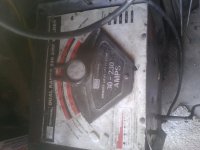
Just to clarify, I in no way claim to be an expert welder. I think I'm pretty darn good with a stick machine and am catching on to TIG pretty well. Here is what I've used for the past 42 years and it has never missed a beat. I think it is a Lincoln, but never opened it and really never thought about it until recently:
150604_0003.jpg

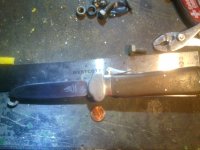
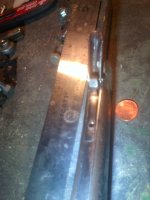
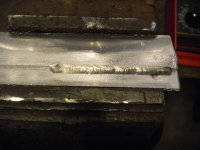
Here is the WWII knife I referenced. Belonged to my dad and I found out that one of the grandkids must have broken it playing with it. Mom couldn't find the parts so I had to make new ones. Had to use 1/16" stainless steel rods to build the tang and tap off the tiny studs that hold it together:
150604_0002.jpg
150604_0001.jpg
150604_0000.jpg
 
   / Welding a Small Part #23  
The oil is an old trick that a guy who makes custom springs taught me. I used to just cool things down with water and you do get some tempering, but the oil works much better. Now on larger pieces you just have to let the air cool it down and be more careful with over heating.

I may be nitpicking here, but when you cool hot metal it's called quenching. It will make the metal harder, possibly too hard. The metal can then be re-heated to a lower temperature to remove some of the hardness, and give it more toughness. That re-heating process is called tempering.
 
   / Welding a Small Part #25  
I may be nitpicking here, but when you cool hot metal it's called quenching. It will make the metal harder, possibly too hard. The metal can then be re-heated to a lower temperature to remove some of the hardness, and give it more toughness. That re-heating process is called tempering.

Never knew. Too bad you're so far North we could use another machinist/fabricator in the shop. I think the greatest asset to these kinds of forums is when people share their ideas and knowledge.
 
   / Welding a Small Part
  • Thread Starter
#26  
On TIG that looks pretty tempting, as if I need any help acquiring tools. I'll have to look at that a bit.

Quenching I could do. Drop it in the bucket of oil, I got that. Tempering, what do you do?
 
   / Welding a Small Part #27  
On TIG that looks pretty tempting, as if I need any help acquiring tools. I'll have to look at that a bit.

Quenching I could do. Drop it in the bucket of oil, I got that. Tempering, what do you do?

Heat it evenly to a light straw color, then air cool.
 
   / Welding a Small Part
  • Thread Starter
#28  
Tempering -- OK that I can do - many thanks.

On TIG, good grief. This is from that ebay listing:

"Tungsten Electrodes
Pure, Thoriated, Ceriated, Lanthanated Tungsten electrodes with varied diameters"

I give up, have just barely got used to MIG.
 
   / Welding a Small Part #29  
I may be nitpicking here, but when you cool hot metal it's called quenching. It will make the metal harder, possibly too hard. The metal can then be re-heated to a lower temperature to remove some of the hardness, and give it more toughness. That re-heating process is called tempering.
Ha ha. They taught me that in high school. Thanks for the refresher, Dan!

Terry
 
   / Welding a Small Part #30  
Tempering -- OK that I can do - many thanks.

On TIG, good grief. This is from that ebay listing:

"Tungsten Electrodes
Pure, Thoriated, Ceriated, Lanthanated Tungsten electrodes with varied diameters"

I give up, have just barely got used to MIG.

Probably not the best time to learn a new process....
 
   / Welding a Small Part #31  
Tempering -- OK that I can do - many thanks.

On TIG, good grief. This is from that ebay listing:

"Tungsten Electrodes
Pure, Thoriated, Ceriated, Lanthanated Tungsten electrodes with varied diameters"

I give up, have just barely got used to MIG.

Get some Lanthanated or Ceriated .. I use Lanthanated 1/16 for most of these small things. Blue band. It is not all as complicated as it first seems. TIG is the most enjoyable process of all. Not very fast though. MIG eats its lunch for good beads quick.
 
   / Welding a Small Part #32  
I agree with kOua completely.
 
   / Welding a Small Part #33  
If I remember correctly from my material science class oil quenching cools the steel slower than water so the hardness is not quite as high as water quenching. It also makes the steel less brittle. Annealing or tempering is done by heating to a lower temperature for a period of time then air cooling. Every steel has a different annealing time and temp. Another trick with the used oil is that the steel will absorb some of the carbon from the oil and become stronger. If I'm wrong let me know, it's been 17 years since I took that class.
 
   / Welding a Small Part #34  
If I remember correctly from my material science class oil quenching cools the steel slower than water so the hardness is not quite as high as water quenching. It also makes the steel less brittle. Annealing or tempering is done by heating to a lower temperature for a period of time then air cooling. Every steel has a different annealing time and temp. Another trick with the used oil is that the steel will absorb some of the carbon from the oil and become stronger. If I'm wrong let me know, it's been 17 years since I took that class.
Don't know the science, but you could be right. The dirtiest oil makes the absolute best springs.
 
   / Welding a Small Part #35  
That's the sort of job that begs to be done on a lathe but welding up a clevis is a good work around. I don't gas weld but a couple of friends do and the jobs they do look fantastic.
 
   / Welding a Small Part #37  
Another tip for welding anything is to clean the metal with a grinding or sanding disc B4 you weld. You will see the difference on the edges of your MIG puddle. A 4-1/2" grinder should be a mandatory piece of equipment to go with any welder. Just my .02
 
   / Welding a Small Part #38  
Dirty oil has a bit of carbon in it as a by product from the combustion process of the engine. Tempering in dirty oil, a little of the carbon is transferred to the surface of the steel raising the carbon content which makes it harder and more brittle. Tempering makes it less brittle but it still retains the carbon it picked up in the quench which makes it stronger. It won't raise the carbon content much but it does raise it some. Even clean oil will raise it some because you are burning the oil when the hot steel hits it.
 
   / Welding a Small Part
  • Thread Starter
#39  
That's the sort of job that begs to be done on a lathe but welding up a clevis is a good work around.


Mace hi. I thought of making it in one piece on a lathe. Either way get to the same place. This way I don't have to do 9/16" of internal 3/8-24 threads, or cut flats to take a wrench. Probably other ways to skin this cat too!
 
   / Welding a Small Part
  • Thread Starter
#40  
And also now I learned about quenching and tempering, that is good to know. Plus learned some tricks on how to weld that small part that I wouldn't have thought out on my own.
 

Tractor & Equipment Auctions

2022 CATERPILLAR 299D3 XE SKID STEER (A60429)
2022 CATERPILLAR...
2020 DRAGON ESP 150BBL ALUMINUM (A58214)
2020 DRAGON ESP...
2018 Keystone Outback Super-Lite 330RL T/A Travel Trailer (A59231)
2018 Keystone...
iDrive TDS-2010H ProJack M2 Electric Trailer Dolly (A59228)
iDrive TDS-2010H...
Classic 1969 Massey Ferguson 135, newly rebuilt engine, refurb front end, 3-pt blade.
Classic 1969...
CATERPILLAR 108" WHEEL LOADER RAKE (A52707)
CATERPILLAR 108"...
 
Top