Welding Rods for beginners

/ Welding Rods for beginners
  • Thread Starter
#81  
I have two boxes of 7014; good to go. I was hoping to get some practice in tomorrow; have a nice pile of scraps to work on.
Want to practice with varying thicknesses to understand penetration better. As long as I make a strong weld, I'll worry about the cosmetics later.
Though after an hour of grinding weld beads I may likely be changing my current tune.
Will start at 110 amps on an Everlast 160 and work my way down. Want to see when the splatter calms down.
Am speculating that I can get it going more easily with a little more amperage.

If I get a rod stuck, just release the rod where it is, let it cool down or break it off while it's hot? I have good gloves.
 
/ Welding Rods for beginners #82  
I have two boxes of 7014; good to go. I was hoping to get some practice in tomorrow; have a nice pile of scraps to work on.
Want to practice with varying thicknesses to understand penetration better. As long as I make a strong weld, I'll worry about the cosmetics later.
Though after an hour of grinding weld beads I may likely be changing my current tune.
Will start at 110 amps on an Everlast 160 and work my way down. Want to see when the splatter calms down.
Am speculating that I can get it going more easily with a little more amperage.

If I get a rod stuck, just release the rod where it is, let it cool down or break it off while it's hot? I have good gloves.

If the rod sticks pull back on your stinger, it will either break the rod loose at the workpiece or will slip the rod from the stinger. With good thick gloves, wiggle the rod back and forth and break it loose. 7014 don't stick bad usually. Keep a tight arc, and you will minimize splatter. You can run 7014 very tight. In fact I have seen videos of people just laying the stinger at an angle and letting the 7014 run itself. At time 7:40 on this video you can see this for yourself.
 
/ Welding Rods for beginners #83  
Use this Miller welds calculator available below for starting points for setting up your welder

Stick Welding Calculator - MillerWelds

This is also available as an app for your smart phone too so you can have it handy in your pocket.
 
/ Welding Rods for beginners
  • Thread Starter
#86  
Jim, great info, thank you. Was tied up yesterday, will watch video today and see if I have questions.

does the length of the rod have any effect on the amount of amps needed; i.e. a half used rod needs the same amps for similar performance as a whole rod? From playing with the Miller calculator, clearly the thickness of the rod makes a difference, but does a rod get "hotter" as it gets smaller? Clearly newbie questions, sorry.

admittedly I tend to overthink and overanalyse and what I need to do is keep trying different combinations until I get what works best and easiest for me. Getting into a comfortable position with my arthritis issues will be my first challenge.
 
/ Welding Rods for beginners #87  
Jim, great info, thank you. Was tied up yesterday, will watch video today and see if I have questions.

does the length of the rod have any effect on the amount of amps needed; i.e. a half used rod needs the same amps for similar performance as a whole rod? From playing with the Miller calculator, clearly the thickness of the rod makes a difference, but does a rod get "hotter" as it gets smaller? Clearly newbie questions, sorry.

admittedly I tend to overthink and overanalyse and what I need to do is keep trying different combinations until I get what works best and easiest for me. Getting into a comfortable position with my arthritis issues will be my first challenge.

To answer to your question, well I don't know for sure. I suppose the reduced length having slightly reduced resistance might change the current a bit, but I doubt this is much of a factor. Yes, I think you might be over analysing it a bit. :) Strike an arc, and make some sparks. Best thing is to just get in there and start welding and gaining your own data set of experiences. :thumbsup:
 
/ Welding Rods for beginners
  • Thread Starter
#88  
ok, I'm getting close. My welding friend/mentor/teacher went fishing this weekend so no welding until next weekend.
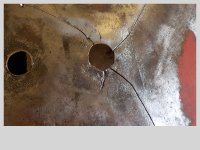
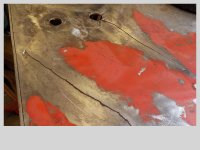
Plenty of other things to work on, but in looking at this abused metal closely, should I be using a thinner rod to fix these cracks
on the deck? Reinforcing metal is going over this area, including the oem 1/4 thick plate, and new metal going over this one really
bad area. So I need to fix these cracks, to some degree, certainly not pretty since I'm covering them with more steel.

I have what I think are standard rods. Worried about burning through, this deck metal is not all there, so I thought perhaps less amps
and a thinner rod. I cleaned but did not route out the cracks, can still do that, but worried about losing what metal I have.
What would you all do?
 

Attachments

  • DSCN0591.JPG
    DSCN0591.JPG
    542 KB · Views: 186
  • DSCN0590.JPG
    DSCN0590.JPG
    530.5 KB · Views: 179
/ Welding Rods for beginners #89  
With stick welding, If burnthrew is an issue, I always used 3/32- 6011 then strengthened with a coulpe psses of 7014 or another steel plate. Now I use a small mig welder for for thin steel.
 
/ Welding Rods for beginners #90  
I would V it out and weld. That one short crack, you didn't get to the end of the crack with the hole drilling. Weld it up and drill another hole at the end of the crack. You have to get out ahead of even the tiniest crack, then drill the hole. 7014 is the easiest rod to fill cracks and holes with.
 
/ Welding Rods for beginners #91  
I would V it out and weld. That one short crack, you didn't get to the end of the crack with the hole drilling. Weld it up and drill another hole at the end of the crack. You have to get out ahead of even the tiniest crack, then drill the hole. 7014 is the easiest rod to fill cracks and holes with.

Me and Donald Trump strongly disagree with that 7014 rod fill hole easy idea and offer an alternate rebuttal and give an alternat fact, 6011 is the go-to easy hole filling rod. I do like 7014 the best for a no gap/hole welding rod, but in a buts, holes and gaps the extra flux is easier to get trapped in the molten puddle and result is slag entrapment which will cause a catastrophic failure on fixing a square hay baler, and could end up with round bales instead.
 
/ Welding Rods for beginners #94  
ok, I'm getting close. My welding friend/mentor/teacher went fishing this weekend so no welding until next weekend.
Plenty of other things to work on, but in looking at this abused metal closely, should I be using a thinner rod to fix these cracks
on the deck? Reinforcing metal is going over this area, including the oem 1/4 thick plate, and new metal going over this one really
bad area. So I need to fix these cracks, to some degree, certainly not pretty since I'm covering them with more steel.

I have what I think are standard rods. Worried about burning through, this deck metal is not all there, so I thought perhaps less amps
and a thinner rod. I cleaned but did not route out the cracks, can still do that, but worried about losing what metal I have.
What would you all do?

You won't know until you start if you are going to burn through with the rods you have. Then you have a bigger mess. For thin stuff I don't have a wire welder but I use a 110 volt stick welder using 1/16" rods. I burn through a whole lot less because of the less amperage. I like going over it with other steel idea.
 
/ Welding Rods for beginners
  • Thread Starter
#95  
if you want a good laugh, and a well deserved groan for the evening, well I've got it for you.
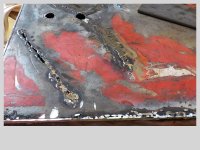
My first weld. What a mess.
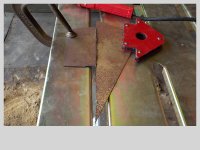
3/32 7014 varied between 85 and 95 amps, worked pretty good on sample pieces in first pic.
Then I went to the deck and it just dissolved away from me.
Come back Come back he said to the deck....sigh. Ok, held rod way too close and burned through.
Looks horrible.
Good news is one hundred percent of this area is being covered with fresh metal, so this is my training ground.
Had real problems seeing, yes worked better with half stick so I could get closer and see better what was going on.
Some times I missed the cracks totally. A few I did pretty well, though doesn't show here.

The deck is much stronger now despite the horrible welds. In the cool of the morning tomorrow without sweat in my eyes I'm redoing some of these

my first weld. Pretty dreadful actually.
Well, can only improve.
Getting that helmet properly adjusted is a first step, and next installing the 2x magnifier into the
eyepiece so I don't have to get so close to see anything.
Wasn't really sure the autodimming was working right. Need to check the batteries in the helmet.

am thinking now I should have used a thicker rod and held it further away for more deposition and less cutting. I seemed to cut well...:rolleyes:

had Hobart shirt on, heavy gloves, heat index over 90, a drippy first attempt.
Want to try this when I'm cooler in morning. This afternoon was a sauna here, even with a fan on me.
 

Attachments

  • DSCN0681.JPG
    DSCN0681.JPG
    545.5 KB · Views: 240
  • DSCN0680.JPG
    DSCN0680.JPG
    519.4 KB · Views: 209
/ Welding Rods for beginners #96  
Projects like that are exactly why I bought my little Lincoln 110v unit, w/gas. Weld a bit, letting cool, working from the outside in of the crack/hole, to fill to the middle. I usually start in the middle, and work out both ways, so as to let it cool, while working on the other end, plus letting it expand outward.

Patched my old Wheel Horse deck 6 years ago, and still holding strong. Even a blind hog finds an acorn every now and then... :)
 
/ Welding Rods for beginners #97  
It looks like you need a welding spoon ( heavy copper plate with a handle on it) to put on the back side so that you can fill that gap without burning through any further.

Aaron Z
 
/ Welding Rods for beginners #98  
Daugen, you do NOT need larger rods. Larger rods go hand in hand with more current. More current is the last thing you need for welding sheet metal. You do NOT need a longer arc either. Set your current down to the lower end of the range 80 amps and work on the edges and hold a very tight arc and move fast enough to keep from burning thru. Filling holes is kind of a skill thing. Not really for beginners. It takes some practice. A welding spoon could help but you would have to have someone hold it up under the deck or get a chunk of copper pressed up under there and clamped in some manner. I don't have anything like that, and I would just concentrate on welding the periphery of the now large trench you have made. :) Keep moving and make small welds, and get rid of slag, let it cool a few seconds, and add some more weld bead. This is not easy. It requires concentration to build up weld on an edge. I have repaired shovels by rebuilding the edge and regrinding them, but it takes some time.

Also, this would likely be easier with a MIG, which you don't have, or even a gas rig if you had the gas rig and the skill which you don't have either. BUT you can do this with 3/32 7014 and your DC welder. I wish I was there to help you. I really do.
 
/ Welding Rods for beginners #100  

Marketplace Items

2017 Ram 5500 Bucket Truck (A61306)
2017 Ram 5500...
RDS Manufacturing 70307 48 Gallon L-Shaped Transfer Diesel Fuel Tank (A59230)
RDS Manufacturing...
2018 Peterbilt 348 T/A Rollback Truck (A59230)
2018 Peterbilt 348...
2020 CHEVROLET SILVERADO CREW CAB TRUCK (A59823)
2020 CHEVROLET...
2008 CAT 305C (A53317)
2018 Chevrolet Trax SUV (A59231)
2018 Chevrolet...
 
Top