Welding table build

   / Welding table build #121  
Please forgive the pictures, it's hard to hold the torch's cutting tip perpendicular to the plate and take a picture.:eek:

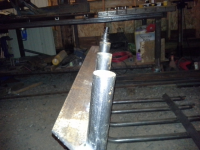
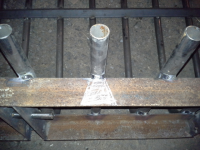
If the circle cutting attachment is built correctly the horizontal, (long key stock) will be 90-degrees to the cutting tip. Once the height is adjusted for the pre-heating cones of the cutting tip, the correct radius is set, you can either watch and make sure the cutting tip is 90-degrees to the plate, or the long key stock is level to the plate. Personally I watch to make sure the tip is 90-degrees to the plate, then I can also adjust my travel speed at the same time. ;)
 

Attachments

  • C dividers.JPG
    C dividers.JPG
    230.3 KB · Views: 227
  • C height.JPG
    C height.JPG
    227.4 KB · Views: 251
  • C threads.JPG
    C threads.JPG
    225.7 KB · Views: 259
   / Welding table build #123  
Not quite what I meant...that sets the initial height but what keeps the torch head from dragging? Been a long time since I've used mine and was only self- taught at that. I know you need to keep a bit of space between the tip and material with a plasma cutter, doesn't a torch work the same way?

I've seen some simple homemade versions of rollers that are attached to the base of the cutting tip. They consist of a couple rollers with an adjustable height to keep the tip the right distance from the plate you're cutting. But you would have to allow enough room from the edge for the rollers to travel, or else place the rollers back behind the tip.

I don't have any now or I would take a pic. You could do a Google search and probably find a pic.
I'm so shaky any more with a damaged nerve in my elbow, I need to make a set-up like Shield Arc's. I like the simplicity of his version with the key stock and electrical split nuts used as brackets. And I'll probably also make a set of rollers for the tip. :cool:
 
   / Welding table build #124  
With a little practice it's not hard to hold the tip at the right height. I tried a circle cutting attachment once that had rollers and didn't like it. If there's any mill scale or the plate isn't perfectly clean, it's hard to do a steady even cut.

As far as a cutting table, I got a couple for almost free. I got along good with my teacher in school and when he replaced a couple tables for one larger one with stainless steel cross bars, he asked me if I wanted the old ones. Sure! I traded some 3" angle iron I got from a neighbors demo job. The only thing is he kept the castors from the tables. Only one of the tables still had the bottom tray and some of the cross bars were missing but these are purpose built cutting tables. Complete sides to contain sparks, a flat plate along the back to hold a radiagraph track and removable cast iron cross bars. Cast iron doesn't cut with a torch but stainless steel is even better. Angle iron frame with plates on a 45 deg., inside the angle, between the cross bars. Easy to remove or replace the cross bars.
 
   / Welding table build #125  
Diamond shaped heating

This works. An old trick that pipefitters learn as apprectices and is used from time
to time (on non-critical applications) to 'adjust' the pipe for fit up or a closure weld.

Non-critical meaning its use is frowned upon and not allowed on nuclear class
or similar high quality piping.

A bit of a learning curve to know in what pattern, how much, and where to apply
the diamond heat, but it does work. Never tried water cooling, always used air
cooling the times that I have done it.
 
   / Welding table build #126  
This works. An old trick that pipefitters learn as apprectices and is used from time
to time (on non-critical applications) to 'adjust' the pipe for fit up or a closure weld.

Non-critical meaning its use is frowned upon and not allowed on nuclear class
or similar high quality piping.

A bit of a learning curve to know in what pattern, how much, and where to apply
the diamond heat, but it does work. Never tried water cooling, always used air
cooling the times that I have done it.

Is that an attachment at the top of your post? If so what is the secret to opening it?

I remember that old trick from my pipefitter days also. We had some kind of off the seat of our A+++ formula that gave us good results, wish I still remembered it. We also pre-loaded the back side of saddles by tack welding on a strong back piece of 4-6? channel with a piece of welding rod the same size as our cover passes under the center of the saddle. We also used to heat bend XH 1/2 through 1" pipe. If we used a formula (forgot it also) to heat before and after the center mark we had almost perfect results even for back to back bends. The formula was based on the pipe OD.

You current pipefitters out there help us old dogs with fading memory, as we still do these things now and then. Boy, bringing back those good ole days in memory, almost 20 years ago now. I still weld pretty good except for the pretty part. Still can do the most important part; the root pass, to code standards. A lot of threads and posts here indicate that some think if the top looks good their weld is sound. Most failures start at the root pass and reflect through the entire weld.

Ron
 
   / Welding table build
  • Thread Starter
#127  
Is that an attachment at the top of your post? If so what is the secret to opening it?

Not attachment, it's a quote from a previous post with suggestions as to how to take the warp out of the 1/2" plate I used as my table top.
 
   / Welding table build
  • Thread Starter
#128  
Hopefully a few of you from early on will still see this and can help me out. Kinda hijacking my own thread but hey, it's mine and what I need help with was built on this table.....

We had a very useful conversation on flame straightening and had it not been for this thread, I'd have never heard of it, nor realized that I have likely a good application for it.

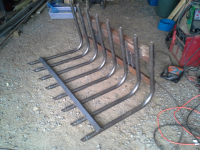
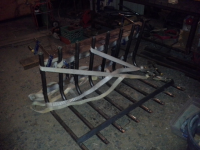
Today I welded up my skeleton bucket (firewood bucket, bottom half of a grapple, whatever you want to call it). 3.5 x 1/4 angle as the back bones, 1.75 x .120 wall for the tines and 2 x 1/4 angle for the front stiffener.


ForumRunner_20150101_183040.png

The heat from welding the tines to the main angles bent the angles approx 1/4" over the 5' length, which has put a nasty twist to my bucket. This is after painstakingly measuring and squaring, double and triple checking and alternating my welds all over the place to try to help eliminate warpage. Now my new bucket looks like shiat and I haven't even burnt in the final welds on the bucket mount. I can't even get it.properly mounted on my loader to tack the pin bosses in place.

ForumRunner_20150101_183054.png

Unless you guys advise me otherwise, I'm thinking the best course of action would be to heat the top flange of the angle to draw it back into place. To me this seems like a good application of flame shrinking.

Having never tried it, (and been more than 10 yrs since I've sparked up my torches), I'm looking for any advice I can get.

ForumRunner_20150101_183103.png
 
   / Welding table build #129  
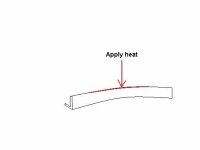
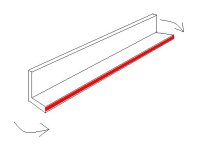
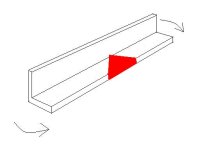
Before I heated that wedge like you have marked out. I would first try heating the toe of the angle. If that won't pull it back enough heat the wedge, or a circle where you have the wedge marked out.
 

Attachments

  • angle iron.JPG
    angle iron.JPG
    24 KB · Views: 152
  • Angle Iron slow.JPG
    Angle Iron slow.JPG
    15.9 KB · Views: 123
  • Angle Iron fast.JPG
    Angle Iron fast.JPG
    14.9 KB · Views: 144
   / Welding table build #130  
Hopefully a few of you from early on will still see this and can help me out. Kinda hijacking my own thread but hey, it's mine and what I need help with was built on this table..... We had a very useful conversation on flame straightening and had it not been for this thread, I'd have never heard of it, nor realized that I have likely a good application for it. Today I welded up my skeleton bucket (firewood bucket, bottom half of a grapple, whatever you want to call it). 3.5 x 1/4 angle as the back bones, 1.75 x .120 wall for the tines and 2 x 1/4 angle for the front stiffener. <img src="http://www.tractorbynet.com/forums/files/welding/404886-welding-table-build-forumrunner_20150101_183040-png"/> The heat from welding the tines to the main angles bent the angles approx 1/4" over the 5' length, which has put a nasty twist to my bucket. This is after painstakingly measuring and squaring, double and triple checking and alternating my welds all over the place to try to help eliminate warpage. Now my new bucket looks like shiat and I haven't even burnt in the final welds on the bucket mount. I can't even get it.properly mounted on my loader to tack the pin bosses in place. <img src="http://www.tractorbynet.com/forums/files/welding/404887-welding-table-build-forumrunner_20150101_183054-png"/> Unless you guys advise me otherwise, I'm thinking the best course of action would be to heat the top flange of the angle to draw it back into place. To me this seems like a good application of flame shrinking. Having never tried it, (and been more than 10 yrs since I've sparked up my torches), I'm looking for any advice I can get. <img src="http://www.tractorbynet.com/forums/files/welding/404888-welding-table-build-forumrunner_20150101_183103-png"/>

Your in good hands with SA.

BFreaky is also a master at prepping, fitting, clamping and welding. His stuff always turns out straight!

Sent from my iPhone 5s 64Gb using TractorByNet
 
   / Welding table build
  • Thread Starter
#131  
Before I heated that wedge like you have marked out. I would first try heating the toe of the angle. If that won't pull it back enough heat the wedge, or a circle where you have the wedge marked out.

Thanks, I'll give that a try. I'm guessing heating the full length will create a more even pull than the wedge which is obviously concentrated?

How do I tell how much to heat it?
 
   / Welding table build
  • Thread Starter
#132  
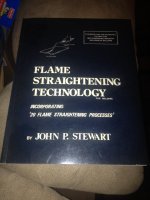
My wife got me this book for Christmas so I had a look to see if it said anything.

ForumRunner_20150101_224857.png

It has 10 pages on flame straightening and a bunch of purdy pictures but I got more out of SA's 4 lines and 3 quick sketches.

I did go back out and have another look at it though. There are 2 distinct spots where it is bent. In this pic, you can see the 2 lines with the zero beside them, those are the apex of the bend. Still straight between the 2 marks. On the left side, it's 1/4" out at the end and on the right, it's 1/8". Surprised me, I figured its would have been more consistent, with similar amount of distortion at each tine

ForumRunner_20150101_224908.png

Since I've discovered it's 2 specific bends, should I still try heating the toe or should I use the V right at these spots?
 
   / Welding table build #133  
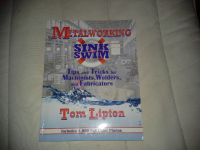
My grandfather gave me a book a few months ago. Here is a picture of the cover. Haven't used it but it might help.

image-1187329791.jpg
 
   / Welding table build #134  
How much heat to apply is the trick to flame straightening! The theory of where to place the heat is the easy part, how much heat is the hard part!

Look at heating just the toe of the angle as a gradual correction. Look at heating the wedge as a hefty correction. Most likely you won't see the heating of the toe after it cools. The wedge will produce a small kink, that will be visible. At first try heating the toe of the angle right where you can see the bend, use a straight edge to find the bends, If heating the toe doesn't work, then heat a wedge.
 
   / Welding table build
  • Thread Starter
#135  
Thanks for your thoughts SA. I always appreciate you input.

Hopefully picking up new tanks today and will give this a try this afternoon or tomorrow morning
 
   / Welding table build
  • Thread Starter
#136  
Got tanks for my torches today and gave it a whirl. Started heating the toe as suggested and quickly got fed up with it and heated the first wedge. Hit it with some water to speed the cooling process and by the time it was cool enough to touch with bare hand, I still didn't see much movement. Ugh.

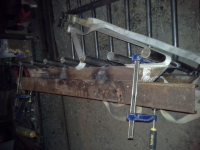
Round 2... Got out a 6' piece of 5" channel to use as a strongback with a couple clamps. Heated at the next 2 marks, clamped on the strongback heated some more then drew the clamps in as far as I could. Something still didn't seem right and there was still some gap. Measured for square from top corner to front tip and was out an inch. Yikes. Dug out two 2" ratchet straps. As there hadn't been much cooling yet, I reheated again and also heated the lower angle iron. Cranked on the ratchet straps till they were fiddle tight which drew it 1/8 past square. With the extra force of the straps and clamps, as it cooled on its own, the last 1/8" gap closed up. Fingers crossed that tomorrow when I undo the clamps and straps, it's close enough.
 

Attachments

  • ForumRunner_20150102_201254.png
    ForumRunner_20150102_201254.png
    443.4 KB · Views: 158
   / Welding table build #138  
Looks good. Maybe (if you need to) shim up the centre a bit, reclamp and reheat. As to your earlier question regarding how much is too much heat, I was going to reply if it bends back TOO far you've used too much heat but figured you probably weren't in a position to appreciate my humor (or lack of):D Terry

Edit:just noticed you DID bend it past square.
 
   / Welding table build
  • Thread Starter
#139  
Looks good. Maybe (if you need to) shim up the centre a bit, reclamp and reheat. As to your earlier question regarding how much is too much heat, I was going to reply if it bends back TOO far you've used too much heat but figured you probably weren't in a position to appreciate my humor (or lack of):D Terry

Edit:just noticed you DID bend it past square.

Oh yes, I'd appreciate the humor lol. No problem on that. Its kinda like giving directions and saying "its the last road before you get to xxxx". How do you know its the last one unless you've driven by? Or the farm I worked summers on in highschool.... Backing self-unloading wagons into the shed for winter storage, I stopped the tractor and got off cause I couldn't see my guide anymore (full-time farm hand). Told him I needed guidance as to how close I was and to stay where I could see him. His response was he'd let me know when I'd hit something.... Like I wouldn't have already felt it. Dumb a**

When I pulled it with the straps, I went the 1/8 past figuring there'd be a bit of spring back. If when I unclamp tomorrow, I find I still want more correction, do I heat the same spots over again (assuming I'm still trying to work the same spot) or do I go just beside ?
 
   / Welding table build #140  
Oh yes, I'd appreciate the humor lol. No problem on that. Its kinda like giving directions and saying "its the last road before you get to xxxx". How do you know its the last one unless you've driven by? Or the farm I worked summers on in highschool.... Backing self-unloading wagons into the shed for winter storage, I stopped the tractor and got off cause I couldn't see my guide anymore (full-time farm hand). Told him I needed guidance as to how close I was and to stay where I could see him. His response was he'd let me know when I'd hit something.... Like I wouldn't have already felt it. Dumb a** When I pulled it with the straps, I went the 1/8 past figuring there'd be a bit of spring back. If when I unclamp tomorrow, I find I still want more correction, do I heat the same spots over again (assuming I'm still trying to work the same spot) or do I go just beside ?


I would try warming up the same spots only over a slightly larger area.
If that doesn't work you should have done it the other way.

Terry
 

Tractor & Equipment Auctions

Toro Greensmaster 3150-Q Riding Mower (A56859)
Toro Greensmaster...
2016 INTERNATIONAL PROSTAR TANDEM AXLE DAY CAB (A59904)
2016 INTERNATIONAL...
2019 Ram 3500 HD (A56435)
2019 Ram 3500 HD...
Year: 2019 Make: Jeep Model: Grand Cherokee Vehicle Type: Multipurpose Vehicle (MPV) Mileage: (A59231)
Year: 2019 Make...
19010 (A55851)
19010 (A55851)
2017 Nissan Altima 4 door (A56438)
2017 Nissan Altima...
 
Top