Thoughts on this used welder?

   / Thoughts on this used welder?
  • Thread Starter
#201  
A capacitor will do a lot to absorb spikes, but a varistor in addition will likely be needed if there is any real electronics involved.

You know, I'm showing my ignorance here, but now that you mention it, that thing I was calling a capacitor is probably a varistor. Capacitors are usually cylindrical in shape, although I think they sometimes come in the dime-shaped package that my welder has got. But more fundamentally, the dang thing says "varistor" on the side. I was trying to look up replacements for it the other day, in case it was messed up, and I could not figure out why it didn't have a Farad rating printed on it. I looked all over the Internet for "Varistor Capacitor" trying to track down who the manufacturer or part number was. James, this may explain why the results I got from my multimeter didn't look anything like a capacitor should look.

But if it's a varistor, where's the capacitor to go with the inductor/choke? I thought they usually came in pairs.

Another thought: if it's a varistor, then isn't it consumable? Won't it eventually lose its ability to protect against spikes, like a power strip?

Every time I look dumb, I learn something new. After all these years, you'd think I'd stop looking so dumb so often.
 
   / Thoughts on this used welder? #202  
Yes Varistors "wear out" eventually. I have been going back and looking at your photo's and I don't see a cap anywhere so far, I do see a little MOV (metal oxide varistor). When a MOV wears out... they are generally are "open" and ineffective. They sometimes fail catastrophically and short, but mostly they just "go away"

Yes caps and inductors are often used together in power supplys . But sometimes only one componet is used. In this case I am thinking since this "power supply" is high current, it would take a large cap to do much good, and the inductor is more effective in this case. This may or may not be true, but it is what I think, perhaps a design engineer could weigh in here.

James K0UA
 
   / Thoughts on this used welder? #203  
joshuabardwell said:
But if it's a varistor, where's the capacitor to go with the inductor/choke? I thought they usually came in pairs.

In a power supply for an electronic circuit, yes. But at the current a welder puts out they wouldn't do much good unless they were huge(expensive).

Another thought: if it's a varistor, then isn't it consumable? Won't it eventually lose its ability to protect against spikes, like a power strip?

depends on its rating, and how big the spikes are. Cheap power strips are made diferent. Often the varister is after a fuse and when it gets a big spike it conducts hard and blows the fuse, saving the down stream circuits. If you replace the varister in the welder, get a big one.
 
   / Thoughts on this used welder?
  • Thread Starter
#205  
Yes Varistors "wear out" eventually. I have been going back and looking at your photo's and I don't see a cap anywhere so far, I do see a little MOV (metal oxide varistor). When a MOV wears out... they are generally are "open" and ineffective. They sometimes fail catastrophically and short, but mostly they just "go away"

Yes. Some of the power strips that I have, when they stop protecting (the MOVs wear out), they stop conducting power too. But I have the impression that many power strips keep conducting power, and are just not protecting anymore. This must pertain to a difference in the wiring of a power strip vs. my welder, as opposed to any quality of the MOV itself. Good to know. If the DC output on my welder ever fails entirely, it could be because the MOV has been consumed and will show "open".

Yes caps and inductors are often used together in power supplys . But sometimes only one componet is used. In this case I am thinking since this "power supply" is high current, it would take a large cap to do much good, and the inductor is more effective in this case. This may or may not be true, but it is what I think, perhaps a design engineer could weigh in here.

Seems like CNCDan agrees with you.

Thanks for the info, guys. I love learning new stuff like this.
 
   / Thoughts on this used welder? #206  
Good to know. If the DC output on my welder ever fails entirely, it could be because the MOV has been consumed and will show "open".

Look at your schematic, the MOV is across the DC output. If it fails open you will never know it. It does not carry any current.

James K0UA
 
   / Thoughts on this used welder?
  • Thread Starter
#207  
Look at your schematic, the MOV is across the DC output. If it fails open you will never know it. It does not carry any current.

Sheesh. You're right. How would I even know if it had failed?
 
   / Thoughts on this used welder?
  • Thread Starter
#208  
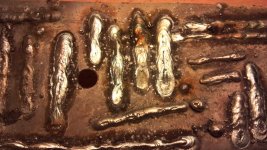
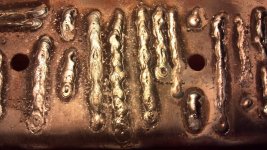
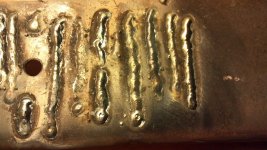
I did some more practice tonight. I had planned on welding up a small frame for the hand truck that I use to move my welder around on. Just a square base-plate basically, to allow me to tilt the truck back and move the welder around without having to have the welder ratchet-strapped to the cart like I do now.

At this point, I figure 1/8" is about the thinnest material I can try to weld, so I got some 1.5" angle iron, 1/8" thick. I actually have another piece of flat, 1/8" scrap that I had laying around my barn, so I shined it up and ran some practice beads. I had previously run some beads using 1/8" 6013, and I thought those were a little thick for what I intended to do, so I got some 3/32 rods at Tractor Supply when I bought the angle iron. Having gotten good results with 6013, and knowing that 6013 is a low-penetration rod (so less chance of blow-through), I wanted to get 6013, but they didn't have anything smaller than 1/8" so that was out. They had 3/32" in 7014, so I got that. They had something even thinner, but it was about twice as expensive as the 7014, so no dice.

I started out using the 1 amp per mil rule. 3/32 = 0.09, so start out at 90 amps.

2012-10-14_01-27-22_402.jpg

WHOAH. Way too hot. Lots of spatter, a "pancake" at the end of the weld, and the puddle was like 2" long. So I turned it down maybe 10-15 amps.

2012-10-14_01-27-46_491.jpg

Still way too hot! Part of what was confusing me was that I was having a little rod sticking and a tiny bit of difficulty starting the arc, so I was thinking my power was on the low side of what the rod needed. But really, I bet it is just that my work metal was not as clean as it needed to be since it had been sitting outside for a couple of moist days. Finally, I dialed the welder down all the way to its lowest setting, about 40 amps.

2012-10-14_01-28-09_397.jpg

Much better.

Oh, and about that frame for the welder? Well, upon further investigation, I discovered that the hand cart could be reconfigured to ride on four wheels like a push-cart, and the baseplate could be flipped ninety degrees so it didn't block the DC lugs on the welder any more. So the frame I was going to make is kind of unnecessary. But I have the metal all cut up, and I may go ahead and weld it up anyway just for the practice.
 
   / Thoughts on this used welder?
  • Thread Starter
#209  
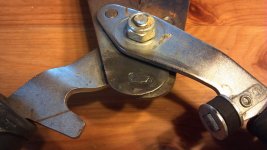
Today's small welding job: fixing a pair of hedge clippers. They are double-jointed, and a pin fell out of a joint. You can see two other pins in the photo that are still in place. I'm honestly not sure what's holding them in. They kind of seem to have been peened at the end, but of course that'd only hold them in from one direction. I previously tried JB-weld, but it gave up nearly instantly. I figured I would probably want some relatively hard metal, so I cut the head off a bolt, stuck it through, put two tack welds on either side of it, and ground it all down.

2012-10-14 17.59.35.jpg

BTW, I am aware of the hazards of welding galvanized steel. In this case, it was, like, literally four total seconds of welding, so I just kept my head out of the fumes and held my breath. If it was a larger job, I would set up a fan blowing across the work location to carry the fumes away.

This was a $30 pair of hedge clippers. The way I see it, I get to count that against the cost of the welder. At this rate, I'll be MAKING money in no time!

BTW, in case you care, I used 1/8" 6011 at about 110 amps.
 
Last edited:
   / Thoughts on this used welder? #210  
I figure that old AC buzzbox I started welding with doesn't owe me a dime, I kept an old lawn mower pieced together after if fell apart so many times from use and abuse mowing 7 acres before I got a tractor and finish mower. I reckon any repair on some of your stuff that you would have thrown away otherwise does really subtract from the price of your welder. And beside that you are gaining skill, a valuable skill to use now and in the future.

James K0UA
 
   / Thoughts on this used welder?
  • Thread Starter
#211  
I went ahead and ordered the diodes just now. The originals were 70 amps and 300 volts. The closest match I could find was 70 amps and 600 volts, but in the interest of beefiness, I ordered a set of 85 amp / 600 volt diodes. It was a difference of $3 each. My Internet research suggests that the higher amp rating will make them more forgiving of heat and will increase their duty cycle (if not the duty cycle of the other welder components). The higher voltage will make them more resistant to damage from voltage spikes. I also got some thermal paste, which is supposed to significantly improve their ability to transfer heat to the aluminum heat sinks. With any luck, I'll be DC welding before too long!
 
   / Thoughts on this used welder? #212  
I went ahead and ordered the diodes just now. The originals were 70 amps and 300 volts. The closest match I could find was 70 amps and 600 volts, but in the interest of beefiness, I ordered a set of 85 amp / 600 volt diodes. It was a difference of $3 each. My Internet research suggests that the higher amp rating will make them more forgiving of heat and will increase their duty cycle (if not the duty cycle of the other welder components). The higher voltage will make them more resistant to damage from voltage spikes. I also got some thermal paste, which is supposed to significantly improve their ability to transfer heat to the aluminum heat sinks. With any luck, I'll be DC welding before too long!

I agree with your substitutions and reasoning. I hope you are welding DC soon too!
 
   / Thoughts on this used welder? #213  
k0ua said:
I agree with your substitutions and reasoning. I hope you are welding DC soon too!

Me too. You are realy going to like DC welding
 
   / Thoughts on this used welder?
  • Thread Starter
#214  
The diodes came today and I just got finished installing them. My little 30 watt soldering iron couldn't even begin to make a dent on those thick wires. I have a small butane torch that came with a soldering tip, so I tried that and it was even worse. I ended up basically brazing the connections with the torch's open flame instead of soldering them. I tried to be very careful not to overheat the diodes. On the last one, I must have been directing the heat somewhere other than where I thought I was, because the solder kept on not fluxing, and then all of the sudden I noticed that the body of the diode had taken on a slight brass color, instead of the gray steel that the others had. Oops! I quit heating it immediately and once it cooled down, it measured the same on the multimeter as the others. The rod will tell the tale! I'm about to go clean off a piece of scrap and run a bead.
 
   / Thoughts on this used welder? #215  
The diodes came today and I just got finished installing them. My little 30 watt soldering iron couldn't even begin to make a dent on those thick wires. I have a small butane torch that came with a soldering tip, so I tried that and it was even worse. I ended up basically brazing the connections with the torch's open flame instead of soldering them. I tried to be very careful not to overheat the diodes. On the last one, I must have been directing the heat somewhere other than where I thought I was, because the solder kept on not fluxing, and then all of the sudden I noticed that the body of the diode had taken on a slight brass color, instead of the gray steel that the others had. Oops! I quit heating it immediately and once it cooled down, it measured the same on the multimeter as the others. The rod will tell the tale! I'm about to go clean off a piece of scrap and run a bead.
Well let us know how you like DC welding. You will be surprised.
 
   / Thoughts on this used welder? #216  
I'm late to the party here, but your "work" pictures seem to be just a bead on top of some metal. That's really pretty limiting. You should be cutting that scrap of metal apart and welding it back.

The difference between a good welder and a novice is in large part the prep work done. Pre-fitting, tack welding, grinding bevels, etc etc. Then you have to learn to listen to the arc.

One tip on method. Your beads don't really show that you are moving the rod side to side in a "C" shaped motion. It also seems that you are probably moving laterally too quickly.
 
   / Thoughts on this used welder?
  • Thread Starter
#217  
SUCCESS! I burned two rods at various amperages and polarities and had no troubles. Welding on DC is different, and I hate to say it but I think my beads actually look worse, but I guess that's to be expected since all my practice so far is on AC.

"Thoughts on this welder"? After 22 pages and 7 weeks or so, I'd say the welder is 100%. Total cost in is under $200, including the fan and the new diodes. I'm going to say I did okay. I am going to keep practicing and see where it takes me.

Thanks very much to everyone who provided so much input, and especially to James.
 
   / Thoughts on this used welder?
  • Thread Starter
#218  
I'm late to the party here, but your "work" pictures seem to be just a bead on top of some metal. That's really pretty limiting. You should be cutting that scrap of metal apart and welding it back.

Someone suggested to me (don't remember who) that you should practice laying beads first, then once you've got a feel for the effect of different amperage settings, etc..., move on to joining. Also--and I acknowledge this is a poor excuse--but the metal that I'm working with is kind of a PITA to cut apart with my little abrasive chop-saw. I need to pick up some 1/8" bar stock and just cut it into pieces.

One tip on method. Your beads don't really show that you are moving the rod side to side in a "C" shaped motion. It also seems that you are probably moving laterally too quickly.

I have been wondering that. I am not moving side to side at all, really--just dragging the rod and trying to keep it ahead of the puddle and keep the puddle the right size. I think I need to go back to those instructional videos and brush up again.
 
   / Thoughts on this used welder? #219  
I need to pick up some 1/8" bar stock and just cut it into pieces.

Good idea:thumbsup: And as others have said, when time and money permits, get a good wire cup brush to really clean the metal of course practice beveling, and puting it back together. Stay with it. And when you get some welds you are really proud of, post em back here and we will all enjoy them. You have already discovered you can actually fix things.. and later when time and experience and money permit you can get a cylinder of Argon, and a regulator and a 17V torch and we will get you into DC TIG for steel.. really great for all those thin metal and little household pieces that need repair.. TIG is 10 times the fun of stick. Stick is great for fixing big ole things but TIG gives you more control than you would believe. If you will follow this link, it is a little TIG repair I did a few months back. Now all that said, don't ever mistake me for an experienced TIG weldor, but I have fun. btw for larger things like that diode, I use a Weller 240 watt gun It also helps to "tin" the wire and "tin" the diode anode before you put them together then you can "sweat" them together, and just as the start to fuse add a little extra solder flow.. also don't fall for this new "clean" rosin free solder, it is crap. some nice old Kester 60/40 or Ersin solder is what you want with the proper tin/lead mix and real rosin, not this "clean" crap. If your throat is not raw after a day of soldering, your not doing it right:)

http://www.tractorbynet.com/forums/welding/239186-am-i-stupid-crafty.html

James K0UA
 
   / Thoughts on this used welder?
  • Thread Starter
#220  
The possibility of TIG does intrigue me. It seems clear that stick welding is a good way to get your fundamentals straight, but at the same time, I doubt I am going to weld much thinner than 1/8" metal, at least until my skills improve a lot. And the real sticker is that many things that I would want to build could be built with thinner metal, which would decrease weight and cost. On top of that, I can see that I am really under-equipped to deal with other aspects of fabrication using heavier metal--specifically cutting. My chop-saw really struggles to get through even the T-bar that I have, which is something like 1/4", especially at the joint of the T where the metal is thick. Just grinding away, popping the circuit breaker if I try to push it any faster. It'd be awesome to have a band saw or a cutting torch, but I can see that building a metal fabrication shop is a long road full of very expensive equipment, and at the end of that road is quite a lot of expensive stock to ultimately build whatever it is you're building. So I have been pondering whether the direction to look is smaller, not bigger. It seems like an awful lot of good could come from materials 1/8" and thinner, which are out of the range of my current welder. But honestly, this is all quite a bit premature, as I have barely been through thirty rods at most, and most of that being flat beads--not even joints. I just need to get some rods under my belt and work on projects as they come up, and eventually I will figure it out.

What I wouldn't have given for that Weller gun tonight. Thing is, I almost never need to solder things, and when I do, I usually muddle through with that little pencil-style iron. I doubt it would make sense to spend $40 on a bigger gun, but I was pretty sure I was going to burn up at least one of the diodes with the butane torch tonight. I looked up the specs, and the lugs are rated for about 400 degrees. My solder fluxes at right around there, so maybe I wasn't as close to the edge as I thought. Still, I discolored the housing of one of the diodes with heat, so I know I got it at least a little bit hot!

I do have a cup wheel and a good ole Harbor Freight 4.25" grinder, though.
 

Tractor & Equipment Auctions

IRET13 ELECTRIC TRICYCLE (A58214)
IRET13 ELECTRIC...
KENWORTH T/A DAY CAB ROAD TRACTOR (A57192)
KENWORTH T/A DAY...
2014 FREIGHTLINER 108SD CONCRETE MIXER TRUCK (A59823)
2014 FREIGHTLINER...
2010 KMC 3376 Peanut Combine (A56438)
2010 KMC 3376...
WOOD GRABBER FOR MINI EXCAVATOR (A58214)
WOOD GRABBER FOR...
DEUTZ MARATHON 60KW GENERATOR (A58214)
DEUTZ MARATHON...
 
Top