how to build your own custom backhoe subframe

   / how to build your own custom backhoe subframe #201  
Just a thought, all of the older farm tractor loaders and dozer type blades always came back to the rear ends for push/lift strength.
Very few used the bolts in the axle ends for the strength even though many of them bolted to the ends, they almost always utilized the square axle housing as the support either from flanges or plates that sandwiched the square housing to the sub frame often with 4 bolts often 3/4" bolts to squeeze the subframe and reinforcement to the axle housing. Looking at your pic woodsframe2 it seems like the angle pieces # 37 and ?? serve in that manner some what. But securing your sub frame to the axle housing would likely be securing it to the strongest casting of the tractor.
 
   / how to build your own custom backhoe subframe #202  
Thanks for the reply LouNY. In your last sentence above, are you saying the "axle housing" as in the ends where the axles come out or the back side where the ROPS connects? Just want to be sure I am tracking with you :)

Something like this is going through my head...
 

Attachments

  • sandwhich block.jpg
    sandwhich block.jpg
    846.7 KB · Views: 190
   / how to build your own custom backhoe subframe #203  
On the square housing at the ends were the axles come out.

Edited to add;
this is a picture clipped from a Miller front end loader,
the long legs go under the rear axle housing and the short bars on top with large bolts joining the two,
the bolts fit very close to the front and rear of the axle housing.
1691254610516.png


1691255013208.png
 
Last edited:
   / how to build your own custom backhoe subframe
  • Thread Starter
#204  
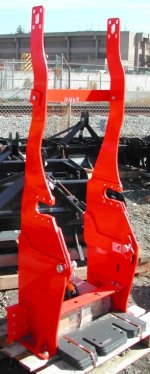
The way woods attaches their subframe at the end of the axle housing using the 4 pre existing bolt holes APPEARS to also be the way some of the kubota sub frames attached on the L series as best I can tell from the first picture. One key I had not picked up on is that both of them also have some type of extension that goes over to the ROPS or similar location for additional support (photo 1 is a kubota bracket and photo 4 is the woods diagram where you can see part 37) . I'm beginning to think that is the key: the combination of axle housing connection WITH a connection at the ROPS area would be pretty strong.
The L -series used all-steel structural components in the rear, including the trumpet housings, but also featured axle hubs that were part of the axle. Earlier Bs had removable hubs; I am not sure of the later ones. That would allow you to put the axle thru a hole in the subframe.

I am reposting 2 pix of Woods 4-pt subframes for B and L Kubotas. There are brackets you can not see that provide additional support. BTW, I am not a fan of these subframes as they are way too long, sticking the hoe too far out back.

Some tractors, like L Kubotas, and my own Kioti have many unused threaded holes underneath the final drive gearbox, some for the drawbar. Those are fair game for a subframe. I did use them for my Kioti subframe.
 

Attachments

  • Wds_Bseries_4pt_2.jpg
    Wds_Bseries_4pt_2.jpg
    164.9 KB · Views: 187
  • woods_L3130mnt.jpg
    woods_L3130mnt.jpg
    204.4 KB · Views: 159
   / how to build your own custom backhoe subframe #205  
It appears that my B2400 hubs slide off of the axle (they are held with a large pin and a squeeze bolt and two wedges) so it appears I could make my subframe with a hole for the axle and thus be solid all the way around. This was my assumption in my first two design ideas in a previous post. I will take a look to see what other options might present themselves down near the drawbar.

I now get LouNYs squash method. That is the idea that I think dfkrug used on his first sub frame earlier in this thread. Unfortunately the axle support housing is not a smooth square so it wouldn't be quite as effective - but probably effective enough. This may end up being the most effective depending on where the final hoe mounting plates need to be.

I guess the next thing to do is get the measurements for a BH600 or BH601 as that is my target hoe at this time (small enough not to damage anything and weighs in at around 620 pounds without the bucket). Once I know the width and height of the hoe bracket that will allow me to fully assess my options as to mounting at the rear. The front is a no brainer - bolt to the FEL housing.
 
   / how to build your own custom backhoe subframe #206  
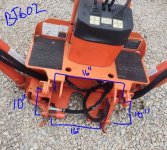
I saw a BT603 today at the local dealer and grabbed some numbers. I was surprised that the mount is basically a 16 by 10 inch rectangle (16 wide by 10 high).

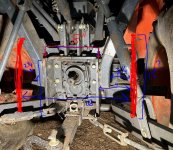
It's looking like my subframe will come out an inch of so wide on each side based on the axle housing but I can deal with that. It appears I can also utilize the ROPS mounting bracket. In the second photo the red lines are the approx location of where my subframe will be. You can see how far I will need to come in to connect to the ROPS area. But I think an axle mash set up with ROPS connection would be plenty strong (and of course up to the FEL).
 

Attachments

  • rops mounting dimensions.JPG
    rops mounting dimensions.JPG
    428.9 KB · Views: 183
  • bt600 basic mounting dimensions.JPG
    bt600 basic mounting dimensions.JPG
    199.7 KB · Views: 198
   / how to build your own custom backhoe subframe
  • Thread Starter
#207  
I saw a BT603 today at the local dealer and grabbed some numbers. I was surprised that the mount is basically a 16 by 10 inch rectangle (16 wide by 10 high).
I imagine the BT603 is similar to the BT600. I like the 4-point mount and how the maker close-coupled the hoe with the tractor.

Here is a new BT600 on a subcompact BX22.
 

Attachments

  • bx22_hoe2.jpg
    bx22_hoe2.jpg
    1.6 MB · Views: 188
   / how to build your own custom backhoe subframe #208  
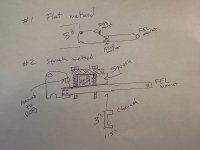
OK, now on to construction basics. What thickness of steel should I fabricate the sub frame from? I am looking at two different ways/methods:
1. flat stock like OEM Kubota and Woods uses that runs from FEL to Hoe attachment
2. channel (3x1.5?) under the axle as many have used on their DIY subframes

If using #1 I think I can use a plasma cutter and a template (wood) to guide my cutter. I likely would not use a squash method but rather the 4 holes already in the axle housing then also attach it to the the ROPs mounting point. My hubs come off the axle so I can slide it over the axle and into place.

If using #2 then I likely am looking at a squash the rear axle housing and still attach also to the ROPs brackets. A possible advantage of this method is the width could be made to be exactly what is needed to match the mounting on the hoe. I will need to remeasure that.
 

Attachments

  • methods.jpg
    methods.jpg
    891.8 KB · Views: 180
   / how to build your own custom backhoe subframe
  • Thread Starter
#209  
OK, now on to construction basics. What thickness of steel should I fabricate the sub frame from? I am looking at two different ways/methods:
1. flat stock like OEM Kubota and Woods uses that runs from FEL to Hoe attachment
2. channel (3x1.5?) under the axle as many have used on their DIY subframes

I have done most of my subframes with channel stock, much of which I acquired, free, from a local Kubota dealer. They were the base of tractor crates.

If you go with flat stock, it will have to be quite thick (at least 3/4") to reduce sideways flex. I used 1/2" plates on one of my subframes, and it had too much sideways flex. Woods and Kubota both use very thick plate, which is hard to handle and cut. My plasma cutter is only good for 40A, which means anything over 1/2" cutting is tedious at best. Maybe you can get away with only 1/2" plate if you stick will a 6' hoe, and add lots of side bracing.

A third choice is tubing, but that is not as simple as channel or plate in that secure weldments really need to fully surround the tube. There are numerous postings on the internet of Kioti OEM subframe failures of tubing.
 
   / how to build your own custom backhoe subframe #210  
How this of channel is needed if I go that route?
 
   / how to build your own custom backhoe subframe
  • Thread Starter
#211  
How this of channel is needed if I go that route?
I do not understand the Q, but I recall that the channel was 3.5x1.5x.25". Reinforced at key mounting points where bending moment would be greatest.
 

Attachments

  • CK30_sub_mntd_2.jpg
    CK30_sub_mntd_2.jpg
    141.6 KB · Views: 163
   / how to build your own custom backhoe subframe #212  
Or use your flat stock and make a T shaped rail.
 
   / how to build your own custom backhoe subframe #213  
Haha - yeah that question was foo barred. I was asking how thick the channel steel needed to be, which you answered. I'm going to start looking around to see what I can get my hands on (not retail).
 
   / how to build your own custom backhoe subframe #214  
LouNY, is a T rail two flats welded to make a T? If so I had not thought of that but it would be strong. I've got a 220v Hobart 180 which is good to 5/16... so that's going to be my limitation. Not sure a 5/16 flat stock is going to be strong enough, but assume a 5/16 channel would be. My hoe is going to be a small one so that will help.
 
   / how to build your own custom backhoe subframe #215  
LouNY, is a T rail two flats welded to make a T? If so I had not thought of that but it would be strong. I've got a 220v Hobart 180 which is good to 5/16... so that's going to be my limitation. Not sure a 5/16 flat stock is going to be strong enough, but assume a 5/16 channel would be. My hoe is going to be a small one so that will help.
Yes, two pieces of flat stock weld together to form a T. V'ed out and welded from both sides you should be able to go up in thickness.
 
   / how to build your own custom backhoe subframe #216  
Question: when people say that backhoes improperly supported can brake a tractor in half (between rear housing and engine housing), what force is causing that? My assumption is it is a situation where the backhoe is pulling down (digging) and hits a rock/root that stops the bucket so the force then transfers up through the hoe and into the tractor ... thus making the tractor raise it's front end if there is enough pressure. Since the hoe can release pressure quickly, once the control is moved the other way the front end of the tractor would come crashing down very quickly AND that would be enough potential force to break the tractor at it's weakest point... in the middle.

So the sub frame would stop this from being a problem because the sub frame itself would hold the tractor together instead of letting the force be only in the middle. A three point BH also adds to the issue because all the force is also going through the rear attachment of the arms and TopLink which then could also be a weak spot in the above scenario.

Just trying to understand the forces to help design the subframe. Does this sound right? Thanks.
 
   / how to build your own custom backhoe subframe
  • Thread Starter
#217  
Question: when people say that backhoes improperly supported can brake a tractor in half (between rear housing and engine housing), what force is causing that?
A backhoe attachment on a CUT that can deliver 2500psi pressures puts enormous push, pull, lift, and twisting forces on the rear of the tractor. Distributing these forces is the job of the subframe.

The most extreme forces are going to be shock loads that happen when the hoe lifts the tractor's rear off the ground and drops suddenly as the load releases, or when driving around at moderate speeds where the hoe is not supported by the outriggers.

I think the first scenario is most likely to happen when digging stumps/roots. Some folks routinely lift their tractor with the hoe to re-position the machine. That is very stressful, too. Backhoe attachments with subframes are not as forgiving as purpose-built "mainframes" on TLB machines.
 
   / how to build your own custom backhoe subframe #218  
Oops - I had that torque backwards. But the end result is the same whether its the front or back that gets let down quickly. I can also see the issue with driving around - good idea to stick to the BT600-603 units as they are very light compared to most (just 630 pounds without bucket I think).

So the subframe will certainly need to be attached to the ROPs area of the rear end as well as the FEL. Is there a good reason to also try to attach in between those two areas somewhere in the middle?
 
   / how to build your own custom backhoe subframe
  • Thread Starter
#220  
A Geo/Suzuki Tracker with subframe and hoe. Nice.
 

Marketplace Items

UNUSED FUTURE FTH50-(50) SHEETS OF GALVALUME (A60432)
UNUSED FUTURE...
UNUSED FUTURE TBL47-47" HYD TELESCOPIC BOOM (A60432)
UNUSED FUTURE...
2022 JOHN DEERE 624P WHEEL LOADER (A52707)
2022 JOHN DEERE...
405 (A52706)
405 (A52706)
Informational Lot - Shipping (A61307)
Informational Lot...
2020 PETERBILT 567 (A58214)
2020 PETERBILT 567...
 
Top