Rockbadchild
Elite Member
So I guess you love it as much as me when folks put stuff like = F_sub_yaw. and (I_zz = I_zz + M*r^2). without specifying what any the letters means... other the R of course he specified that one.
yeah it check out...
So I guess you love it as much as me when folks put stuff like = F_sub_yaw. and (I_zz = I_zz + M*r^2). without specifying what any the letters means... other the R of course he specified that one.
How is that going to help tongue weight?I second your concern based on the image. If you’re buying new, then I’d be very selective.
Bandaids could include installing airbags or an add-a-leaf, but going that route wouldn’t be my Plan-A.
That depends. Too much tongue weight can cause the same kinds of problems as too little, with lack of steering also thrown into the mix. Here's an example I saw parked at Home Depot a while back. Toyota Tundra with a tandem dually trailer with concrete perma column posts loaded at the very front of the trailer. I think I could have lifted the front of the pickup off of the ground by hand.Tongue weight is your friend, not your enemy. Either run airbags or a WDH or buy a truck that can handle the weight without dragging its bumper.
That depends. Too much tongue weight can cause the same kinds of problems as too little, with lack of steering also thrown into the mix. Here's an example I saw parked at Home Depot a while back. Toyota Tundra with a tandem dually trailer with concrete perma column posts loaded at the very front of the trailer. I think I could have lifted the front of the pickup off of the ground by hand. View attachment 855876
lol that photo belong in the ''Pics of people hauling or towing something wrong'' tread, a toy truck hauling a real truck load is the problem here not too much tonged weight.That depends. Too much tongue weight can cause the same kinds of problems as too little, with lack of steering also thrown into the mix. Here's an example I saw parked at Home Depot a while back. Toyota Tundra with a tandem dually trailer with concrete perma column posts loaded at the very front of the trailer. I think I could have lifted the front of the pickup off of the ground by hand. View attachment 855876
True. The principle still applies though. Even if the trailer is at or lighter than the rated capacity of the tow vehicle (unlike the one in that photo), too much tongue weight can cause big problems.lol that photo belong in the ''Pics of people hauling or towing something wrong'' tread, a toy truck hauling a real truck load is the problem here not too much tonged weight.
True. The principle still applies though. Even if the trailer is at or lighter than the rated capacity of the tow vehicle (unlike the one in that photo), too much tongue weight can cause big problems.
The weight a pickup can safely take on the hitch is significantly less than what it can take evenly distributed or centered in the bed. That's a big part of the reason that gooseneck trailers can haul so much more than tag trailers.I agree to your point you don't want to exceed the truck bed capacity weight on the hitch.

yeah usually about half I be interested on testing it out to see how unsafe it is but if you stick to 10 to 15% of the trailer weight as hitch weight and don't go over your towing capacity you don't have to go there. Most people don't have a scale so you go by eye and by feel and you call it good enough.The weight a pickup can safely take on the hitch is significantly less than what it can take evenly distributed in the bed.


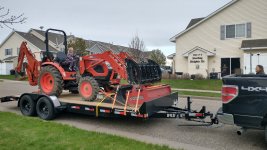
Having (been following) seen a friend coming home from work one day with a 16' tandem, bumper pull trailer, loaded with 4 concrete culverts (approx 3' in diameter) loaded behind the tandem on the trailer, and watching as he came down a hill, hit a bridge and having watched the trailer instantaneously slam back and forth smashing both sides of the rear of the truck, one realizes that having the trailer front heavy makes for seamless pulling.I'm in the market for a 22' car hauler for my Kubota. What I've been noticing is that most of the trailer length is in front of the axles, putting a lot of weight on the hitch. What am I missing here? My last 22' trailer had the same problem and I recently sold it. I was constantly being flashed at night for high pointing headlights. Any manufacturers that put their axles a little more towards the front?
The new 1/2 ton trucks are weak and poor load haulers, they are known as grocery getters for a reason. Aint it the truthYour biggest issue is too small a truck for a loaded 22’ trailer.
The new 1/2 ton trucks are weak and poor load haulers, they are known as grocery getters for a reason.
I built trailers for several years in my younger days and the front spring hangar should be in the middle of the bed less the tongue.
Long trailers look funny but that is how long bumper trailers are built.
Good trailers have an adjustable height hitch for this reason.
A shorter trailer or bigger truck would help solve your issue.
Proper load weight position is extremely important.
OK thats right but the difference in handling is like night and dayI respectfully disagree. Weight distributing hitches are widely used in the RV market and make it possible to tow a trailer that is well within the total tow weight rating of the tow vehicle but is front heavy making the total hitch weight too high.

I have a 15ft open center deck car trailer that I converted to a full deck equipment trailer. The axles were almost centered (enough that you didn't need a tongue jack on level ground) and was miserable to tow empty and hard to load correctly.If you have too much weight behind the axles it can - more than likely will - cause you to lose control swerving all over the road. I had one about 30 years ago with the axles in the middle and it did that to me with a heavy load on. I talked with several of my friends who said there was too much weight behind the axles and that I should move the axles back - which I did. Never had a problem with that again. The modern half tons crouch down really easy but id rather the truck was squatting then going in the ditch.