At Home In The Woods

/ At Home In The Woods #921  
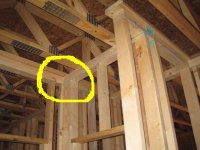
In one of the pics, it shows a 2x4 interior wall meeting a 2x6 exterior wall - if I am seeing it right.

It seems counter-intuitive to me that cutting a notch in the 2x6 top plate to overlap the 2x4 top plate will result in a stronger structure. My backyard engineering sense is saying you are giving up more than you are gaining because it creates a single plate 'hinge' point in the top plate of the 2x6 exterior wall. Whatever stiffness is given up by cutting the 2x6 plate has to made up for by the lateral strength of the interior wall. Depending on what/where the interior wall goes to, that could be good or bad.

Maybe tying them together with a piece of 2x8 would add strength, piece of mind and provide corner nailing in the ceilings.

Of course, my backyard engineering sense has been wrong before. :)
Dave.
 
/ At Home In The Woods #922  
Dave,

Imagine wall that is just standing there on it's own without any support. Then add corners to that wall and see how much stronger it becomes. now add another wall in the middle and see how much stronger it becomes. This is all very obvious.

Not take those walls and nail them together through their verticle studs. The wall becomes evern stronger to allot of movement, but with movement, that wall will also work itself loose. The further you go up that wall, the more movement that you have. The foundation isn't moving, it's solid. The wall is attached to the foundation with bolts, and the bottom of that wall is just as solid as the foundations.

Now the trick is to make the wall as strong as possible as high as possible. The simple act of overlapping your top plates will lock the walls together in such a way that they cannot work themselves loose when the house moves. All houses move, it's something that never stops happening.

In CA, where earthquakes are common and homes move more then homes in most other places, metal straps are run from inside the foundation to the tops of the top plates. That has since chaged to the tops of the rafters to hold it all down and tight.

With the overlapping top plates, you are locking the walls together like you do when playing with legos or building with cinder blocks.

The strength increase is significant. Anybody who does not build this way doesn't know what he's doing, or is in such a hurry that he doesn't care. If you look at 1,000 houses, you will never see this done any other way. It's the most basic part of framing. Not doing it doesn't make any sense, except for speed of doing the walls on the ground, lifting them into position and moving on to the next wall. It's faster to do it wrong, but not stronger.

Adding the top plates to the walls after they are up isn't very hard to do and in most cases, something you have the rookie to do keep him busy and to have something that's just about impossible to screw up. I remember getting that job before I was in High School, so that should give you an idea of how basic it is.

Eddie
 
/ At Home In The Woods #923  
At this stage of framing, it shouldn't be a big deal to do what Eddie is suggesting, and there's bound to be a pile of cut lumber available on site to do it with unless someone has been very busy getting rid of it.
 
/ At Home In The Woods #924  
At this point some sort of metal plate or strap might be on option. I think simpson makes a code - compliant connector.
 
/ At Home In The Woods #925  
Dave,

Imagine wall that is just standing there on it's own without any support. Then add corners to that wall and see how much stronger it becomes. now add another wall in the middle and see how much stronger it becomes. This is all very obvious.

Not take those walls and nail them together through their verticle studs. The wall becomes evern stronger to allot of movement, but with movement, that wall will also work itself loose. The further you go up that wall, the more movement that you have. The foundation isn't moving, it's solid. The wall is attached to the foundation with bolts, and the bottom of that wall is just as solid as the foundations.

Now the trick is to make the wall as strong as possible as high as possible. The simple act of overlapping your top plates will lock the walls together in such a way that they cannot work themselves loose when the house moves. All houses move, it's something that never stops happening.

In CA, where earthquakes are common and homes move more then homes in most other places, metal straps are run from inside the foundation to the tops of the top plates. That has since chaged to the tops of the rafters to hold it all down and tight.

With the overlapping top plates, you are locking the walls together like you do when playing with legos or building with cinder blocks.

The strength increase is significant. Anybody who does not build this way doesn't know what he's doing, or is in such a hurry that he doesn't care. If you look at 1,000 houses, you will never see this done any other way. It's the most basic part of framing. Not doing it doesn't make any sense, except for speed of doing the walls on the ground, lifting them into position and moving on to the next wall. It's faster to do it wrong, but not stronger.

Adding the top plates to the walls after they are up isn't very hard to do and in most cases, something you have the rookie to do keep him busy and to have something that's just about impossible to screw up. I remember getting that job before I was in High School, so that should give you an idea of how basic it is.

Eddie

Thank you Eddie. I can see if the interior walls are all locked together, and with the corners in them too, it will stiffen up the entire framing.
Dave.
 
/ At Home In The Woods #926  
The strength increase is significant. Anybody who does not build this way doesn't know what he's doing, or is in such a hurry that he doesn't care. If you look at 1,000 houses, you will never see this done any other way. It's the most basic part of framing. Not doing it doesn't make any sense, except for speed of doing the walls on the ground, lifting them into position and moving on to the next wall. It's faster to do it wrong, but not stronger.


Eddie

Excellent statement. I absolutely agree 100%.

Also if you were to calculate the small amount of time saved doing it the quick and dirty way and than total up the time for the retro fit repair to try to bring back some strength, there would be no savings in time at all.
 
/ At Home In The Woods #927  
Double top-plate interiror wall question
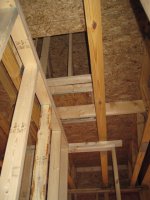
The framer has built several interior walls. I noticed some spots at the wall intersections that the double top-plates do not overlap but the dead wood is used to do the overlapping. Is this ok? If it is not ok, what issues will it cause?

Thanks, Obed

Are these interior walls in the basement or above ground floors? It looks like these interior walls are built after the trusses are placed on the load bearing walls, such as maybe a closet wall or something, the first picture doesn't look like you could cut the top plate out to overlap. At least with the deeper trusses there should be room to nail an overlap if the wall is in between, and the 2nd picture shows the drywall backer overlapping.
 
/ At Home In The Woods
  • Thread Starter
#928  
Oh Happy Day!
The Construction Manager's Contract Has Been Terminated!


attachment.php

Intersecting wall that is tied together by only 1" of dead wood

The earlier pictures of the non-overlapping top plates that I posted a few days ago were not the worse examples. This message shows how the master bath walls were tied to the intersecting wall using only the 1" overlap of the 2x6 dead wood. The sloppy construction of the top plates was the final straw for me. Yesterday the construction manager/framer's contract was terminated. We had to pay him a little more than I think he deserved to make him go away but it was worth it.

Eddie and some others were right that this guy should have been fired. There were multiple reasons why he wasn't let go earlier. However, in retrospect I wish we would have severed ties with him early in the project.

Here's how it played out. About 3 weeks ago, the CM asked to get his 2nd draw paid to him early. I was already unhappy about his lack of urgency to get the roof on and protect our house from the winter rains and snow so we told him no. He stormed and ranted and raved and acted like a 5 year old. He muttered that he wouldn't do anything more "extras" for us since we wouldn't do him this favor. From my perspective, I didn't see that he had done that many "extras". The guy just didn't get it. If he had done quality work and had shown a genuine concern about protecting the house and materials from the weather, we would have worked with him.

After we said no to the draw, he became even more difficult to work with. My wife had been the primary interface with him for several weeks because he couldn't deal with me because I wouldn't put up with his antics. It got to the point that my wife was afraid to talk to him about anything. I had about had it watching my wife go through that kind of stress. So on Friday a week ago I made an appointment for the following Monday with a contract lawyer to see what my options were regarding ending the contract.

Later that Friday evening the CM built a bathroom wall 3 1/2" in the wrong place, a place that disagreed with the floor plan drawings. I told my wife to make him fix it. When she told him to fix it, he blamed her for where he put the wall. He had marked a line on the floor and asked her if that's where she wanted the wall. Keep in mind, she never told him that she wanted to change the location of the bathroom walls so the assumption was to use the floor plan drawings. So she told him the location looked right. Well, he built the wall on the wrong side of the line he had marked on the floor.

The wife was out in the house for an extended period so I figured the CM was being difficult with her. So I left the camper and went into the house. I told the CM that he had the house plan drawings and that I expected him to build the walls according to the drawings. My wife should not have to use a tape measure to tell him where to put the walls. The CM then went into orbit worse than I had ever seen him. During this outburst, he told me "You have your head up your A**." I told him that I wasn't going to argue with him. I told him I had given him my expectations (the walls go where the plans say they go) and that I expected him to follow them. I turned around an walked off.

My wife came into the camper torn up. I decided that I couldn't subject my wife to this kind of unnessary stress and that this guy needed to go. My wife agreed with me. We needed to decide how to part ways with him. The next morning (Sat), we get a knock on the door. It was the CM. He came to apologize for his outbreak the day previous and appeared sincere in his apology. The guy was fighting back tears. I accepted his apology and let him go. I have to say I was moved and impressed. During these months, I had primarilly seen his proud, stubborn, defensive side. My wife kept telling me he was a "good guy" but I had not seen much of the "good" side of him.

Over the weekend, I had a look at the interior walls and saw that many of the top plates did not overlap at the intersecting walls. I was disgusted. Some of the top plates overlapped properly at the intersections but several did not. The CM was taking shortcuts to save time. He had obviously built the walls lying on the floor and nailed both top plates to the walls while the walls were still lying on the floor with the intention that he would use dead wood (drywall nailers) to tie the walls together. Even I knew this was a sorry practice. I've worked on Habitat for Humanity houses as a volunteer and knew that you nail the top most plate on the walls after the walls are standing in order to tie the walls together properly.

My wife then showed me an issue with the chimney chase that the CM told her about on Friday. Our fireplace and chimney sit in the middle of the house, not on an exterior wall. The chimney chase, main floor trusses, and attic floor trusses were all 6 inches in the wrong spot. To leave them there would squeeze the master bath by 6". It would also affect the basement bath because our plans also call for a fire place in the basement below the main floor fireplace. Both fireplaces would use the same chase for running the flue pipes. It was impossible to squeeze the basement bath by 6" due to tight tolerances and basement slab plumbing.

attachment.php

The fireplace wall and the chimney chase through the trusses are out of alignment by 6"

Of course the CM would not admit any responsibility for the mistake. It was the truss designer's fault because his layout showed trusses layed out evenly at 19.2" O.C. and then showed a wide 24" gap between two trusses where the chimney chase would go. So the CM just started at one end of the house laying the trusses at 19.2" O.C. and made a 24" gap for the chimney after he had lad the first x nunber of trusses. He never checked the floor plan to make sure he got the trusses in the right spot to allow correct placement of the fireplace.

Any willingness to give the CM a break was quickly diminishing.
 

Attachments

  • IMG_3404TopPlate.JPG
    IMG_3404TopPlate.JPG
    56.6 KB · Views: 442
  • IMG_3408.JPG
    IMG_3408.JPG
    117.9 KB · Views: 1,004
Last edited:
/ At Home In The Woods
  • Thread Starter
#929  
Oh Happy Day!
The Construction Manager's Contract Has Been Terminated!
(Cont'd)


On Monday, we went to see the lawyer at $250/hr. I had e-mailed him our contract with the CM and related documentation. After explaining our circumstances, the attorney said the best thing to do was to stay out of court. While our legal obligation to pay the CM would likely be an amount less that what the CM would want, the CM could take us to court for payment even if we were in the right. Going to court would cost us $10,000. The attorney recommended that we sit down with the CM and work out an amount with the CM that would be acceptable and sign a contract termination.

On Friday we had a long talk with the CM. The meeting went well; everybody stayed professional. We asked the CM to work out what he thought we owed him. He worked up a settlement amount and we countered. We ended up with a settlement amound in the middle.

The wife is relieved the CM is out of the picture. We hope the next guy we get works out better than the first.

We have met with 4 contractors or framers this week and have one more to see. Today we looked at 3 houses under contruction that have been overseen by one of the guys we are considering. His work looked very good; I am more encouraged now about the house project than I have been since the excavation began.
 
/ At Home In The Woods #930  
We hope the next guy we get works out better than the first.

I am glad he went so easily. Whether or not the next one works out better is up to you. Do multiple in-depth interviews before hiring anyone.

My experience both in CA and in OR is that it is not unusual for construction workers to be quite stubborn, set in their ways, and quick-tempered. The only real difference is that in OR they are considerably less foul-mouthed than in CA. In both places they do not like to admit mistakes and are quick to put the blame on anyone they think they can.

When we had our house built by a contractor in OR, he was an even-tempered guy, sort of on the medium-small side. During construction parking was limited and some times subcontractors would have to park as much as 200' feet from the site. The arguments that developed were so bad that the general contractor got a concealed handgun license "just in case". It was a smart move.

Not all construction workers are this way, but enough are that when I am interviewing, the willingness to put up with me overseeing the job is a top priority. I have told more than one guy not to bother coming out to the site to give me a bid because of his cocky attitude over the phone.

In your case, the willingness of a manager to work with your wife should be a strong selection criteria. Some guys will not accept a woman's authority, even if she is a paying customer. ONe of his primary functions is to act as a buffer between her and any of the "rough and ready" subcontractors you may have. Make it clear from the beginning that your wife has full authority, but that any plan changes need to be in writing and signed by her. There is a process called a "change order" which needs to be filled out to make a change. A good contractor has a form for this, although you can make one up on your own if you want.

Right now, I am acting as my own general contractor and hiring people to do the fire rebuild of my house in CA. With the economy being so weak, I have a lot of choice in workers and have a pretty good crew, who will accept my authority even though I am an "amateur" instead of a contractor.

One of the things that helps you maintain control is a larger number of small draws instead of a small number of large draws.

Up until recently, I have never given advances on draws. Lately, with the economy being in such bad shape, I will give small advances if someone has both a good reason for needing it, and it is only a week or two worth of work. Last week a guy needed to make up a late mortgage payment on his house, and I gave him an advance for that, but I went to the bank with him and watched him make the payment. It was embarrassing enough for him that he won't do it again, and I made sure the money went for the mortgage and not whiskey & women.

* * * *

Not all construction workers are the way I described, but enough are so that you will run into a few on any large job.
 
Last edited:
/ At Home In The Woods #931  
Just wondering if you will have trouble finding a CM willing to come on in the middle of the build? I'm thinking I would be hesitant to step into a situation where I may have to fix someone else's work, but attributed to me. Does that make sense?

MK160
 
/ At Home In The Woods #932  
Hey Obed,

I spent ten years working for a general contractor building wood structure three and four story hotels, using trusses exactly like the ones you have in your house. We always required the framer to layout the trusses, including adjusting locations so that chases would work corectly, and WE ( the GC ) would check the layout.

Your CM is another word for GC, just different size of projects. The CM should be responsible to check that things are laid out properly, since he was also the framer, perhaps he felt he did not need to double check?

I think you are totally in the right to expect him to build to the plans, using commonly accepted building practices ( proper top plate tie in ).

Good decision to cut ties.

Trusses can be moved, it is a pain in the you know what, but with wedges and a sledge it can be done...i have done it myself. :mad:

expect it to be expensive if you want them moved it can take a full day for a couple of guys to move one truss. if you are going to do it, do it now before any more progress is made on the house. it will only be more difficult with more things in the way later. :mad::mad::mad:

good luck finding a new CM, and as said earlier make sure they are willing to work with your wife!!!

Rick
 
/ At Home In The Woods #933  
Obed,

What's done is done and I admire your decision to move forward without your original CM.

In the interview process, be sure to walk through the house with the potential GC and let him point out the things HE sees. Telling him everything that you know of can come later, but what you want is to hire a guy who can spot a problem and figure out how to fix it. YOU need to take notes of what each of them say.

Sadly, personality is what gets most of us hired. I always appreciate the work, but wonder about my clients who hire me because I'm a nice guy and we had a nice first meeting. Interviewing at least five contractors is a very smart move, but don't limit yourself to just five. If it takes 20, then that's just what it takes.

You are in an awkward position because you need a contractor that can identify problems and correct them before moving forward. This isn't normal for most new home builders. If they are good, it's done right the first time and they never have to go back and redo the basics. Remodelers, like myself, do this all the time, but on a smaller scale. I wouldn't hire me for this job, and I wouldn't hire most new home builders for it either.

With the knowledge that the CM cut corners, didn't pay attention to the plans and is of questionable competence, I would also suggest hiring an engineer to take a look at what was done. If not that, bring out the archetect who drew up your plans to see if they can spot anything that you and the contractors that you bring in there might have missed. Right now is the time to correct any issues, and get it right. It sucks that you have to waste money on doing things twice, and undoing what's already done, but it will be so much cheaper to do it now then in ten years when it might become a very expensive issue.

Most everything can be cut out and moved with a sawzall. I have at least a dozen, long metal cutting blades, in my bag of blades just to cut nails in between the lumber and still have the lumber in perfect condition. On a small scale, it's fast and easy to do.

Again, identify every single issue that needs to be fixed. Be open to what everyone has to say, and hire the guy who impresses you the most. Be careful of salesmen, and try to talk to the guy who will actually be there. Some contractors are just a phone and a list of people they hire to do the work. Those are the guys who make the big money because they know all the best people and get the job done. They are also the ones who have the biggest problems and give the rest of us such a bad name. Finding the good one from the bad one is a real challenge. Then there is the guy who does the work himself and is on site every day. This is how I work, and what I'd recomend. Limit the number of people that you have to deal with, and make sure you have direct contact with whoever you hire.

I'm sorry that you have had to go through this, but want to thank you for being so open with it and sharing with all of us. I know it's been hard to hear some of our ctitisisms, but we're here for you and want you to end up with the best house possible.

Good luck,
Eddie
 
/ At Home In The Woods
  • Thread Starter
#934  
One of the things that helps you maintain control is a larger number of small draws instead of a small number of large draws.
The draw schedule was a major factor that caused us to keep the CM as long as we did. Our contract had us paying him (labor only) in 3 equal payments.
1. After the footers were poured.
2. After the framing was completed. I would estimate that the framing would occupy 90% of the CM's effort with 10% going to other tasks he was supposed to perform.
3. After completion of drying in the house

Once the footers were poured and the first draw was paid, the CM had all the advantage. We would lose a large chunk of money for not much work if we let him go at that time. It was after we had paid him the first draw that I started getting hints that his competancy and quality of work might have some issues. But we were hesitant to get rid of him because we hadn't yet gotten much work for our money.

If I had it to do over again, I would not have given him such a large draw near the beginning. I would have made smaller payments so that I could let him go if needed without losing a large sum of money. I know a lot of contractors will ask for a large chunk up front. However, in today's slow economy, I'm thinking that issue could be negotiated.

Toward the end, we had the advantage because most of the house had been framed and he had not received a payment in a while. We could have gotten rid of him, paid him what we felt he had earned minus our costs to fix his mistakes. The only thing he could have done would have been to put a lien on our house and then sue us for extra payment (i.e. the full 2nd and 3rd draws).

According to our attorney, once the CM finished the framing, we could pay him the 2nd draw and would not legally owe him any other money. So we had that option and could have used that leverage if needed. We have required the subs to sign lien release waivers when we paid them that stated that all work performed and materials used to-date were paid in full. I'm fairly confident that we could have paid the CM the 2nd draw and gotten him to sign the waiver before letting him know we wanted to terminate the contract. He had already signed a waiver for the 1st draw. We could have then fired him without paying anything extra and it would have been very difficult for him to collect any more from us.

His only option for getting any more money from us would have been to put a lien on our house and bring suit against us for non-payment within 12 months. If he didn't file suit within the 1st 12 months, he would not be able to file suit against us for non-payment later. Although he wouldn't have much legal standing to file the lien, it would still be easy to do and would require us to sue him to have the lien released.

In our situation, filing a lien against us wouldn't affect us. The attorney said that most title companies ignore liens older than 3 years. If the CM filed a lien but didn't follow up with a lawsuit within 12 months, he would lose the right to bring the suit to court and would have no legal way to collect. So the CM would have to file a lawsuit within 12 months if he wanted to collect more money (i.e. the 3rd draw).

Our attorney said that if we had to go to court, it would cost us $10,000 in legal fees and that the best thing for us to do would be to sit down with the CM and work out an agreement to end the contract. If we paid the 2nd draw and got the lien release signed before firing him, it might not appear above board and might encourage the CM to fight us. So we followed the attorney's advice. While I believe it is unlikely that the CM would go to the effort to take us to court, it seemed best to just try to cleanly end things now than to start a fight. The last thing I wanted was to end up in court where the big winners are the lawyers. So we sat down with the CM, worked out a payment to him, and signed a lien waiver and contract termination form. The CM didn't act mad and was probably as glad as we were to end the contract.
 
/ At Home In The Woods #935  
Obed;

Have you thought about filing a report to the BBB or Angie's list documenting his performance so others may be fairly warned?
Just a thought....
 
/ At Home In The Woods #936  
The draw schedule was a major factor that caused us to keep the CM as long as we did. Our contract had us paying him (labor only) in 3 equal payments.
1. After the footers were poured.
2. After the framing was completed. I would estimate that the framing would occupy 90% of the CM's effort with 10% going to other tasks he was supposed to perform.
3. After completion of drying in the house

Once the footers were poured and the first draw was paid, the CM had all the advantage. We would lose a large chunk of money for not much work if we let him go at that time. It was after we had paid him the first draw that I started getting hints that his competancy and quality of work might have some issues. But we were hesitant to get rid of him because we hadn't yet gotten much work for our money.

If I had it to do over again, I would not have given him such a large draw near the beginning. I would have made smaller payments so that I could let him go if needed without losing a large sum of money. I know a lot of contractors will ask for a large chunk up front. However, in today's slow economy, I'm thinking that issue could be negotiated.

Toward the end, we had the advantage because most of the house had been framed and he had not received a payment in a while. We could have gotten rid of him, paid him what we felt he had earned minus our costs to fix his mistakes. The only thing he could have done would have been to put a lien on our house and then sue us for extra payment (i.e. the full 2nd and 3rd draws).

According to our attorney, once the CM finished the framing, we could pay him the 2nd draw and would not legally owe him any other money. So we had that option and could have used that leverage if needed. We have required the subs to sign lien release waivers when we paid them that stated that all work performed and materials used to-date were paid in full. I'm fairly confident that we could have paid the CM the 2nd draw and gotten him to sign the waiver before letting him know we wanted to terminate the contract. He had already signed a waiver for the 1st draw. We could have then fired him without paying anything extra and it would have been very difficult for him to collect any more from us.

His only option for getting any more money from us would have been to put a lien on our house and bring suit against us for non-payment within 12 months. If he didn't file suit within the 1st 12 months, he would not be able to file suit against us for non-payment later. Although he wouldn't have much legal standing to file the lien, it would still be easy to do and would require us to sue him to have the lien released.

In our situation, filing a lien against us wouldn't affect us. The attorney said that most title companies ignore liens older than 3 years. If the CM filed a lien but didn't follow up with a lawsuit within 12 months, he would lose the right to bring the suit to court and would have no legal way to collect. So the CM would have to file a lawsuit within 12 months if he wanted to collect more money (i.e. the 3rd draw).

Our attorney said that if we had to go to court, it would cost us $10,000 in legal fees and that the best thing for us to do would be to sit down with the CM and work out an agreement to end the contract. If we paid the 2nd draw and got the lien release signed before firing him, it might not appear above board and might encourage the CM to fight us. So we followed the attorney's advice. While I believe it is unlikely that the CM would go to the effort to take us to court, it seemed best to just try to cleanly end things now than to start a fight. The last thing I wanted was to end up in court where the big winners are the lawyers. So we sat down with the CM, worked out a payment to him, and signed a lien waiver and contract termination form. The CM didn't act mad and was probably as glad as we were to end the contract.
I'm not sure he would have any standing to file a lien since he hadn't performed the work required for the 3rd draw. He could possibly file suit for breach of contract.
In my area a contractor filing a lien can throw a monkey wrench in the entire payout system. When a lien is in place the title company will require the customer to put up more cash or secure loan commitments for the original payout schedule plus as much as 150% of the amount of the lien.

Payout schedules have changed over the years. It used to be common to get a down payment before construction began, a draw when the foundation was done, 2nd draw at dry in, and final at completion. Over time the down payment disappeared. Now days Bi-weekly or even weekly payouts are much more common. The upside is contractors don't need as much working capital. The down side is the bank and title companies charge the customer more for making the extra payouts.
 
/ At Home In The Woods #937  
FYI, Here's a wood frame details document I found on the web.

http://www.awc.org/pdf/WCD1-300.pdf

I also have a couple books I found to be very handy:
1. Modern Framing
2. The complete Guide to contracting your home
3. AIA Architectural Graphic standards - check your library
 
/ At Home In The Woods #939  
Obed

Sorry you had to go though this but like Eddie and others have said get a few guys in there and act stupid letting them point out to you what is wrong. Just tell them you contractor quit and you need to find a new one.

At the end of the day this is your dream home. You have lived in the trailer this long so a few extra weeks or months will be nothing to get it done right.

Chris
 
/ At Home In The Woods #940  
Your learned knowledge and progress has now become indispensable. I have certainly learned something here. If I ever hire a contractor, I would make sure I don't pay more then what the work has done and keep losses to minimum.
 

Marketplace Items

23105 (A56859)
23105 (A56859)
(2) UNUSED 31" X 8 MM EXCAVATOR TRACKS W/ PINS (A60432)
(2) UNUSED 31" X 8...
iDrive TDS-2010H ProJack M2 Electric Trailer Dolly (A59228)
iDrive TDS-2010H...
3 Row Twin Row Renaldo Planter (A53317)
3 Row Twin Row...
2014 Nissan Altima Sedan (A59231)
2014 Nissan Altima...
FUTURE 60" PALLET FORK (A60432)
FUTURE 60" PALLET...
 
Top