You are using an out of date browser. It may not display this or other websites correctly.
You should upgrade or use an alternative browser.
You should upgrade or use an alternative browser.
Build A Pond?
- Thread starter ctpres
- Start date
- Views: 131802
More options
Who Replied?
/ Build A Pond?
#61
Retirement and plans for lots of travel resulted in decision to get rid of anchors. This included our sheep. So now I have some 18" concrete culverts (former sheep climbing hill) that will be used for pond overflow. The coupling ends are pretty well messed up, main bodies are ok. What should I use to seal or cover joint?

radioman
Super Member
ctpres - are you sure you want only 4 ft ? I know you said you have no plans for the pond. When it does dry up some, the water will be shallow enough for mosiqutios.  Not something I want. I'd go deeper to have less water loss due to larger water mass. Another foot or 2 would be better. 1/5 of acre is not that big.
As for your culverts, since its concrete, it would make sense to use hydraulic stop concrete to fill in gaps and "seal" . I don't think you really need to worry about dirt getting in, just wrap the ends with scrap landscape fabric, tarp, rubber seal for roofs, tar paper, anything just to slow down the soil filteration through the ends after filling in with concrete. I say scrap because there is always something laying around from new home contructions and still usable.
Not something I want. I'd go deeper to have less water loss due to larger water mass. Another foot or 2 would be better. 1/5 of acre is not that big. As for your culverts, since its concrete, it would make sense to use hydraulic stop concrete to fill in gaps and "seal" . I don't think you really need to worry about dirt getting in, just wrap the ends with scrap landscape fabric, tarp, rubber seal for roofs, tar paper, anything just to slow down the soil filteration through the ends after filling in with concrete. I say scrap because there is always something laying around from new home contructions and still usable.
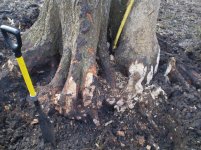
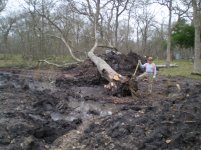
One of my early problems turns out to be top soil removal around large tree roots. My Bota just is not big enough. Since I only have a few trees left to deal with I don't want to bring in bigger equipment yet. I tried cutting big roots out several feet before pushing tree down and it works great. Yup more work but working with a shovel and axe is good exercise for an old man. Picture is my worst case, two big trees in same spot. Lots of chain, rope and two tractors to pull should get the job done
Attachments
radioman
Super Member
ctpres- is that a maple tree ? if so, you are in trouble. There are tap roots underneath the tree that goes more then 6 feet down. It took me 2 days with a bota BH and my fathers massey to dig it out and took two of us to topple it. chopping the roots on the side is good, but you need to remove all the dirt around it first to expose the bottom of the tree to see what I mean.
dave1949
Super Star Member
One of my early problems turns out to be top soil removal around large tree roots. My Bota just is not big enough. Since I only have a few trees left to deal with I don't want to bring in bigger equipment yet. I tried cutting big roots out several feet before pushing tree down and it works great. Yup more work but working with a shovel and axe is good exercise for an old man. Picture is my worst case, two big trees in same spot. Lots of chain, rope and two tractors to pull should get the job done
I took out a maple about the size of the one in your pic. It had a double trunk too. I dug and pushed for a long time. Finally ended up with a crater with a still very upright tree in the middle
Could not figure out why I could not get the thing loose.Eventually I got to the 'root' of the problem. The tree roots were grown around a rock so big, all I could do is push it in low gear. Fortunately, it was sandy soil or the tree might still be there.
You just never know.
Dave.

firefighter9208
Platinum Member
Pond = firewater = lower insurance. Now that is a winner. Thanks Bartcephus.
It's not that easy. I wish it was.
You have to install a dry hydrant dryhydrants.com: Mainstream Dry Hydrants Home Page. . You also have to have the hydrant "engineered" and the pond has to pass a 100 year drought survey before ISO (Insurance Services Organization) will recognize it as a water source. ISO is the company that rates fire departments. You also have to have a road built to within 10 feet of the dry hydrant that will support a fire truck (30,000# to 50,000#) 365 days out of the year.
I've been in the fire industry (as a volunteer in a rural dept) for 19 years so I am speaking from experience.
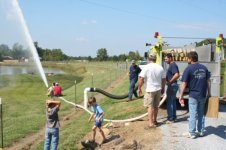
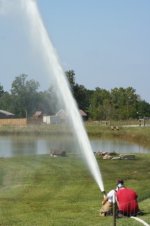
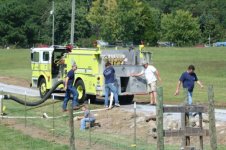
Here are some pictures of the dry hydrant that we have in our pond. The driveway runs right against the pond. It cost about $1000.00 to install and I did all the work myself. That's me stepping over the suction hose in the first picture.
My suggestion is to check with your local department before you spend your money.
Chris
Attachments

Thanks Firefighter9208. Looking at pic's I couldn't see $1,000. until I followed your link. As usual anything related to fire prevention, detection and fighting has big dollar signs. My business does a lot of fire alarm installation, service and testing and once you understand everything, it all make sense. I will check with local AHJ/vol. fire dept. I really like the idea and will probably do it with or without official approval just so I can have an easy way to pump water for other uses.
firefighter9208
Platinum Member
I may be off a little on the pricing, but by the time I bought 100' of 6" schedule 40 pipe ($5.00 a foot) , the strainer and stand assembly ($100.00) for the end of the pipe, several 6" couplings ($17.00 each) , a 6" 90 ($35.00) and the dry hydant head ($200.00) it came in close to $1000.00.
You have to glue the pipe. You can't use the bell ends with rubber gaskets, because you are using the fire engine to create a vacuum in the pipe to move the water. The rubber gasketed pipes are for pressure applications.
The general contractor that was re-claiming the pond let me use his Komatsu excavotor to dig the trench for the dry hydrant so I didn't have to pay for that part.
Chris
You have to glue the pipe. You can't use the bell ends with rubber gaskets, because you are using the fire engine to create a vacuum in the pipe to move the water. The rubber gasketed pipes are for pressure applications.
The general contractor that was re-claiming the pond let me use his Komatsu excavotor to dig the trench for the dry hydrant so I didn't have to pay for that part.
Chris
This pair of trees turned out to be a major project. It rained resulting in more fun. Lots of shovel and axe work to get these two down. Finally dug deep enough to flood base and soften soil around remaing roots under base. At 65' high I didn't have enough chain to safely pull with tractor. Attached 1 ton cable winch to nearby tree and every few hours I'd crank it a few more notches. It finally fell sometine wed. night. Never got to see the big event-sound asleep. More rain today so top soil removal on hold.
Attachments

andrewj
Platinum Member
I guess I need to find new ways to spend money as all the $ I am out on my half acre pond so far is 1000 bucks in fuel and a small dozer repair.
CTPRES:
We are in the excavating business, among other things, - - - - - hire someone who builds ponds and knows what he is doing!!!!!!! Don't try it on your own!!!!!!! Even without knowing much about your situation, there are many things to consider, design of primary spillway, secondary spillway, compaction, regulatory requirements, safety (moving that much material with that type of equipment takes time, time results in fatigue, fatigue may lead to mistakes), etc., etc.
Our farm is in Ohio, and it has to be easier to build a pond in Texas than in the hill country of Ohio. However, I find it amazing that people talk about building a pond for a few thousand dollars and in a few days. That is probably possible in the ideal location, but it isn't the case in instances. In fact, I often wonder if those people have ever built a pond. Or, did the build a mud hole?
For example, last year I built a pond on my farm with OUR employees and OUR equipment (750 JD dozer, 850 JD dozer, 160 JD excavator and a BOMAG for compaction). We had to construct a deep pond due to the lay of the land (ended up 17-18 feet deep) and it wasn't a dug pond like you would probably have. It was an impoundment with a dam. Quality fishing was important to us so we built structure and did a few extras. In the end, the pond was a little over an acre in size, we moved the 750 dozer and the excavator in on August 9. We took the 850 over two weeks later after the grub work and key were well under way. I pulled the equipment out the first week of November with a total cost of $65,000 - - - - and keep in mind that we owned the equipment and paid the employees thier regular hourly rate. In the end, we had approximately $ 30,000 in diesel fuel - - - the 850 alone burns 100 gallons of fuel a day.
I would think two or three times before I started to build any pond with a compact tractor. Just my two cents.
radioman
Super Member
This pair of trees turned out to be a major project. It rained resulting in more fun. Lots of shovel and axe work to get these two down. Finally dug deep enough to flood base and soften soil around remaing roots under base. At 65' high I didn't have enough chain to safely pull with tractor. Attached 1 ton cable winch to nearby tree and every few hours I'd crank it a few more notches. It finally fell sometine wed. night. Never got to see the big event-sound asleep. More rain today so top soil removal on hold.
Huh!! who would have thought? That was a dandy idea. get the tree area wet and apply tension and crank it and leave it.
One more bit of knowledge under my belt for future!Congrats on getting the tree down easy and cheap! now the real work begins- cutting it up and getting it out of there in the MUD!!
Rain and more rain so lots of time to think about moving 500 to 750 yards of dirt. Three combinations come to mind, keeping it cheap of couse!
Option one-FEL and dirt scoop. This option would be pretty fast but not a lot of dirt moved per trip. The good side of this one is dirt well placed and somewhat smoothed after dumping and no need to leave seat.
Option two-FEL and small trailer using FEL to dump it. More dirt per trip but more time spent messing with trailer.
Option three- FEL and dump trailer, something like King Kutter 1.5-DT-XB. Most dirt per trip but also most expensive.
Equipment cost per option. One $375, Two $25 (for parts) and Three $2,000
I really need to explain option two. I think I can also do this one without leaving seat. Have very old med. duty 4X5 trailer. Weld rear facing tow hook on top front of hitch and loop a chain under FEL. Using quick hitch to move trailer and fel/chain to grab and dump trailer.
Just thinking outloud, any comments?
Option one-FEL and dirt scoop. This option would be pretty fast but not a lot of dirt moved per trip. The good side of this one is dirt well placed and somewhat smoothed after dumping and no need to leave seat.
Option two-FEL and small trailer using FEL to dump it. More dirt per trip but more time spent messing with trailer.
Option three- FEL and dump trailer, something like King Kutter 1.5-DT-XB. Most dirt per trip but also most expensive.
Equipment cost per option. One $375, Two $25 (for parts) and Three $2,000
I really need to explain option two. I think I can also do this one without leaving seat. Have very old med. duty 4X5 trailer. Weld rear facing tow hook on top front of hitch and loop a chain under FEL. Using quick hitch to move trailer and fel/chain to grab and dump trailer.
Just thinking outloud, any comments?
MarkV
Super Member
- Joined
- Apr 7, 2000
- Messages
- 5,698
- Location
- Cedartown, Ga and N. Ga mountains
- Tractor
- 1998 Kubota B21, 2005 Kubota L39
I was looking at your options and had to wonder if the developing pond will stay dry enough to use any of them? We had a drought here that let me get into my pond and it was months before I could access some areas. Never went as far as I wanted. Your photo's looked like that is pretty saturated soil and going to be wet for awhile. I have never found that to be the ideal scenario for moving dirt.
MarkV
MarkV
I was looking at your options and had to wonder if the developing pond will stay dry enough to use any of them? We had a drought here that let me get into my pond and it was months before I could access some areas. Never went as far as I wanted. Your photo's looked like that is pretty saturated soil and going to be wet for awhile. I have never found that to be the ideal scenario for moving dirt.
MarkV
MarkV You are right now it is wet, but it will be very dry by late summer. I am dividing work into two parts, digging and moving. 1- Digging hole and piling dirt near hole. 2- Moving dirt where needed later. Phase one digging, removing topsoil, is underway now. Due to moist soil this is very easy right now, all I do is slice six inch or so off edge by pushing FEL into hole at about 45 degrees. The options I'm working on right now are just to move the dirt after digging.
radioman
Super Member
If you are just trying to get dirt out of the hole and pile it up on a bank for removal later when hole fills up again, I really cant see using anything else but the FEL and toothbar. using a trailer will eat your time and fuel when trying to get dirt out of the hole. The only way to make trailer worthwhile is have a buddy work with you with another tractor. you can load with your tractor and while he drives away to dump it somewhere you go back to scooping more dirt with both FEL and rear scoop and moving it out off the hole, waiting for your buddy to come back.
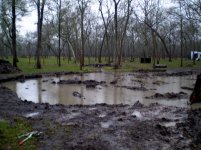
All the recent rain gave me a chance to test the water level. Now I have some idea as to how much dirt needs to be removed on the bank. End result will be a slope that can be safely mowed right to the waters edge with a zero turn. Top soil removal about 1/3 done. Current objective is to remove topsoil, slope shoreline and get something growing around the edges for erosion control
Attachments
radioman
Super Member
good start- is that a stream in the back of pic leading to some sort of a bridge ?
Good eye Radioman. Pond being built around wet weather stream with bridge on downstream end. Bridge is multi purpose. 1. Allows wet weather equipment crossing and 2. Determines water level. Water level will be adjusted by simply raising or lowering material on upstream side of culverts. Plus or minus a few inches the bottom of culverts establishes the wet weather water level and the low ends of dirt approach to culverts will allow for flood relief during very high water flows. This feature was tested sucessfully last week.good start- is that a stream in the back of pic leading to some sort of a bridge ?


