Electrical Trenching

   / Electrical Trenching #21  
That is good news!!!

David Sent from my iPad using TractorByNet
 
   / Electrical Trenching #22  
How about some dynamite on your next big rock that gives you problems. :laughing:
 
   / Electrical Trenching #23  
Since you are getting so good at trenching.... maybe you should consider filling that trench in and starting a new one 10' or so beside it..... :)
 
   / Electrical Trenching #24  
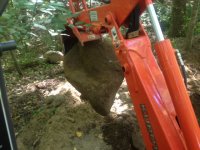
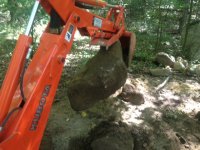
Goodness gracious, those are some big rocks! You are really working for those 256 feet!

I trenched in about 1000' of 2" conduit, 36" down for mainline power service this past year (plus 1" for cable service around 24" down). Two pad-mounted transformers.

And I thought I had it bad sitting on a Ditch Witch RT45 for 12 hours one day going through nothing but mostly red dirt... your project puts it into perspective for me! I didn't hit one single rock. Good job! :thumbsup:

9964987945_a9a7c3208f_z.jpg 9965021624_1d2f7b3809_z.jpg
 
   / Electrical Trenching
  • Thread Starter
#25  
dexpan and a hammerdrill will take care of those large rock issues
I thought of trying that. The problem I have found is drilling the holes. A feather and wedge should work equally well, but I'm finding that drilling the hole takes a huge amount of time (hammer drill and carbide tip drill). I did it on the big rock earlier in the thread and found that when I banged in the wedges that the rock split, but just the top layers around the hole. My theory is a deeper hole was needed, so I got a diamond hole saw, which I heard may be faster. I'll try that on the next one after I get the right drill adapter for it. It sure would be easier!

Goodness gracious, those are some big rocks! You are really working for those 256 feet!

I trenched in about 1000' of 2" conduit, 36" down for mainline power service this past year (plus 1" for cable service around 24" down). Two pad-mounted transformers.

And I thought I had it bad sitting on a Ditch Witch RT45 for 12 hours one day going through nothing but mostly red dirt... your project puts it into perspective for me! I didn't hit one single rock. Good job! :thumbsup:

View attachment 338729 View attachment 338731

I envy your soil! Any project I have that requires any amount of digging ends up with these huge boulders. I've been VERY lucky so far on this project. At any point I could easily encounter a boulder that is far bigger than the tractor and impossible to move. I actually found one in my lawn last year and couldn't even get it to wiggle after excavating it. I figure it weighed 20k lbs. The one I moved last night was probably 8 - 9,000 lbs.
 
   / Electrical Trenching
  • Thread Starter
#26  
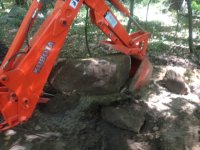
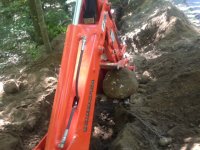
Here is the final resting place of yesterday's rock. It's tough to see because it was dark out when I finished (the work lights on the B2920 work pretty good, the last hour was in darkness). I ended up standing it on it's edge and off to the side so the new trench path will miss it by a small amount. To give some perspective on size the hole it is in is probably 5' deep.

big_rock2.JPG

While digging this out I did make an interesting discovery. Down about 5' deep the soil changes and is much more sandy clay soil with virtually no rocks. Not sure why, but found it interesting that there is such a dramatic change in soil types. Very easy digging if you can get to it!

I had to fill in all of my holes and that part of the trench to secure the rock and get things back on track. This weekend I will retrench the area next to the rock and continue the last 100' at a depth of either 24" or 18" VS the 30 I had been doing. Hopefully I'm out of the rockiest part now.
 
   / Electrical Trenching #27  
Man, that is one monster rock! Nice work! :thumbsup:
 
   / Electrical Trenching #28  
Aerial means running the cable above ground on poles, like the electric company does. As many trees as you have you almost wouldn't notice it. There's pros and cons to each, aerial is subject to ice and falling trees, but it's easy to get at and fix. Buried isn't vulnerable to much except backhoes and post hole diggers, but it's tough to get at and replace.

:laughing: I was sure you meant aerial bombardment! :laughing: But poles would work too!
 
   / Electrical Trenching #29  
Here is the final resting place of yesterday's rock. It's tough to see because it was dark out when I finished (the work lights on the B2920 work pretty good, the last hour was in darkness). I ended up standing it on it's edge and off to the side so the new trench path will miss it by a small amount. To give some perspective on size the hole it is in is probably 5' deep.

View attachment 338817

While digging this out I did make an interesting discovery. Down about 5' deep the soil changes and is much more sandy clay soil with virtually no rocks. Not sure why, but found it interesting that there is such a dramatic change in soil types. Very easy digging if you can get to it!

I had to fill in all of my holes and that part of the trench to secure the rock and get things back on track. This weekend I will retrench the area next to the rock and continue the last 100' at a depth of either 24" or 18" VS the 30 I had been doing. Hopefully I'm out of the rockiest part now.

Now that you have it positioned for blasting post video of you launching it out of the trench!
 
   / Electrical Trenching
  • Thread Starter
#30  
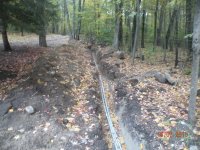
I finished the trenching on Saturday. I'm happy to say that the last 100 feet was MUCH easier. There were sizable rocks, but nothing that took more than 5 minutes to deal with. The digging surface was also level, which is a huge help in terms of positioning the tractor and not pivoting or sliding when doing the work.

The next phase is to backfill a few inches of sand, install conduit and then cover with 12" of sand and caution tape" then I'll pull the wires.

Here are some pics of the final 100' and some of the rocks encountered.
1.JPG
Finally done! The last bit looks nice and uniform since there were so few big rocks, lower down the rocks required wider holes to be dug and backfilled.

2.JPG
A typical rock. At the beginning these took a lot more work to get out. Now they're a minute or two. I've discovered that by clearing off the soil and then using the bucket curl you can often pop them out and then either drag them out or pick them up with the thumb. Using the curl helps reduce the force on the tractor since the ground is the lever, otherwise the tractor is light enough that pulling on a rock like this that's embedded with the whole boom just drags you around.

3.JPG
the last rocky section. All the brown rocks were clustered together in a 5' section and had to be removed one by one.

4.JPG
This is about the max size that can be easily lifted by the BH65. Luckily it's narrow so I can grab it. Obviously bigger rocks can be moved, but they usually can't be fully lifted up and swung like this one.

5.JPG
Another near max size rock

6.JPG
Yet another. It's impressive how much a small BH can move around.

7.JPG
This size rock was everywhere. I probably hit one of these about every 3rd or 4th scoop. Most of them I just tossed and rolled into piles down the slope. Eventually i'll collect them all again and build something. I must have 50+ of these!
 
   / Electrical Trenching
  • Thread Starter
#31  
I haven't posted on this in a while and thought I'd provide a quick update - especially if other folks think about similar projects. In the last few weeks there has been less digging and more loader work. My town uses the NEC rules for electrical code and for this job specifically table 300.5 governs the burial depth, conduit etc. The electrical inspector requires 3 different visits - Raw trench, trench with bedding and conduit and finally trench backfilled 12" with shading material and a warning ribbon run.

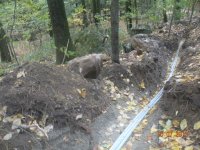
In my case I backfilled with around 10 yards of sand for the first run to create about 6" of bedding depth in the entire trench length. I then installed 3 conduit runs, 2 x 1" and 1 x 3/4". Code dictates that low voltage control wires (a phone cable and video cable in this case) be separate from the high voltage (120v) lines (2 in this case). The third is a spare. The conduit had to be schedule 40 PVC and in my case code required a cover depth of at least 12" (120v GFCI), but deeper is better. In my case the depth ranged from 30" to 18". As a trick to lay the conduit I built 20' sections in the garage and then covered the ends with socks and elastics to avoid getting a rock in it. We will pull 10 gauge wire for the electric to deal with voltage drop.

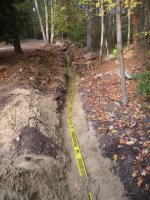
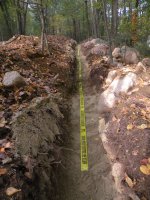
The conduit then needed to be shaded with 12" of sand (about 15 yards) and then marked with warning tape. Based on the huge number of rocks it was recommended that the trench be mostly back filled with sand to avoid issues, so another ~15 yards got it mostly filled. It's worth noting that the B2920 worked perfectly for the backfill, I was able to climb the spoils pile and get enough reach with the FEL to backfill over the pile VS trying to move it around or need access to both sides of the trench. I then pushed back the excavated soil into the trench minus rocks any bigger than about 6" across (per code). The interesting this was that even with the 40 yards of sand I still had low places because of the number of rocks I took out!

The next part of the project is the actual installation of the gate and low voltage control lines and a bore under the driveway to get power and control lines to the opposite side. Then everything can be wired up.

Here are some pictures of the trench work:
DSCN4960.JPG
Conduit on sand bedding
DSCN4963.JPG
Conduit on bedding, it curved nicely on the uphill portion and had more flex than I expected.
DSCN4966.JPG
Shaded with 12" of sand and flagged with warning tape
DSCN4969.JPG
 
   / Electrical Trenching #32  
That looks good! I'm glad you are installing it in accordance with the NEC. Remember you have to be schedule 80 where you emerge from the ground.
 
   / Electrical Trenching #34  
Wow!

I do not own a bh65 for the 2920 but after seeing your work makes me feel a whole lot more confidant in its capabilities!
 
   / Electrical Trenching #35  
Just something quick, maybe run two 120vac lines out (240 between the hots) if they will let you get away with it. be sure to run some pull tape/rope in there with the wires as a leave in for later. best to pull it WITH the wires so they do not twist around each other. Seen pull tape cut thru wires that the tape had been twisted around.

Mark
 
   / Electrical Trenching
  • Thread Starter
#36  
Good job but how do you get your tractor down that trench of boulders?

I backfilled from the side. I put the biggest rocks on one side of the trench, where they'll stay (I'm now moving them into piles for some future project). The other side of the trench closest to the drive had the dirt piles. The B2920 had enough clearance for me to drive up on the dirt piles and then dump the bucket into the trench. It worked out well because 1 bucket is about equal to 6' of trench filled with sand to 12". I just went bucket length by bucket length down it, then leveled with a rake and packed it down. The final backfill was done using the FEL to push the dirt into the trench and the weight of the machine to pack it. For the few areas with dirt piles on the far side of the trench I drove into the trench (front wheels hanging on edge), then lifted the front out with the FEL and back dragged the pile into the trench. It worked out much easier than expected. Now if I could just find someone to buy my rocks by the pound!
 
   / Electrical Trenching
  • Thread Starter
#37  
Quick update - The trenching is done for the gate control system and electric. I dug in an exit and entry trench to 3 - 4' deep so that I could attempt to bore under the driveway. I first attempted it myself using some techniques I read about on-line. I tried to hammer a pipe through (3/4" steel) and not surprisingly - Hit a rock! I bent the pipe with the BH trying to push it through. I tried with a piece of rebar and had the same result. I tried using water pressure via a PVC wand and high pressure nozzle, that got me a few feet, but ultimately I hit a rock.

Out of desperation I started to look into outsourcing the job. A cut in the driveway wasn't desirable (new driveway) and was expensive, plus the contractors are all to busy to hit my time-frame. I then checked into directional boring (a horizontal drill basically) and the setup alone was $2,000. I finally found an irrigation contractor with a pneumatic piercing device who was between jobs. For $250 he came this morning and was able to use the device to get through at 3' deep and put 2" HPDE pipe in. The device was very cool, it uses air pressure to propel a conical metal device that's like a self propelled jackhammer through the hole and works by compressing the soil and pushing or hopefully cracking small rocks.

I'll post some pics later, but it looks like the job is getting to the final stages!
 
   / Electrical Trenching #38  
The device was very cool, it uses air pressure to propel a conical metal device that's like a self propelled jackhammer through the hole and works by compressing the soil and pushing or hopefully cracking small rocks.

Pneuma-gopher is what they call them around here. Short for Pneumatic- Gopher.
 
   / Electrical Trenching #39  
The device was very cool, it uses air pressure to propel a conical metal device that's like a self propelled jackhammer through the hole and works by compressing the soil and pushing or hopefully cracking small rocks

Would love to see pictures of that,, I'm going to have to Google that one,,, :thumbsup:
 
   / Electrical Trenching
  • Thread Starter
#40  
Here is a link to the brochure for the actual tool. http://www.hammerheadtrenchless.com...nguageId=a37c4322-49d1-4151-a78c-6a6b9f17f0fd

It was tough to find someone with it, but one of the drillers was nice enough to give me suggestions and said to try calling the local ditch witch as they rent the tools. When I talked to them it turned out training was required and the rental was expensive, but they gave me names of contractors who purchased the tools that were local and they were able to recommend a couple companies. Very cool tools, but apparently they can be tough to control over long distances and if you lose it you're out big $$. Rental looks to run a few hundred per day...
 

Tractor & Equipment Auctions

2019 Jeep Grand Cherokee SUV (A59231)
2019 Jeep Grand...
2008 CAT D6T DOZER (A58214)
2008 CAT D6T DOZER...
1454 (A57192)
1454 (A57192)
gps trailers (A56859)
500 BBL FRAC TANK (A58214)
500 BBL FRAC TANK...
2009 PETERBILT 340 WATER TRUCK (A58214)
2009 PETERBILT 340...
 
Top