any theories from you guys on why log splitter wedges are shaped the way they are? it seems to me that rather than have a straight vertical sharpened edge, the wedge would require much less force to 'start' the split if the front edge were to have a more arrow-point shape (not as pronounced, of course, maybe 10-20 degrees of tilt ). the force to start the split would be reduced by having a 'pointy' wedge. watching splitters operate, there is the initial 'pop' to start the splitting action, probably the first inch of the stroke, followed by the spreading action which takes much less force. i compare it to cutting a piece of steak with a knife. pushing straight down with the knife doesn't work and would require a large force, but using the point of the knife to pierce the steak is easy. i've seen forged steel wedges on splitters but they, too, have vertical cutting edges. but i have seen 4-way drop-on wedges that have the wings tapered back. why not the main cutting edge? any theories other that cost to manufacture?
You are using an out of date browser. It may not display this or other websites correctly.
You should upgrade or use an alternative browser.
You should upgrade or use an alternative browser.
log splitter wedge design
- Thread starter wowbw7
- Start date
- Views: 66710
More options
Who Replied?
/ log splitter wedge design
#1

mwb
Platinum Member
I don't know what you would do if you stuck an arrow shaped wedge into a tough old twisted piece and go it stuck. At least the straight wedge will not penetrate to the point that you can't remove it. Kind of like trying to split wood with a limbing axe.
I think that if the machine does not have enough force to split with the straight wedge then the arrow point will not gain you anything except having to burn your firewood on the splitter.
Also, the straight wedge will allow you to split any diameter of wood; using a pointed wedge means you have to suspend smaller or odd shaped pieces until it has been penetrated. Sounds like a good opportunity for a crushed hand.
I think that if the machine does not have enough force to split with the straight wedge then the arrow point will not gain you anything except having to burn your firewood on the splitter.
Also, the straight wedge will allow you to split any diameter of wood; using a pointed wedge means you have to suspend smaller or odd shaped pieces until it has been penetrated. Sounds like a good opportunity for a crushed hand.

denmansoft
Gold Member
Theory:
angled or pointed leading edge would allow or cause, some peices of wood to move or slide until the cutting edge has dug in. You don't want it moving once the pressure starts to build.
angled or pointed leading edge would allow or cause, some peices of wood to move or slide until the cutting edge has dug in. You don't want it moving once the pressure starts to build.

bjcsc
Platinum Member
- Joined
- Feb 20, 2007
- Messages
- 559
- Location
- Johns Island, SC
- Tractor
- JD 5225, JD 555B, JD 333E, JD 225DLC
any theories from you guys on why log splitter wedges are shaped the way they are? it seems to me that rather than have a straight vertical sharpened edge, the wedge would require much less force to 'start' the split if the front edge were to have a more arrow-point shape (not as pronounced, of course, maybe 10-20 degrees of tilt ). the force to start the split would be reduced by having a 'pointy' wedge. watching splitters operate, there is the initial 'pop' to start the splitting action, probably the first inch of the stroke, followed by the spreading action which takes much less force. i compare it to cutting a piece of steak with a knife. pushing straight down with the knife doesn't work and would require a large force, but using the point of the knife to pierce the steak is easy. i've seen forged steel wedges on splitters but they, too, have vertical cutting edges. but i have seen 4-way drop-on wedges that have the wings tapered back. why not the main cutting edge? any theories other that cost to manufacture?
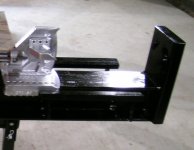
You are correct about it being way more efficient. The sliding problem is solved by a tip at the top. This style of wedge has been around awhile. Here's a pic of the business end of mine, notice the wings and main edge:
Attachments
bjcsc
Platinum Member
- Joined
- Feb 20, 2007
- Messages
- 559
- Location
- Johns Island, SC
- Tractor
- JD 5225, JD 555B, JD 333E, JD 225DLC
now that makes sense. so is cost the reason for not using this design? too expensive to machine the curved edge?
I don't know, but I doubt it. I built mine myself, but the wedge is nothing exotic - just this kit from Northern Tool...
That said, it does work very well!
SPYDERLK
Super Star Member
- Joined
- Feb 28, 2006
- Messages
- 12,536
- Location
- VA
- Tractor
- JD2010, Kubota3450,2550, Mahindra 7520 w FEL w Skid Steer QC w/Tilt Tatch, & BH, BX1500
I built my moving wedge with a "point" directly in line with the ram. The wedge cutting edge tapers back about 1/2" above and below this. It works well and with 18T splits everything. I do notice tho, that the point starts the split and then very often the top of the wedge does not enter the split but instead enters next to it causing a sliver to split from the main part. Im sure the point is a benefit in starting the split, but I cant tell that its needed, and the slivers are a bit frustrating unless you need plenty of kindling.any theories from you guys on why log splitter wedges are shaped the way they are? it seems to me that rather than have a straight vertical sharpened edge, the wedge would require much less force to 'start' the split if the front edge were to have a more arrow-point shape (not as pronounced, of course, maybe 10-20 degrees of tilt ). the force to start the split would be reduced by having a 'pointy' wedge. watching splitters operate, there is the initial 'pop' to start the splitting action, probably the first inch of the stroke, followed by the spreading action which takes much less force. i compare it to cutting a piece of steak with a knife. pushing straight down with the knife doesn't work and would require a large force, but using the point of the knife to pierce the steak is easy. i've seen forged steel wedges on splitters but they, too, have vertical cutting edges. but i have seen 4-way drop-on wedges that have the wings tapered back. why not the main cutting edge? any theories other that cost to manufacture?
larry
so BJCSC, in your opinion, would it make sense to you, for me to buy one of Northern Tools' 10 inch wedges and grinding it to a profile similar to the one you have? I'm building a splitter in the spring and i want to get it right the first time, while trying to keep costs down .
Cord
Veteran Member
I don't know if you need to think about this so much. We're talking about the power of hydraulics here. If you select a 4" cylinder and decent parts that will push to 3,000psi, you'll have more than enough power. If you buy cheap parts that can't produce pressure, then you need to get inventive with your wedge design.
Personally, I hate slow splitters. While using my dad's painfully slow $800 splitter, I got to thinking about the process of splitting. I thought to myself "why do people think of log splitting like they are trying to split the wood with a wedge and maul?" The more I thought about it, the more I like the idea of trying to extrude the wood, instead of splitting it. Yep, I built a wood extruder, not a splitter! The first time my neighbor saw my creation, he immediatly dismissed it, saying "that'll never work!" Oh, how wrong he was! The head that I built is around 16" wide. It first splits the wood horizontally and then splits the bottom half 3 more times. For each pass of the splitter I get 4 pieces of wood. When the push plate cycles back the area is clear and I slide the nsplit half back. No having to catch and hold pieces so you can resplit them. To run this splitter you must have a 5" ram and 3,000psi of pressure. Anything less, won't work. Using it on dry wood (elm, oak, maple, hickory, etc), it has never jammed. I have jammed it with green box elder though (not my wood). Is it fast? **** yea! This splitter requires 3 people to operate. One works the controls and positions the pieces. Another brings the chunks in and the third person clears the splitter of pieces. Everybody is always busy. If you wanted to stack the pieces, you'd need a 4th person because there isn't enough time to stack. With this splitter we managed to split 14 full cords of wood in 2 long days.
Personally, I hate slow splitters. While using my dad's painfully slow $800 splitter, I got to thinking about the process of splitting. I thought to myself "why do people think of log splitting like they are trying to split the wood with a wedge and maul?" The more I thought about it, the more I like the idea of trying to extrude the wood, instead of splitting it. Yep, I built a wood extruder, not a splitter! The first time my neighbor saw my creation, he immediatly dismissed it, saying "that'll never work!" Oh, how wrong he was! The head that I built is around 16" wide. It first splits the wood horizontally and then splits the bottom half 3 more times. For each pass of the splitter I get 4 pieces of wood. When the push plate cycles back the area is clear and I slide the nsplit half back. No having to catch and hold pieces so you can resplit them. To run this splitter you must have a 5" ram and 3,000psi of pressure. Anything less, won't work. Using it on dry wood (elm, oak, maple, hickory, etc), it has never jammed. I have jammed it with green box elder though (not my wood). Is it fast? **** yea! This splitter requires 3 people to operate. One works the controls and positions the pieces. Another brings the chunks in and the third person clears the splitter of pieces. Everybody is always busy. If you wanted to stack the pieces, you'd need a 4th person because there isn't enough time to stack. With this splitter we managed to split 14 full cords of wood in 2 long days.
Attachments
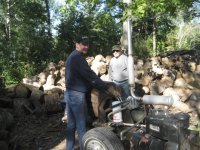
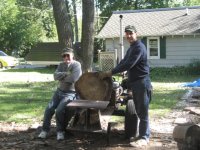
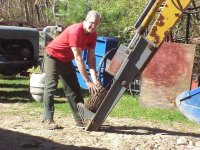
that's quite the rig you've got there. i'm sure it works well for you but in my case i'm trying to get all the info i can on improving or modifying a copy of the one pictured. my backhoe bucket has a 4-1/2" cylinder, 27" stroke, but i'm not sure on the psi...maybe between 2500 and 3000. the cost, with new metal, should be about $300. were cost no object, i'd have a 30 ton unit sitting in my shop, but such is not the case. but where's the fun in 'buying' when you can 'build' , right?
Attachments

WilliamBos
Super Member
- Joined
- May 1, 2004
- Messages
- 5,360
- Location
- Innisfil, Ontario, Canada
- Tractor
- MF 1635 12x12 Powershuttle
Thus design seems to work well. Be interesting to see how long it stays sharp, and how long the wedge lasts.


Berniep
Platinum Member
I have been thinking a lot lately about building something like that. Did you use any kind of special steel in the blades? Maybe hardfacing rod on the leading edges? Did you angle them at all to prevent wedging?For each pass of the splitter I get 4 pieces of wood. When the push plate cycles back the area is clear and I slide the nsplit half back. No having to catch and hold pieces so you can resplit them.
denmansoft
Gold Member
I've been looking at various designs.
One thing I've seen is some log splitters have a moving wedge and fixed block to push against. Others have a moving pusher block and fixed wedge.
The fixed wedge idea seems to be self unloading, at least for a while, until the pile gets big. Also if a peice doesn't split clean the next peice will just push it through.
The moving wedge you would have to clear your input area each time?
Any other thought on this?
One thing I've seen is some log splitters have a moving wedge and fixed block to push against. Others have a moving pusher block and fixed wedge.
The fixed wedge idea seems to be self unloading, at least for a while, until the pile gets big. Also if a peice doesn't split clean the next peice will just push it through.
The moving wedge you would have to clear your input area each time?
Any other thought on this?

Bill Barrett
Platinum Member
- Joined
- Jul 11, 2006
- Messages
- 671
- Location
- midwest
- Tractor
- Kubota L3130, Satoh G650, Case 580, Case 446
I've been looking at various designs.
One thing I've seen is some log splitters have a moving wedge and fixed block to push against. Others have a moving pusher block and fixed wedge.
The fixed wedge idea seems to be self unloading, at least for a while, until the pile gets big. Also if a peice doesn't split clean the next peice will just push it through.
The moving wedge you would have to clear your input area each time?
Any other thought on this?
I like wedge on ram, that way you don't have to bend down and pick up wood to split again.
On large logs I split up to six times. Wood will stay on beam, back up, and split again.
Cord
Veteran Member
I have been thinking a lot lately about building something like that. Did you use any kind of special steel in the blades? Maybe hardfacing rod on the leading edges? Did you angle them at all to prevent wedging?QUOTE]
The steel is regular A-36 1/2" plate. I put a very sharp edge on the plates and did hardface the edge so it would stay sharp. The plates must splay apart or the wood will wedge. My first design did not splay the plates enough and it took too much power to split the wood. You can see how much the throat opens up in my current design.
skidsteer.ca
Gold Member
I don't know if you need to think about this so much. We're talking about the power of hydraulics here. If you select a 4" cylinder and decent parts that will push to 3,000psi, you'll have more than enough power. If you buy cheap parts that can't produce pressure, then you need to get inventive with your wedge design.
I agree
The wedge does not need to be anything other then straight. Mine works fine on a 4" ram. Its not overly sharp either, about 1/16" wide on the front edge. You can cut a piece of 5" ash cross grain if you like, just shear it off. And my relief is set at 2250 psi, relatively low.
I also favor the moving wedge for re splitting without doing anymore then turning the block 1/4 turn. Yes you have to clear that area manually but I favor that over picking the pieces off the ground. Mine has a stripper on it incase the block sticks to the wedge, when you retract the ramit strips it off. I usually throw the pieces across the splitter into my loader bucket and grab the next round while the ram retracts. Every 15 blocks or so I go straighten up the wood in the bucket. (my 4 year old is not alot of help yet
The self clearing of the fixed wedge design would not last too long. A table on that style is a good idea, but works best with a helper, as the splitter would have to move himself from the splitting area to the table to clear it.
I put a table across from the splitting area on mine, so large blocks get split in 1/2, the one 1/2 sits on the table while I split the other 1/2 a couple more times and fire it into the bucket. then I don't have to pick the 2nd 1/2 up from the ground again. I hate working at my feet.
Ken

F.L. Jennings
Bronze Member
I added 3" to the height of my wedge this past weekend. I split a lot of Hickory and it is very fibrous. When I am splitting larger stuff 18"-24" the splitter will push it through the wedge but the part of the wood above the top of the splitter wedge often has many uncut fibes that hold the two halves together. I've had to cut these with an ax or hatchet to part them in the area that was avove the wedge.
I'll still have to do that on some larger pieces but now the overall height is about 15-16".
Make your wedge tall enough unless you are splitting much smaller wood.
I'll still have to do that on some larger pieces but now the overall height is about 15-16".
Make your wedge tall enough unless you are splitting much smaller wood.
wedge height was another concern i had, but 16".... wow! i was torn between 8 and 12 inches.
i, too, plan on incorporating a 'stripper' on each side of the wedge to un-stick the ones while the wedge retracts.
F L, did you catch my idea on your other post on the adjustable cables?
i, too, plan on incorporating a 'stripper' on each side of the wedge to un-stick the ones while the wedge retracts.
F L, did you catch my idea on your other post on the adjustable cables?



