LPGS For Kubota B2910

/ LPGS For Kubota B2910
  • Thread Starter
#101  
Here's another little tidbit to throw into the mix, although I haven't seen anyone do it ...

I have the capability to add an additional 3' of "wheelbase" to the LPGS ... with minimal weight and no essentially additional ground resistance:

I have a pair gauge wheels mounted on a pair of arms that I built for my box blade and landscape rake. They are fairly hefty ... the mounting plates are either 3/8" or 1/2" plate and the tubes are 2" x 1/4" wall square tube. Wheels/tires might need beefed up a little tho' ...
 
/ LPGS For Kubota B2910 #102  
Everyone will have a different way to build a lpgs, and there are many designs that will work satisfactorily. You can easily see that the two I built have different shapes and materials used to build the skids. I use my lpgs quite a lot from driveways, lawns to open fields. I have picked up a few things that help with their use and will add some changes to subsequent builds. The more you use one the more important the subtle differences make.

Of all the home built designs I have seen on TBN so far I like Gordon Gould's and my own the best. When I build another one it will combine some of the features of both Gordon's and mine. Just my opinion.

My opinion on a few points discussed in this thread, you can take them or leave them.

Skid length, short skids will work but not as well as longer skids. Motor graders have a long wheel base for a reason and the same principle applies here. There is a huge difference in how smooth you can get a driveway or field depending on how long the skids are.

Blade setting is another point of interest, if all you ever do is work a gravel driveway you could set the blades 3/4" below the skids and leave them there (fixed). This would give you slightly better mixing of the fines and larger rock. If you do fine or precision grading and packing, the blades are better set flush, this keeps you from moving material that is where it should be. Before packing the ground or driveways a lpgs with the blades 1/2" above the skids will still churn up a full load of gravel very quickly because the skids will dig in the loose materials. As you pack the surface down the skids tend to ride on the surface and you move less material. The reason I choose to set my blades flush with the bottom of the skids is simple, it works on both loose and packed surfaces without a need to adjust the height.

Grader blades are not all the same. A good quality, heavy duty blade will cost more than a soft, thin and short one. You can pick either a single edged or double edged reversible blade as long as it is mounted properly it will work. The better quality blades will last longer than the cheap thin ones, take your pick. I agree with Richard (overszd) that you should mount the blades to their support before mounting. I found that 3" angle did not have enough room to allow the plow bolts and nuts to be tucked under the edge enough to prevent wearing the nuts down, 4" angle was a better fit and is what I suggest. The plow bolts are 5/8" and require these holes to be the same size and you need enough clearance to get a socket on the back side to tighten them. Once you have the angle iron and blades made up you can choose the height you want to install them.

How far forward you set the skids is a consideration, when I built the smaller lpgs for the garden tractor I took this and the height of the limited category 1 hitch into consideration. I use a 12' trailer with a fold down tailgate to transport and made sure that it would fit inside, just enough room.

Size of the overall land plane, you don't want to struggle too much pulling it and have your tires spin. This is a finishing tool and if you spin the tires you have a hole to fill in. Better to have one you can pull a little easier and faster, you can get the same amount of work done in the same amount of time. A 54" or 60" width with long skids is what I would recommend for the 2910. With the optional tail gate similar to Gordon's design the overall weight should be in the 700 lb. range and is all you want to handle.

Here are a few pictures of the 4' and 8' land plane grader scrapers I built

Hi,

It looks like your little plane has the blades set on something like a 45 degree angle, and that the blades on the larger one are set more vertically.

Do you recommend one over the other, and why?

Thanks as always for the excellent information and even more pictures of your builds.
Thomas
 
/ LPGS For Kubota B2910 #103  
Hi,

It looks like your little plane has the blades set on something like a 45 degree angle, and that the blades on the larger one are set more vertically.

Do you recommend one over the other, and why?


.

Thanks as always for the excellent information and even more pictures of your builds.
Thomas

Thomas, thanks for the nice comments.

Probably an optical illusion as both lpgs have the same grader blades and the mountings are both set at 45 degrees The larger plane has 5/8" thick x8" flatbar for the blade mounting and has two 3x3 angles added to box in and add rigidity.

I sold the 4' land plane and older pine straw rake today. So I will be building a new lpgs with some improvements and a new EA pine straw rake will be ordered.
 
Last edited:
/ LPGS For Kubota B2910 #104  
I wound up out of town tonight but was able to sketch up a simple pin joint drawing for the level acting blade carrier. Hope it makes sense as I did not have my computer with me and just a paper tablet and ruler to work with.

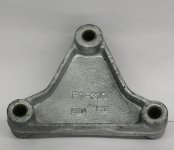
If I were to build this I would likely combine the cylinder rod connection with the pin joint pieces in front. A good way to do this that would be sturdy would be to use four of the trailer equalizers common on tandem axle trailers. Those triangular equalizers are about the correct size and could utilize the top hole for the cylinder rod. The lower front pin joint could connect to the skid. The lower rear pin joint could connect the adjustable blade carrier. The rear pin for the blade carrier joints do not need to connect to the cylinder, so only the lower holes would be used. Four identical equalizers would hold the alignment and are relatively cheap to buy.
 

Attachments

  • 20160506_223041.jpg
    20160506_223041.jpg
    1.6 MB · Views: 339
/ LPGS For Kubota B2910 #105  
Here is a sketch and picture of an equalizer to clarify what I meant in the above post.

You would have to make sure this was set up with the cylinder stop to prevent it from running over center and dropping down to far.
 

Attachments

  • 20160506_233510.jpg
    20160506_233510.jpg
    2 MB · Views: 593
  • 6_x_4_Galvanized_Equalizer__23692.1439585565.1280.1280.jpg
    6_x_4_Galvanized_Equalizer__23692.1439585565.1280.1280.jpg
    31.2 KB · Views: 139
/ LPGS For Kubota B2910
  • Thread Starter
#106  
I wound up out of town tonight but was able to sketch up a simple pin joint drawing for the level acting blade carrier. Hope it makes sense as I did not have my computer with me and just a paper tablet and ruler to work with.
Thanks.

Yeah ... nope, it makes total sense ... (pictures are always good ... :laughing:)

If I were to build this I would likely combine the cylinder rod connection with the pin joint pieces in front.
Keep in mind I just woke up, only had 5 hours of sleep, and am still working on the first cup of coffee ... but:

Why ?

Looking to understand the thinking behind it.

It seems to me that doing so would require either: 1. two cylinders (which might not be a bad thing, other than the cost), or 2. a bunch of steel (weight) to make the linkage to make the connection (if only using one cylinder)

What advantage do the triangular pieces with three connection points provide over just the four pieces of barstock you posted in the first picture ?

A good way to do this that would be sturdy would be to use four of the trailer equalizers common on tandem axle trailers. Those triangular equalizers are about the correct size and could utilize the top hole for the cylinder rod.
I'd have to do a bit more searching - and admittedly I just took a quick look at the results from Google - but most of what I found seemed pretty undersized.

All of them had bolt holes of only 9/16" ... which seems way small to me ... and they look like cast metal ...

I don't think I'd want to go with less than 1" pins ... minimum ...

The lower front pin joint could connect to the skid. The lower rear pin joint could connect the adjustable blade carrier.
If you were to swap the lower holes around for the connection to skid and the blade carrier - skid connection in the rear and blade carrier in front - the cylinder would be extending rather than retracting when it was lowered, and would be exerting more force ... although maybe more force would be needed to pull the blades back up out of the ground on the fly once they have dug in and are cutting ... :scratchchin:

The rear pin for the blade carrier joints do not need to connect to the cylinder, so only the lower holes would be used.
Right.

Four identical equalizers would hold the alignment and are relatively cheap to buy.
They also wouldn't be all that hard to make ...

Just some plate or barstock, cold roll solid round for the pins, and some D.O.M tubing or seamless pipe for the pin bushings.

Tack the 4 plates/barstock together, stick 'em in the drill press and punch the holes for the bushings and then weld the bushings in ...

The PITA for me would be doing the holes in the C-channel ... man-handling those up into the drill press mostly.

And doing so would allow some customization, as far as the relationship of the three pivot points in the triangle (or two points if using a simple lever) - which would determine the (amount of) range of motion and/or leverage.

Overall, I like the general concept - obviously, having the blades act in parallel is far more ideal than not ...

Good job ... :thumbsup:
 
/ LPGS For Kubota B2910 #107  
I would definitely use a cylinder on each side, much better to support each blade carrier mount. Looking at it this morning the first drawing does make more sense. I would have to think about it a little more and make some refinements before building but the general concept is there. For instance I would have to consider whether the two front cylinders need to be connected together to keep them in alignment. Don't let the equalizers get in the way of the general idea they may not be as good a solution as I thought. I prefer to work with the drawings to finalize everything before I start cutting and building.

Drilling holes, I have always found that good bits are the key. I have a small drill press 1hp floor model 20" throat that is better suited for woodworking than metal. Sometimes it is more trouble to use than a cordless drill. That said when I drilled out the 5/8" holes for the grader blades last time I used a good bi metal hole saw and a small 1/8" pilot bit from cnc machines. Those little cnc bits are really sharp and drill right through the thick plate. The 8' grader blades were clamped in place on the assembly and provided their own guides for the holes. I drilled these out with a corded drill as I remember.

For a home shop set up the hole saws work better than most would expect. Not like having a real machine shop but they do get the job done for these simple projects. Cutting oil or fluid helps a lot and I am liberal with it.
 
/ LPGS For Kubota B2910 #108  
Thomas, thanks for the nice comments.

Probably an optical illusion as both lpgs have the same grader blades and the mountings are both set at 45 degrees The larger plane has 5/8" thick x8" flatbar for the blade mounting and has two 3x3 angles added to box in and add rigidity.

I sold the 4' land plane and older pine straw rake today. So I will be building a new lpgs with some improvements and a new EA pine straw rake will be ordered.

Hi,

Thanks for the kind reply, I did see where you said they were both at 45 deg, but the larger one so clearly looked vertical, I had to ask...
 
/ LPGS For Kubota B2910
  • Thread Starter
#109  
I would definitely use a cylinder on each side, much better to support each blade carrier mount.
Would hopefully solve any tendency for the blades to fail to want to lower or dig in ... or to tend to rack.

Doubles the cost for cylinders and hoses and adds weight however.

Looking at it this morning the first drawing does make more sense.
It's the (seemingly) less complex design (imho) ... unless there is a specific reason to have a more complex mechanism - and there very well could be, but I'm not aware of it at this point (admittedly I've been busy with other stuff and haven't spent much time thinking about it) - I'd think that simpler might be better.

I would have to think about it a little more and make some refinements before building but the general concept is there.
Yup.

For instance I would have to consider whether the two front cylinders need to be connected together to keep them in alignment.
Connected together hydraulically ?

I'd think so ... because using a single lever to control the depth-of-cut would be more convenient ... not to mention the fact that independent control of two cylinders would have a tendency to make the blade carrier mechanism want to rack out of square/parallel.

Don't let the equalizers get in the way of the general idea they may not be as good a solution as I thought.
No worries ...

I was ready to move forward with the first design ... unless I heard a good reason to do otherwise ... :D

I prefer to work with the drawings to finalize everything before I start cutting and building.
Ideally I do too ... but there often seems to be something that was unanticipated that comes up or is discovered along the way that necessitates a change in plans.

Often times that has unintended consequences, usually of a bad variety.

Drilling holes, I have always found that good bits are the key. I have a small drill press 1hp floor model 20" throat that is better suited for woodworking than metal.
Sounds similar to the Sears one I have ... really doesn't go slow enough for the larger sizes.

Sometimes it is more trouble to use than a cordless drill.
If it's a large and heavy piece same deal here, although I'm old school ... most of my drills have cords attached ... :D

Having a mag drill would be really nice. If I had to guess, I'll bet my next door neighbor carries one on his work truck.

That said when I drilled out the 5/8" holes for the grader blades last time I used a good bi metal hole saw and a small 1/8" pilot bit from cnc machines. Those little cnc bits are really sharp and drill right through the thick plate. The 8' grader blades were clamped in place on the assembly and provided their own guides for the holes. I drilled these out with a corded drill as I remember.
Right.

If I can, I'll usually tack pieces together and drill them and then just grind the tacks off after I'm done.

For a home shop set up the hole saws work better than most would expect. Not like having a real machine shop but they do get the job done for these simple projects. Cutting oil or fluid helps a lot and I am liberal with it.
Yup ... I've got either a plumber's or electrician's set of Lennox bi-metal hole saws - can't remember which - with some fill-ins for (some of) the missing sizes ... all of them are still cutting pretty decent. Also have a (fairly) cheap set of Silver and Deming bits from Enco for up to 1 1/2".

BTW ... I spent a good bit of time dragging around my home-built 80" landscape rake over wet, greasy ground yesterday ... and I'm about convinced to go with a 60" width on the LPGS. The lack of loaded rears and/or wheel weights was just causing too much loss of traction.

Might have to investigate "quick-attach" wheel weights for the rear as an upcoming project ... :rolleyes:
 
/ LPGS For Kubota B2910 #110  
rswyan,
When I say connect the cylinders together I meant mechanically. Really boils down to keeping these front flat bars in alignment with each other. This is needed to keep the blade straight and with that in mind you could use a single cylinder in the middle if everything is sized correctly. This is similar in function to the torque tube on most fels.

Perfect example why I prefer to draw it out first and debug before building.
 
/ LPGS For Kubota B2910
  • Thread Starter
#111  
rswyan,
When I say connect the cylinders together I meant mechanically. Really boils down to keeping these front flat bars in alignment with each other. This is needed to keep the blade straight and with that in mind you could use a single cylinder in the middle if everything is sized correctly. This is similar in function to the torque tube on most fels.
Got it ... thanks.

Perfect example why I prefer to draw it out first and debug before building.
Yup.

The application that I'm modeling in doesn't have inverse or forward kinematics (old version) so it's hard to check the action of the mechanism and the range of motion. Might have to take it into the other software that I used to for rendering and animation which I believe does.

I would think that it would be ideal to get as large a height adjustment as possible.
 
/ LPGS For Kubota B2910
  • Thread Starter
#112  
By my estimates I'm currently at 641 lbs with the new width. That includes the runners, side plates, 3PH frame, tailgate and angles for the blade carriers - including cutting the angles for the carriers down to 4" x 3 1/2", instead of leaving them 6" x 3 1/2".

It does not include any pins, bushings, hydraulic cylinders, hoses, or the steel for the mechanism to raise/lower the blades and the attachment points for the pins for the hydraulic cylinders and 3PH. Probably figure another 75 or 100 lbs for that stuff.
 
/ LPGS For Kubota B2910 #113  
So about 750 lbs. for a 6' lpgs is reasonable. After you drill the holes for the grader blades in the angle I would add some small gusset plates in between the holes on the angle iron. That will help with strength and rigidity.
 
/ LPGS For Kubota B2910
  • Thread Starter
#114  
So about 750 lbs. for a 6' lpgs is reasonable. After you drill the holes for the grader blades in the angle I would add some small gusset plates in between the holes on the angle iron. That will help with strength and rigidity.
LOL ... you mean 5' LPGS dontcha ? ... :wink:
 
Last edited:
/ LPGS For Kubota B2910
  • Thread Starter
#115  
... After you drill the holes for the grader blades in the angle I would add some small gusset plates in between the holes on the angle iron. That will help with strength and rigidity.
Ok ...

I can either use some of the 3/8" x 2 1/2" barstock I picked up or I could use some of the 1/2" x 3" drops I'll have after I'm done trimming things down.
 
/ LPGS For Kubota B2910
  • Thread Starter
#116  
On the way back from my steel supplier the other day I stopped by Southeastern Equipment and spoke with the service manager to see if they had any used/scrap cutting edges. No soap ... although they did have some nice new flat cutting edges in stock which looked to be reversible, probably for something other than graders. Didn't even bother asking the price.

Haven't heard anything from my neighbor so he must not be having any luck either.

Still have plenty to do as far as cutting goes, so it isn't really holding me up.
 
/ LPGS For Kubota B2910 #117  
The blades are an important part of the lpgs. I would not cheap out on the blades, I would rather skip the add on hydraulics first.

And yes a 54" or 60" sounds more reasonable too.
 
/ LPGS For Kubota B2910 #118  
Got it ... thanks.


Yup.

The application that I'm modeling in doesn't have inverse or forward kinematics (old version) so it's hard to check the action of the mechanism and the range of motion. Might have to take it into the other software that I used to for rendering and animation which I believe does.

I would think that it would be ideal to get as large a height adjustment as possible.


You mentioned 'computer skills' in a few threads back, but if you're comfortable with new things, try Onshape. (do google search, don't know if mods will allow link to source page). It is very similar to full blown Solidworks and ProEngineer, yet free*, read the free policy before you get terribly excited - wasn't a show stopper for me yet.

It allows full top down design with movement and animation - very powerful!

I am using Solidworks as my primary CAD, however, I have played with Onshape a good bit and there is a lot of similarity between the two. Modeling with motion almost takes all the fun out of fabrication in the garage...almost! I am currently working on an add-on thumb function to my BH7500 and a 'mini' Gannon style box blade with movable scarifiers: (separate threads will be started soon, once construction begins)


/ LPGS For Kubota B2910
  • Thread Starter
#119  
The blades are an important part of the lpgs. I would not cheap out on the blades, I would rather skip the add on hydraulics first.
No particular plans to "cheap out" ... but I am going to shop for the best value I can find.

If I'm going to pay real money for cutting edges, my inclination is to go with flat industrial cutting edges which are reversible.

It appears there is a guy (wholesalepartsjim) out of Woodland, GA that has a business (Wholesale Ground Engaging Tools) that sells new bolt-on cutting edges for a variety of different industrial equipment for sale on Fleabay. Dunno where they were made or what the quality is tho' ...

I have to figure that anything that is intended for industrial use is probably going to be better in terms of quality, than whatever I could pick up for a box blade from a box store (TSC, Rural King, etc.)

Here's one that I'm looking at:

Case R44592 Center Edge, that is 5/8" thick, 6" wide and 71.75" long,12-bolt-nut

Will probably continue to explore other options as well.

And yes a 54" or 60" sounds more reasonable too.
I figured you would be onboard ... :D
 
Last edited:
/ LPGS For Kubota B2910
  • Thread Starter
#120  
Very timely ... was just about to start a search for something that has forward and reverse IK that will run on my computer equipment.

You mentioned 'computer skills' in a few threads back, but if you're comfortable with new things, try Onshape. (do google search, don't know if mods will allow link to source page). It is very similar to full blown Solidworks and ProEngineer, yet free*, read the free policy before you get terribly excited - wasn't a show stopper for me yet.
I think this package came up at some point during conversations with a friend of mine that is a designer and is still doing 3D work.

It allows full top down design with movement and animation - very powerful!
Sounds like just what the Doktor ordered ... thanks for the heads up.

I am using Solidworks as my primary CAD, however, I have played with Onshape a good bit and there is a lot of similarity between the two. Modeling with motion almost takes all the fun out of fabrication in the garage...almost!
LOL ... :thumbsup:

Building it in the "virtual world" is sure a lot easier ... :laughing:

I am currently working on an add-on thumb function to my BH7500 and a 'mini' Gannon style box blade with movable scarifiers: (separate threads will be started soon, once construction begins)
:thumbsup:

It looks like it will run (mostly) on the version of FireFox I have installed ... I'll check it out.

Thanks !
 

Marketplace Items

CAT930K (A58214)
CAT930K (A58214)
Traxmax 300 Stand-On Sod Installer (A59228)
Traxmax 300...
2025 CFG Industrial NT20-CZ Mini Excavator (A59228)
2025 CFG...
2007 CATERPILLAR 725 OFF ROAD DUMP TRUCK (A60429)
2007 CATERPILLAR...
2012 DOOSAN G25KW GENERATOR (A58214)
2012 DOOSAN G25KW...
UNUSED SDLANCH MINI EXCAVATOR RIPPER (A60432)
UNUSED SDLANCH...
 
Top