y

My Senior design project - a "Swamp Thing" tracked vehicle clone

   / My Senior design project - a "Swamp Thing" tracked vehicle clone #581  
I've wondered what the Ripsaw's drive system is comprised of.
Depends on the version of believe. Diesel, maybe a Duramax, Allison transmission. Bunch of brakes on the rear axle. Never did figure out the details, but it looks like some of the calipers rotated, which I never understood.

I watched
a year or so ago when it came out. Think that one has them working on the drivetrain a bit. May have been a different Cleetus McFarland video, or one from Heavy D Sparks before he sold it to Cleetus.

Truly impressive machines, but costs more than a Lamborghini & seems to require more maintnance. Maybe if I win the lottery some day.
 
   / My Senior design project - a "Swamp Thing" tracked vehicle clone
  • Thread Starter
#582  
Thanks for the video. I see that they are probably using brake steering in that Ripsaw model.

Ripsaw steering brakes.jpg
 
   / My Senior design project - a "Swamp Thing" tracked vehicle clone #583  
One day I want to make a differential steering vehicle that, rather than using brakes on either side, uses a variator. If you're unfamiliar with a variator it's basically a CVT that, instead of changing its ratio dynamically based on RPM/torque, is directly controlled by the user.

The way it works in my head is:
  • Power is transferred to the tracks via a normal differential.
  • On either side of the differential, inboard of the track, where the brake would normally be, instead there is a variable pulley.
  • These two variable pulleys are coupled via CVT belts (picture snowmobile belt) to a common intermediate shaft with complementary variable pulleys.
  • When the vehicle is going straight, both variators are at 1:1 ratio and the intermediate shaft just idles at the same speed as the axle shafts.
  • When turning, the intermediate shaft will shift to one side, opening its variable pulley on one side and closing the variable pulley on the other side.
  • This will (in my head) take speed from one side and, rather than wasting it as heat, divert/add it to the other side.
I know that a differential already does that (divert speed from one side to the other) but only in response to unequal torque, normally achieved by differential braking. I think this system would merely assist the differential in doing what it's already made to do, and allow it to do its job without wasting (much) power. In addition to eliminating the bulk of the waste power, I think it would make for a much more stable vehicle at high speed. The differential would be more or less "locked in" to certain ratio (left:right) as if by gearing, rather than be at the mercy of however the brakes feel like responding depending on how hot or worn they are.

I think you could conceivably get rid of the differential altogether with a similar variator-controlled setup, but then the variators would need to be much more robust as they would bear the entirety of the drive power. In the system I described above, I think the power of locomotion would be transmitted 100% by the differential and the only power that the variator system would be responsible for transmitting is that which results from the friction between the two tracks whenever not going straight. I'm not totally certain of this but like I said, that's how it works in my head.
 
   / My Senior design project - a "Swamp Thing" tracked vehicle clone #584  
One day I want to make a differential steering vehicle that, rather than using brakes on either side, uses a variator. If you're unfamiliar with a variator it's basically a CVT that, instead of changing its ratio dynamically based on RPM/torque, is directly controlled by the user.

The way it works in my head is:
  • Power is transferred to the tracks via a normal differential.
  • On either side of the differential, inboard of the track, where the brake would normally be, instead there is a variable pulley.
  • These two variable pulleys are coupled via CVT belts (picture snowmobile belt) to a common intermediate shaft with complementary variable pulleys.
  • When the vehicle is going straight, both variators are at 1:1 ratio and the intermediate shaft just idles at the same speed as the axle shafts.
  • When turning, the intermediate shaft will shift to one side, opening its variable pulley on one side and closing the variable pulley on the other side.
  • This will (in my head) take speed from one side and, rather than wasting it as heat, divert/add it to the other side.
I know that a differential already does that (divert speed from one side to the other) but only in response to unequal torque, normally achieved by differential braking. I think this system would merely assist the differential in doing what it's already made to do, and allow it to do its job without wasting (much) power. In addition to eliminating the bulk of the waste power, I think it would make for a much more stable vehicle at high speed. The differential would be more or less "locked in" to certain ratio (left:right) as if by gearing, rather than be at the mercy of however the brakes feel like responding depending on how hot or worn they are.

I think you could conceivably get rid of the differential altogether with a similar variator-controlled setup, but then the variators would need to be much more robust as they would bear the entirety of the drive power. In the system I described above, I think the power of locomotion would be transmitted 100% by the differential and the only power that the variator system would be responsible for transmitting is that which results from the friction between the two tracks whenever not going straight. I'm not totally certain of this but like I said, that's how it works in my head.
I once had an Austrian snow machine that was all based on VW components.
The power was transmitted via what I now believe was a viariarer such as U describe.
Was very smooth to drive.
Machine was a Westmizer Skinner , was either Austrian or German.
It was very fast and agile.
 
   / My Senior design project - a "Swamp Thing" tracked vehicle clone #585  
I once had an Austrian snow machine that was all based on VW components.
The power was transmitted via what I now believe was a viariarer such as U describe.
Was very smooth to drive.
Machine was a Westmizer Skinner , was either Austrian or German.
It was very fast and agile.
Well that is usually how I know when I've had a good idea - I find that someone else did it 100 years before me.

Thanks for the lead; I will see if I can find any information about this Austrian Westmizer Skinner snow machine
 
   / My Senior design project - a "Swamp Thing" tracked vehicle clone #586  
One day I want to make a differential steering vehicle that, rather than using brakes on either side, uses a variator. If you're unfamiliar with a variator it's basically a CVT that, instead of changing its ratio dynamically based on RPM/torque, is directly controlled by the user.

The way it works in my head is:
  • Power is transferred to the tracks via a normal differential.
  • On either side of the differential, inboard of the track, where the brake would normally be, instead there is a variable pulley.
  • These two variable pulleys are coupled via CVT belts (picture snowmobile belt) to a common intermediate shaft with complementary variable pulleys.
  • When the vehicle is going straight, both variators are at 1:1 ratio and the intermediate shaft just idles at the same speed as the axle shafts.
  • When turning, the intermediate shaft will shift to one side, opening its variable pulley on one side and closing the variable pulley on the other side.
  • This will (in my head) take speed from one side and, rather than wasting it as heat, divert/add it to the other side.
I know that a differential already does that (divert speed from one side to the other) but only in response to unequal torque, normally achieved by differential braking. I think this system would merely assist the differential in doing what it's already made to do, and allow it to do its job without wasting (much) power. In addition to eliminating the bulk of the waste power, I think it would make for a much more stable vehicle at high speed. The differential would be more or less "locked in" to certain ratio (left:right) as if by gearing, rather than be at the mercy of however the brakes feel like responding depending on how hot or worn they are.

I think you could conceivably get rid of the differential altogether with a similar variator-controlled setup, but then the variators would need to be much more robust as they would bear the entirety of the drive power. In the system I described above, I think the power of locomotion would be transmitted 100% by the differential and the only power that the variator system would be responsible for transmitting is that which results from the friction between the two tracks whenever not going straight. I'm not totally certain of this but like I said, that's how it works in my head.
This will work exactly as you've described it. And it would work very well for long smooth curves up until you want to "spin on a dime". To accomplish that you need a clutch and brake for each track. As soon as you do that the regulation of the variator gets a bit cumbersome as the power will all want to go the path of least resistance. I think you are better off with a separate clutch and brake for each side with no differential action at all. Or if you have the horse power and money to burn you could use a hydraulic motor for each track, but that has limitations too. There are other solutions also but the expense is way beyond the scope of this project.
 
   / My Senior design project - a "Swamp Thing" tracked vehicle clone #587  
I thought Gary is looking to fix his idler wheel problem.....
 
   / My Senior design project - a "Swamp Thing" tracked vehicle clone
  • Thread Starter
#588  
Arly - I plan to make up some wooden idler wheels after I travel to my parents place where they have a nice stack of free maple planks.
 
Last edited:
   / My Senior design project - a "Swamp Thing" tracked vehicle clone
  • Thread Starter
#589  
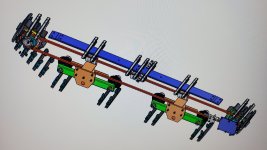
A quick update on my tweaking: I plan to be heading up to my parent's place in a few weeks to check out the previously mentioned hardwood supply that I plan to use to build and replace at least 4 of the eight idler wheels. If it works out well, I will build the other 4. One of the shortcomings I found of using conveyor belting for the track construction is that the belting stretches quite a bit especially when turning. This stretching causes the extended belt to bunch up or bulge at the front of the track. This reduces the number of driven teeth in contact with the track bars on the front drive sprocket and results in the track slipping over the sprocket teeth. To remedy this I thought about installing some roller chain to connect the front drive sprocket to the rear idler wheel effectively making it a drive sprocket as well. I was not sure I could fit it in there behind the sprockets but according to my cad efforts, it could fit. I plan to use some 520 chain which has an ultimate strength of about 6100 lb. Any comments as to why this might not work? This chain installation will be pursued next spring at the earliest.
 

Attachments

  • 20231022_090724.jpg
    20231022_090724.jpg
    1.3 MB · Views: 174
   / My Senior design project - a "Swamp Thing" tracked vehicle clone #590  
I thought it may be possible to detune it by disabling a cylinder or pulling a NASCAR trick of adding an intake restrictor plate. Anyone else have a better idea?

A bolt and nut adjusted to your liking.

image.jpg
 
   / My Senior design project - a "Swamp Thing" tracked vehicle clone
  • Thread Starter
#591  
I did place an adjustable stop on my gas pedal and I installed a rev limiter set to 5000. I don't think I need to limit the hp output. The track belts are just too stretchy when making turns.
 
   / My Senior design project - a "Swamp Thing" tracked vehicle clone #592  
I did place an adjustable stop on my gas pedal and I installed a rev limiter set to 5000. I don't think I need to limit the hp output. The track belts are just too stretchy when making turns.
Ya, track belting is filled with cord and super strong plus idler tires have high number of belting.
 
   / My Senior design project - a "Swamp Thing" tracked vehicle clone #593  
Couldn't you attach the cleats to roller chain, manure spreader chain or just plain chain to control the stretch?
 
   / My Senior design project - a "Swamp Thing" tracked vehicle clone
  • Thread Starter
#594  
Couldn't you attach the cleats to roller chain, manure spreader chain or just plain chain to control the stretch?
Hmmm. I'm not sure how you would attach the chain to the track bars and still have it serviceable. Also, I would think it would tend to collect grit more readily being so close to ground. Thanks for the comments.
 
   / My Senior design project - a "Swamp Thing" tracked vehicle clone #595  
Is there anyway to make the belt tensioner sprung so when the belt stretches it take up the slack? Or maybe do the same with one of the center wheels always pushing up under spring tension?
 
   / My Senior design project - a "Swamp Thing" tracked vehicle clone
  • Thread Starter
#596  
Is there anyway to make the belt tensioner sprung so when the belt stretches it take up the slack? Or maybe do the same with one of the center wheels always pushing up under spring tension?
I think you are missing the issue here. The problem occurs in front of the front drive sprockets. When making a left turn, say, the left sprocket is held and the right driven one pulls on the track stretching the belts. This results in an excess of track being pushed in front of the sprocket creating a bulge in front above the ground. Does that make sense?
 
   / My Senior design project - a "Swamp Thing" tracked vehicle clone #597  
It made sense the first time just thinking something with enough spring pressure may take the slack out but maybe not. I picture a v-belt with a sprung idler on the return side but obviously more to this. Something that stops the track from stretching in the first place like Airbiscuit mentions seems like it would work but hard to make happen. Maybe used snowmobile tracks would work better as they don't stretch much.
 
   / My Senior design project - a "Swamp Thing" tracked vehicle clone #598  
To see if I understand; the front sprocket is the drive?

If so, can you change so the rear sprocket drives? Then the tension and compression on tracks would be in a better place
 
   / My Senior design project - a "Swamp Thing" tracked vehicle clone
  • Thread Starter
#599  
Yes - the front sprocket is driven at this point. You can see the design in previous posts.
If so, can you change so the rear sprocket drives?
That is the purpose of adding chains and sprockets to drive the rear sprocket from the front axles.
 
Last edited:
   / My Senior design project - a "Swamp Thing" tracked vehicle clone #600  
Did you ever get the wheel situation resolved?
If not, have you considered laminated wheels like on the back of brush hogs?
Example but they are available in lots of sizes:
 
Last edited:

Marketplace Items

2009 CHEVROLET C8500 DUMP TRUCK (A59823)
2009 CHEVROLET...
2008 TOYOTA Camry Solara (A59231)
2008 TOYOTA Camry...
2025 CFG Industrial NT20-CZ Mini Excavator (A59228)
2025 CFG...
2025 CFG Industrial NT20-CZ Mini Excavator (A59228)
2025 CFG...
DRAGON 500 BBL FRAC TANK (A58214)
DRAGON 500 BBL...
Snorkel Uno 41D 4x4 Articulating Boom Lift (A59228)
Snorkel Uno 41D...
 
Top