y

My Senior design project - a "Swamp Thing" tracked vehicle clone

   / My Senior design project - a "Swamp Thing" tracked vehicle clone
  • Thread Starter
#601  
...have you considered laminated wheels?
Thanks for the link. I have seen these but have not really considered using them. I wonder how effective they would be to handle the side loading they would experience. In any case, I am nearing completion of installing four wooden wheels on Snowzer. Here's a couple of images showing them.
 

Attachments

  • 20231217_111134[1].jpg
    20231217_111134[1].jpg
    2.3 MB · Views: 171
  • 20231220_092457[1].jpg
    20231220_092457[1].jpg
    2 MB · Views: 171
  • 20240102_133616[1].jpg
    20240102_133616[1].jpg
    2.2 MB · Views: 167
   / My Senior design project - a "Swamp Thing" tracked vehicle clone #602  
My first thought here is what happens when you hit a substantial bump at speed? A tire alone will deform considerably and provides a cushioning effect on the rest of the suspension and ride. I understand that cushioning is not the goal here; but when that tire deforms in response to said bump it would seem that the wooden portion will strike the tracks and experience shock loading as well as having lateral forces applied from the tire bulging.
 
   / My Senior design project - a "Swamp Thing" tracked vehicle clone
  • Thread Starter
#603  
A valid point - look closely at the middle photo and you'll see the rubber tread that I cut off the original tire - that should add some cushioning. There should be no direct wood-to-metal contact occurring on except on the sides. I am not worrying about the wooden construction too much as it is made from multi-ply plywood with cherry and oak on the outside faces for wear resistance. It is all glued together with Gorilla urethane glue and should not come apart. I'd gladly like to hear if anyone has a different suggestion on how to make a 5" wide, 16" OD flat-proof tire to handle side loading. Keep in mind I did look into filling the original trailer tires with 2-part rigid foam but it was expensive at about $130 per tire. As a side note, I plan to install the previously defined chain drive system to the rear sprockets this spring. Due to the tight spacing between the tire supports and the frame, I have to reduce side-to-side movement of the tracks so collisions do not occur. The new wider wooden wheels should do that (I hope).
 
Last edited:
   / My Senior design project - a "Swamp Thing" tracked vehicle clone #604  
Did you guys get snow there?? And thanks for posting updates.
 
   / My Senior design project - a "Swamp Thing" tracked vehicle clone
  • Thread Starter
#605  
6" a week ago. Just a dusting last night.
 
   / My Senior design project - a "Swamp Thing" tracked vehicle clone
  • Thread Starter
#606  
One of the things I think can be improved is the feel of the brake steering sticks. I think I initially used the wrong kind of master cylinder (MC) - one that is used to operate a clutch. The feel is very mushy as though there's air in the system. I've tried numerous times to bleed it and nothing made it better. The sticks also have to travel a ways before enough pressure is generated to initiate a turn. I wonder if the MC, when it retracts, is pulling the caliper pistons back from the pads/rotors too far. The Echo OEM MC has two plungers, each 13/16" dia. I played with cad today and laid out how I could install and plumb the Echo MC. Looking at the attached image, the pink cylinders are small check valves. When the steering lever is pulled, both MC plungers push fluid to the caliper pistons to take up any gap between the pads and the rotor. As pressure builds, one of the check valves acts as a PRV (at about 14 psi crack pressure ) and vents fluid back to the reservoir. The second plunger continues to act normally. Suggestions / comments?

20240115_133101[1].jpg
 
   / My Senior design project - a "Swamp Thing" tracked vehicle clone #607  
If you had a clutch MC there would only be one outlet port for the slave cylinder. What I would try is to plumb the lines so that both outlet ports operate the slave cylinder. Eliminate the return to the reservoir. I don't know why you have 14 psi residual pressure valves. It would be like having your brakes partially on all the time. Disc brakes in an automotive application normally operate with no residual pressure valves. Drum brakes usually run with about 5 psi residual pressure valve. There are different residual pressure valves if the master cylinder is on the firewall or under the floor boards but I don't remember which requires what.
 
   / My Senior design project - a "Swamp Thing" tracked vehicle clone
  • Thread Starter
#608  
If you had a clutch MC there would only be one outlet port for the slave cylinder.
Yes - that is what I have currently installed. The image shows the OEM Toyota Echo brake MCs. I need the return to pass flow and bleed excess pressure off the primary plunger so I get full pressure from using only the secondary plunger area. The primary plunger is only there to help push the caliper piston quickly up against the pads - does that make sense? The check valves crack at 14 psi. In the image, the line to the caliper bleeds off return back pressure thru the secondary plunger port which does not have a check valve in it.
 
Last edited:
   / My Senior design project - a "Swamp Thing" tracked vehicle clone #609  
Ok I see what you are doing.

Do you have single piston calipers? I'd almost be tempted to add a second caliper and use the brake MC to activate both calipers.

Is the mushiness from flex in the linkage? Maybe some ceramic brake pads would give enough grip to enable you to turn with less effort.

I'm just tossing out ideas.
 
   / My Senior design project - a "Swamp Thing" tracked vehicle clone
  • Thread Starter
#610  
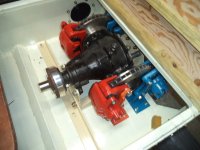
Thanks for the ideas. There's not enough room for another caliper as I already have two on each rotor. The second one is for a service brake - see image. I may try the ceramic pads.

DSC01103.JPG
 
   / My Senior design project - a "Swamp Thing" tracked vehicle clone
  • Thread Starter
#611  
I've been thinking about the second caliper idea. Obviously, I still want to keep the service brakes but I was wondering if it was possible on each caliper to take a tee plumbed so fluid can come from both the service MC and the steering MC and insert a small "shuttle" into the straight run of the tee. The branch of the tee would be piped to the caliper. The shuttle would be a small cylinder with tapered ends that would be able to slide back and forth as it is pushed by pressure from the active MC to seal off (plug) the inactive caliper piping port. Hmmm. Do they make these? I'll look for a couple later.
 
   / My Senior design project - a "Swamp Thing" tracked vehicle clone #612  
I know you can purchase single piston rear calipers that have a mechanical park brake built in. VW's and Audi's come to mind as I'm familiar with those models.
 
   / My Senior design project - a "Swamp Thing" tracked vehicle clone
  • Thread Starter
#613  
Good idea but in this case, there's no room for utilizing the parking brake hardware. I found some 3-way shuttle valves which is what I was thinking of.
 
Last edited:
   / My Senior design project - a "Swamp Thing" tracked vehicle clone
  • Thread Starter
#614  
Another option I am looking into - bolting a smallish diameter rotor (9") onto the input flange of the front differential and use it for my service brake. A 1985 Honda Civic rotor will fit nicely. I would then repipe the ports from each steering MC to the two existing calipers on each side of the diff. I think this may end up being the best solution by doubling the brake surface area. Here's a model layout.

20240116_162436[1].jpg
 
Last edited:
   / My Senior design project - a "Swamp Thing" tracked vehicle clone
  • Thread Starter
#615  
I am looking into another slight modification that will provide better access to the track tensioners as shown in the attached image. I plan to accomplish this by lowering the support wheel axles by 1" effectively raising the chassis.
 

Attachments

  • 20240124_080645[1].jpg
    20240124_080645[1].jpg
    2.3 MB · Views: 156
Last edited:
   / My Senior design project - a "Swamp Thing" tracked vehicle clone
  • Thread Starter
#616  
If you have seen some of the running gear photos, you may have seen that there is no real "suspension" in my current design. Each set of two support wheels are attached to a walking beam that pivots around a central axle and has hard stops to limit travel. I've felt strong whacks when the beam hits the stop when traveling over bumps. I fired up the cad system yesterday to come up with some kind of springing that might soften the end stops. I might add a fork gaiter (not shown) to protect them from debris. Comments?
 

Attachments

  • 20240126_094134[1].jpg
    20240126_094134[1].jpg
    2.7 MB · Views: 161
  • 20240126_095756[1].jpg
    20240126_095756[1].jpg
    2.4 MB · Views: 156
   / My Senior design project - a "Swamp Thing" tracked vehicle clone #617  
That seems to be pretty close to the pivot point of your rocking beam fulcrum and from lever mechanics you may need a very strong spring assembly (and correspondingly very rigid mounting points) to make a difference depending on the articulating mass distal to the spring/strut attachment point. You also may find you would need a progressive type spring for the application that may be challenging to calculate for and locate. Another thought is do you really want a spring on a rocking axle? It seems it may actually make for a rougher ride as I thought the suspension's ability to adapt to terrain depends on the free articulation of the rocking beam?

I also think that as you recognized the open strut assembly is unlikely to stay clean and unencumbered during operation.

Another alternative is to make springed bump stops where you have short/stiff springs topped with a traditional rubber stop. Pros here are reduced bump stop slamming/banging and simpler design/lower cost, while cons are you don't have the shock dampening effect at partial articulation that the strut would provide. You also would have more mounting flexibility as these could be installed either on the frame or on the articulating beam.

A third alternative is to use the springed bump stops in combination with shock absorbers instead of struts. This will allow articulation dampening coupled with bump stop dampening but may have fewer downsides than the struts.

Regardless of the direction you go, thanks for sharing your ideas here
 
Last edited:
   / My Senior design project - a "Swamp Thing" tracked vehicle clone
  • Thread Starter
#618  
Great feedback - thanks! Those spring you see are pretty stiff at 313 #/in. As this is a prototype project (as well as something to keep me busy during retirement) keeping costs down is important so I bought a set of (16) high (.600) lift valve springs for an LS engine for $35 delivered. The full travel is calculated to be about 1.3" hence the need for two springs on each side. I could move them away from the pivot for more travel if needed. I wanted to have the springs in hand before I finalized the design.
 
   / My Senior design project - a "Swamp Thing" tracked vehicle clone #619  
Great feedback - thanks! Those spring you see are pretty stiff at 313 #/in. As this is a prototype project (as well as something to keep me busy during retirement) keeping costs down is important so I bought a set of (16) high (.600) lift valve springs for an LS engine for $35 delivered. The full travel is calculated to be about 1.3" hence the need for two springs on each side. I could move them away from the pivot for more travel if needed. I wanted to have the springs in hand before I finalized the design.
I edited the post and put in a few more thoughts while you were writing that might be useful
Edit: If keeping costs down I imagine repurposed valve springs - maybe a cluster of 4 would be ideal for the springed bump stops as well
 
   / My Senior design project - a "Swamp Thing" tracked vehicle clone #620  
Back in the 50's my grandpa toke an old 18 wheeler tractor
toke old tires and wrapped them around the back rims and
wired them on so no air needed and it worked great for him
as a tractor.

For your wooden wheels I would have bolted some metal on
the outside of the wood for more support.

I don't know if you have checked out tractor supply for wheels?

willy
 

Marketplace Items

2016 INTERNATIONAL PROSTAR TANDEM AXLE DAY CAB (A59904)
2016 INTERNATIONAL...
KUBOTA M8540D TRACTOR (A60430)
KUBOTA M8540D...
Morgan 26ft Box Truck Body (A59228)
Morgan 26ft Box...
3-Gang Reel Mower Pull-Behind Tractor Attachment (A59228)
3-Gang Reel Mower...
FARMHAND 827 FEED MILL (A60430)
FARMHAND 827 FEED...
2016 MACK CXU613 MID-ROOF SLEEPER (A58214)
2016 MACK CXU613...
 
Top