Retaining wall and leveling project:

   / Retaining wall and leveling project: #1  

Kodthree

Member
Joined
Nov 13, 2011
Messages
42
Location
North Idaho
Tractor
2007 Kubota L3130
Friends,

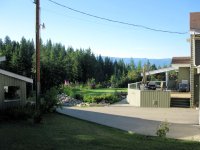
I need advise, guidance, and tips and tricks on a project in the "just thinkin' 'bout it" stage right now. Here is a picture of the project area:
IMG_0868.jpg

Our lodge is built on the man-made dike of our lake, and about thirty feet back from the water. Our problem is that the dike slopes steeply away from the front of the structure to the water's edge, and as such is quite difficult to use and/or drive on most of the year. The excavated material from the lake forms the dike, and is clay, so it gets slippery and soft with rain or melted snow.
The general idea of this project is to create an arc'd retaining wall with its top level being at or slightly lower than the foundation of the lodge. The radius of the arc would be centered with the peak of the roofline. I think some stone or brick steps leading down to the water and possibly a floating dock projecting out from the area in front of the deck on the right side of the picture would be desireable, too. We intend to extend the driveway (with geo fabric, 3", and 3/4 minus) from the left of the picture to past the lodge on the right, adjacent to the structure, so it will be more accessible at all times, and we will cover the remainder of the back-filled area with grass to make a front yard, including a firepit area.
My questions are:
1: What is the cheapest and easiest material to use for a retaining wall (large rocks, basalt columns, gabiens, driven posts with treated timbers forming the wall, etc.)?
2: Drainage considerations?
3: Can a guy (that's me in this story) simply excavate a flat shelf along the intended area of the retaining wall, set the materials (rock, gabiens, or whatever) on that shelf or step and then just backfill, or is some kind of anchor used? To be clear, once constructed, nothing heavier than about 10 people will be anywhere near the edge of the retaining wall...it will not be driven on in that area at all.

Please feel free to chime in with any thoughts or tips you might have. I can include more pictures to help visualize, too. And, we'd like to do this in house as much as possible. I'm sure we'll rent an excavator for a lot of the work, but think we'll also need a rolling compactor over the back filled areas.

Thanks,

Kodthree
 
   / Retaining wall and leveling project: #2  
I have seen telephone poles used exactly for what your talking about, but have no clue on the longevity. I would have concerns about a rock wall since you will really need one heck of a foundation. I know there are company's that contract both. I think driven in poles would be the easiest since you have water in the pond already. I know this isn't "how to do it advice" but it is 2 options I have personally seen. Might also be cheaper and easier to pour something like a stem wall and just top that with native stone.
 
   / Retaining wall and leveling project: #3  
Just wondering if you need to contact anyone before you mess with a water source? I am not sure of the laws/regulations in idaho. Pondboss is a website that many people have recommended over the years for projects involving lots of water.
 
   / Retaining wall and leveling project: #4  
how about steel I beams pile driven down,figure twice the length in ground as above, spaced apart to slide 6x6's in the channels.
 
   / Retaining wall and leveling project:
  • Thread Starter
#5  
I like the pole idea, but have concerns about polution from the creosote affecting our lake and wildlilfe. The stem wall approach is a great idea, but probably more not the look (from the lake) we'd be interested in...face it with something? We have zero need to worry or plan for wave action against the wall...biggest waves in our lake are from the moose swimming by. :)
 
   / Retaining wall and leveling project:
  • Thread Starter
#6  
another great idea...what equipment to drive the beams, and how long will the treated 6x6s last?
 
   / Retaining wall and leveling project:
  • Thread Starter
#7  
Just wondering if you need to contact anyone before you mess with a water source? I am not sure of the laws/regulations in idaho. Pondboss is a website that many people have recommended over the years for projects involving lots of water.

Nope, its our water...all of it. I'll research Pondboss right now, though! Thanks.
 
   / Retaining wall and leveling project: #8  
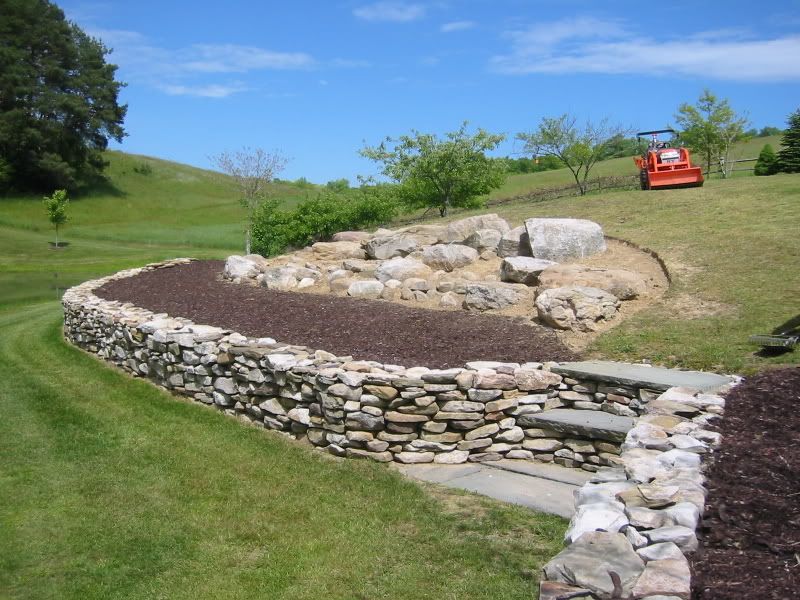
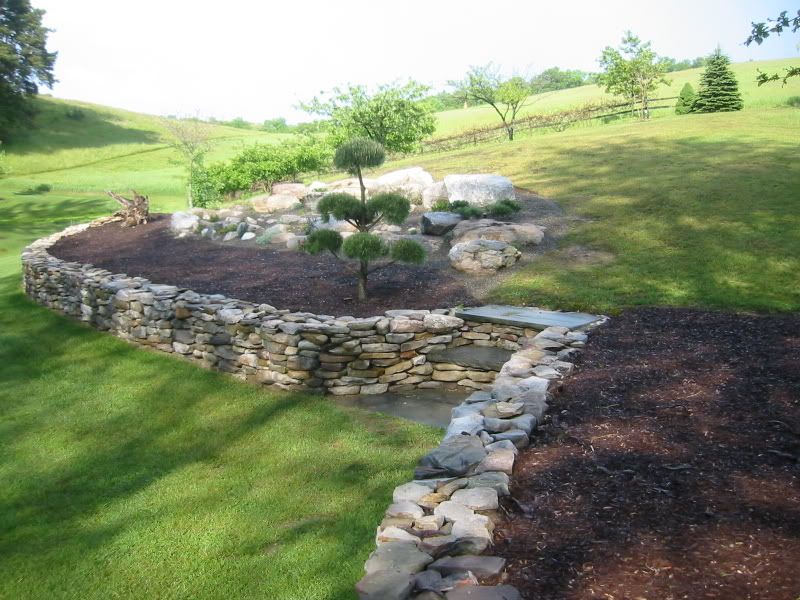
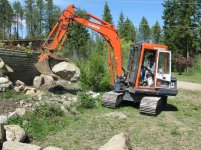
I have done free standing stone walls with field stone with various levels of success.
This one is around 2'-3' tall and 2'wide, backfilled with gravel to the edge,transitioned at a 45 degree angle for drainage off the hill,it has not pushed out after 4 years.
78983d1181853924-pennsylvania-stone-wall-project-lower-wall.jpg


IMG_1416.jpg


IMG_1430.jpg


This one is about 4' in the highest placeand 2-3'foot wide,it pushes in the highest area, but its also on a hillside,I use the bota to push it back with 2"X12"'s across the bucket to spead the load.
78982d1181853905-pennsylvania-stone-wall


Here is that whole write up on the construction,but most of it applies to the rock garden

http://www.tractorbynet.com/forums/projects/102305-pennsylvania-stone-wall-project.html

I have had better success with versa lock(solid man made blocks using nylon interlocking pins),but engineering is needed after 48"of height due to the hydrolic load that will push. Mine are no higher than 45" and have had no issues since 93-1994 or so.

With lumber,you have to be sure to get the ones "treated for in ground contact" and deadmans are required. I chose to use deadmans and .50" rebar for anything over 2 ters high as I only wanna do it once, 2nd time round is always more than twice the work!

Prices vary,but if you look hard enough,you will find a good price. My two stone walls are over 120'long for each,and have a total of 120,000 lbs of rock, 39 3000lbs pallets. They cost under 4500.99 for all labor,and stones,including backfill gravel. I did as much as i could though,plantings,layout,trench cut, and all loader work. It took 2 months minimum and looks great 4 years later. All leveling was done by sight.

HINT: Use a garden hose to get the curves you want,keep radiuses with in the turning radius of your mower, once you have the hose where ya want it,spray a line with marker paint along the hose, then use a flat spaid to cut the leading edge into your sod for a clean line.On these,I went 2-3" deep, then used my back hoe,leveled up with the outriggers to cut the 2' trench without the teeth on the bucket, all this then went behind the wall for fill as I moved along.
 
Last edited:
   / Retaining wall and leveling project: #9  
I like the pole idea, but have concerns about polution from the creosote affecting our lake and wildlilfe. The stem wall approach is a great idea, but probably more not the look (from the lake) we'd be interested in...face it with something? We have zero need to worry or plan for wave action against the wall...biggest waves in our lake are from the moose swimming by. :)

Add a concrete colorant to the mix, or rather have the cement company do it. A light Brown to Dark Brown may accent your house (nice place BTW), Topped with a row of your native rock, might just "fit right in" .
 
   / Retaining wall and leveling project: #10  
If you have them, rocks from your place would be cheapest. How's that for a masterful grasp of the obvious? A small excavator with a thumb can do a fine job of placing or stacking the rocks; use geotextile fabric and a little gravel behind. Done all the time here in New Hampshire; they don't call it "the Granite State" for no reason.
 
   / Retaining wall and leveling project: #11  
Retaining wall blocks really arent that expensive and work very well as long as you follow the guidelines. Like the fabric every other layer, and only go as high as they reccomend. But...(it could be decieving)...it dont look like you need much height. Maybe 2' or so at the most.

The cheap brick I like to use are about $1 per block with tax. And they are 3.5" x 12". So a 5 block high wall, 40' long would only require about $200 worth of block, and a few bucks for fabric.

If you go the premade block route, just be sure to pay extra special attention to bedding and making the first row perfectally level. After that, its just stacking block up.
 
   / Retaining wall and leveling project: #12  
Premade: try to get all the black at the same time as there are subtle differences in batch colors that don't look well next to one another. If you get all at the same time, you can mix them all in the wall as you build.
 
   / Retaining wall and leveling project: #13  
I have a professionally built dry stack retaining wall behind my house, and have been working on building a similar wall on the opposite side of my driveway. It is very simple to do with the dry stack blocks, which for the anchor diamond pro ( professional) run around $6 each for 8"x16". I think the homeowner blocks are ~$5 each but are only 6" tall.

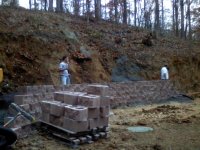
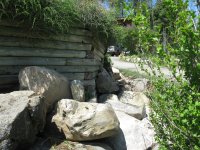
With most of the dry stack blocks, drainage and the first layer is important, but creates an awesome finished product. First, a trench roughly a foot is dug down, and filled halfway with compacted base. then the first layer is laid down and perfectly leveled. If going higher than 4 blocks or if cars are going to be parked next to the wall, geofabric is laid down every two layers. After that, its basically stacking and filling with more base material. stump grinding.jpgretainin wall1.jpg
 
   / Retaining wall and leveling project: #14  
I think you should not build with wood since it will need to be replaced in 20 or 30 years (even if it is treated). I replaced one (very poorly built) wood wall at our first house in the mid 70's with a properly designed 4' to 5' reinforced concrete wall.

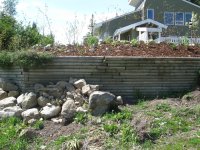
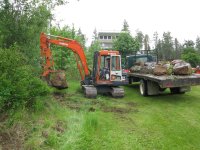
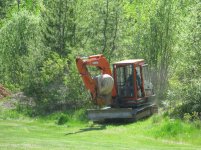
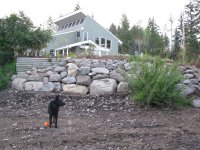
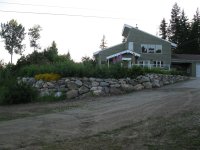
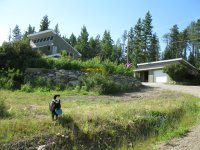
Our present house had a treated timber wall ranging from 1' to 7' high. It was built in 1981 and it had "deadmen" to make it as sturdy as possible. In 2009 we shored it up with rocks taken from a new driveway we built to reduce the grade of the old one. In the spring of 2010 it was obvious that was not going to work so we removed those rocks and built a proper wall with rocks we harvested from the property. In the spring of 2011 we finished the remaining wall that varies from about 4.5' to 1' as it was also starting to collapse. I have one more section of 1.5' wall bordering the driveway(in the foreground of the last photo) by the garage which needs to replaced. I'll likely use blocks for that.

We are in an area of old moraines and glacial till and it is quite easy to find large rocks.

Here are some photos showing the old, temporarily shored-up wall, gathering rocks, and the finished walls:
1_20100514_origWall1.JPG1_20100514_origWall2.JPG2_20100522_Gathering_Rocks1_.JPG2_20100522_Gathering_Rocks2.jpg2_20100522_Gathering_Rocks4.jpg3_20100522_FinishedWall.JPG4_20110703_FinishedWall1.JPG4_20110703_FinishedWall2.JPG5_20110704_FinishedWall1.JPG5_20110704_FinishedWall2.JPG
 
   / Retaining wall and leveling project: #15  
I have built some retaining walls and second the warning to get first course level. More is needed than just level though. You need to dig out more than you think necessary and put in gravel, tamping/compacting in lifts to not exceed 3-4 inches. Level this and lay your first course so half a block is below original grade (dirt height, not grass. This is more expense and work but... it will greatly reduce the odds of differential settling over time which will make the job look much worse than "rustic."

I also have cast concrete with rebar retaining walls that are 12 inches thick and have perforated drain lines at the mid level and bottoms to alleviate hydrostatic pressure problems. The drains run downhill and drain to daylight just above a backyard pond. These retaining walls have developed cracks but the cracks are cosmetic and not spreading due to considerable rebar. Wall height is over 12 ft and slopes to about 6 ft.

One way to get a better look is to line the forms with rock (I favor a little glue to hold the rocks to the forms (just a tiny dot of glue) and then when you pour the wall and remove the forms it looks like you have a natural rock wall.


Pat
 
   / Retaining wall and leveling project: #16  
first - very nice location!
second - what do you have available in your area? what can you move it with? timeline? 1 month? 3 years?
third- do you want to incorporate a walk out dock into your plans?

If it was my place therre- I'd source out a large amount of large boulders on my land or rocks from local stone quarry. If the stones were about half size of a car or larger, I'd hire out a excavator to place the rocks for you. Normally I would do it myself, but its right next to the water and if anything happens, its not on me if it tips into the water. I'd start placing rocks/stones right in the water edge and dry stack them up till its at your desired height. This would maximize your space. In my opinion using the largest stones/rocks you can get will allow you to just place it where you want it without much prep and it won't move since its so heavy. After the wall is done, I'd would take my time to bring in dirt/clay what have you locally cheap and start filling in after putting fabric inside the walls to stop dirt from leeching out.

If you insist on doing all the work yourself, then use smaller rocks a tractor can move and get a good base at least a couple foot down at the water edge , not in water.
 
   / Retaining wall and leveling project: #17  
Rocks may settle some due to their weight. To avoid that put down small gravel and "bed" the bolders in it to get more contact between bolder and soil (small gravel fills the "interstices."

Pat
 
   / Retaining wall and leveling project: #18  
I have built some retaining walls and second the warning to get first course level. More is needed than just level though. You need to dig out more than you think necessary and put in gravel, tamping/compacting in lifts to not exceed 3-4 inches. Level this and lay your first course so half a block is below original grade (dirt height, not grass. This is more expense and work but... it will greatly reduce the odds of differential settling over time which will make the job look much worse than "rustic."

I also have cast concrete with rebar retaining walls that are 12 inches thick and have perforated drain lines at the mid level and bottoms to alleviate hydrostatic pressure problems. The drains run downhill and drain to daylight just above a backyard pond. These retaining walls have developed cracks but the cracks are cosmetic and not spreading due to considerable rebar. Wall height is over 12 ft and slopes to about 6 ft.

One way to get a better look is to line the forms with rock (I favor a little glue to hold the rocks to the forms (just a tiny dot of glue) and then when you pour the wall and remove the forms it looks like you have a natural rock wall.


Pat

You glue them to the inside of the forms prior to pouring? Are they large flats or boulders that stretch the width of the form? Sounds interesting, my BIL has a few schwing pumpers and has a lot of forms for his business.
 
   / Retaining wall and leveling project: #19  
I built a wall that was about 100' long and up to 4' high above grade. I ended up burying the first course under ground. Like said here, you want to dig down enough to have a base of 57 rocks (rock put under concrete). I then put some crush and run/tamped and level. Then set first course. I put perforated pipe behind the wall and back filled with a few feet of 57 stones to help drain to the pipe. The pipe was sloped all the way out to the woods. We got a lot of rain run off from the neighbors house so I wanted to be sure the wall held. I never had an issue with it while I lived there. I can try to find some pics of the progress. I did use the blocks that stack on top of each other and step back an inch or so each course. Each block weighed about 80lbs a piece. I was a bit sore after that project.
 
   / Retaining wall and leveling project:
  • Thread Starter
#20  
Thanks for the compliments on the place...we are BEYOND blessed. How cool is it to be sitting with your feet up in your recliner, hot toddy in hand, book in the other, and a moose walks past the windows...basically eye to eye with you? Happened many times, and its fun. Anyway, thanks for the awesome pictures of your builds. Keep them coming!
 

Tractor & Equipment Auctions

2012 INTERNATIONAL 4300 26 FT BOX TRUCK (A59904)
2012 INTERNATIONAL...
2015 Peterbilt Dump Truck (A55973)
2015 Peterbilt...
2017 Freightliner M2 106 AWD Terex Hi-Ranger 5TC-55 55ft Insulated Material Handling Bucket Truck (A60460)
2017 Freightliner...
2013 Freightliner Bucket Truck (A55973)
2013 Freightliner...
2019 Ford F-350 4x4 Crew Cab Pickup Truck (A59230)
2019 Ford F-350...
Michelin CARGOXBIB High Floatation Tires (SET OF 6) (A56438)
Michelin CARGOXBIB...
 
Top