Solar power anyone ?

/ Solar power anyone ?
  • Thread Starter
#21  
In the For-what-its-worth column, I took a solar course (NABCEP certification) over the mtn at Appy State, and they had some small Arco from the early 80's. The output on them was about 80% what they were rated to produce, and they had been in use for nearly 30 years. You can buy brand new panels and not get much better under real world conditions.
 
/ Solar power anyone ? #22  
... Lets says we would use 3KW per hour or a total of 15 KWH during that power generation time. We would have to install about 3.75 KW of panels on the roof to get 3KW at the outlets. The extra PV is for power loss in the system.
...

I was writing in a hurry and left out some information.

There is power loss from the generation of the DC power by the PV when converted to AC and other parts of the system. The calculator we used in class assumed an efficiency of around 75%. Meaning you would loose 25% of the power generated on the roof by the time it got to the outlets for use. Another way to look at this inefficiency is that it increases your cost by 25%. This is a little detail that can bite you. One might figure you need 40 KWH a day to cover one's power usage. Now one would assume you get power production sometime after sunrise until sometime before sunset. Nope. In my location, I get five hours of power producing light year round. This is another detail that is important. So if I need 40 KWH a day, I need to put 8 KW of panels on the roof, 40 KWH / 5 sunlight hours equals 8. Nope, that won't work because we will only get roughly 75% of the power from the panels to the outlets, so I REALLY need 8*1.25 or 10 KWH.... This just pushed up the cost.

But, the panels will loose efficiency over time so the design should include some extra generation to cover that loss. How much? Another 10-20% sounds good to me. So lets split the difference and say another 15% which means 11.5 KWH. The final KWHs is going to depend on the area you have for the PV installation as well as the best bang for the buck on the PV panel. Panels come in different power densities and costs so one has to balance the area for the installation with the PV size, and cost. In any case, this pushed up the cost again.

But, this really does not work either because my power usage is spread over 24 hours a day and I am producing power over five hours. So now you have to grid tie and/or have batteries. In NC, it does not appear to make money sense to grid tie AND produce 100% of your power unless you grid tie AND store your five hours of production in batteries. The grid tie would be to provide power when you have exhausted your batteries. One would not want to sell power back to the grid in NC under the current regulations.

BUT, batteries cost mucho money and have a limited lifetime. PV panels seem like they will last many decades. Frankly, I would be shocked if they did not produce a good part of the rated power for the rest of my life. Batteries are a different story. They add cost to the system but I don't see that they make money sense every time I look at the numbers. A problem with batteries is that they don't like temperature extremes so they should be in the house or other AC environment. I personally do not have space for them in the house so we are SOL.

People need batteries because batteries are required to provide backup power when there is a power outage. People are shocked when the find out that a grid tied system is not usable during a power outage.

But wait, storing power is going to loose a bit of power so you need to add more PV to the roof to make up for the loss which will require more battery storage. The system ends up being a bit larger than would initially expect and the price increases accordingly due to these power loses.

These issues are not show stoppers but they are buried in the details and not readily apparent but they do increase the system cost. Grid tie regulations change and can really determine what one does or does not do with a PV installation.

Later,
Dan
 
/ Solar power anyone ? #23  
We installed a system last month, here's our public system monitor: https://enlighten.enphaseenergy.com/public/systems/Xwcn203374

it's a 4.2kw DC system, at peak it maxes out at about 3.2kw AC so the 75% rule of thumb mentioned works well.

With the incentives our up-front cost was 18.5k (including installation), but with tax incentives over the next 4 years that drops to net of 4500 out of pocket. We pay around .10/kwh so our payback period is estimated at 10 years. So less than half the warranted lifetime of the panels and inverters. Past that 10 years they're producing free electricity. We used Solarworld panels and Enphase inverters, installation was done by AES (Advanced Energy Systems) out of Eugene. It took two days for the installation and one pre-installation planning visit. We could have cut some costs by using Chinese panels and a string inverter but chose the US made panels and microinverters instead.

IMAG0231.jpg
 
/ Solar power anyone ? #24  
I was writing in a hurry and left out some information.

Actual efficiency for a well designed system is around 85%. For panel loss figure 1%/yr on average. Batteries have much higher charge-discharge losses, much higher installation costs and usually make sense in off-grid installations.

The big news today is that good quality panels today are under $1/watt. Systems do make sense if the price is right. I will have about a 5 year payback on my system. Typically I am getting up to 94% of installed nameplate on bright sunny days. Warm weather lowers output and cold increases it.

paul
 
/ Solar power anyone ? #25  
As opposed to spending $8-10k or so for a good standby generator that will burn fuel everytime you need it, solar is looking better and better.
 
/ Solar power anyone ? #26  
Oh me, I'm as confused as ever now! :confused2: my normal state.

So, no batteries, no good when power goes out? Maybe I should have some solar boys come give me explanation and estimate.
 
/ Solar power anyone ? #27  
Actual efficiency for a well designed system is around 85%. For panel loss figure 1%/yr on average. Batteries have much higher charge-discharge losses, much higher installation costs and usually make sense in off-grid installations.

My use of 75% is from http://rredc.nrel.gov/solar/calculators/pvwatts/version1/US/North_Carolina/Raleigh.html

PVWATTS assumes a 77% based on the following values( For some reason I can't upload a gif/jpg). Formatting before posting does not stick. The second column is the values used to calculate the .77 number. The third column is the range of values that they could have picked. The page is here: http://www.nrel.gov/rredc/pvwatts/changing_parameters.html#dc2ac
Component Derate Factors PVWatts Default Range
PV module nameplate DC rating 0.95 0.80-.05
Inverter and transformer 0.92 0.88-.98
Mismatch 0.98 0.97-.995
Diodes and connections 0.995 0.99-.997
DC wiring 0.98 0.97-.99
AC wiring 0.99 0.98-.993
Soiling 0.95 0.30-.995
System availability 0.98 0.00-.995
Shading 1.00 0.00-.00
Sun-tracking 1.00 0.95-.00
Age 1.00 0.70-.00
Overall DC-to-AC derate factor 0.77 0.09999?.96001

I suspect your numbers do not take into account soiling.

Later,
Dan
 
/ Solar power anyone ? #28  
Oh me, I'm as confused as ever now! :confused2: my normal state.

So, no batteries, no good when power goes out? Maybe I should have some solar boys come give me explanation and estimate.

The inverter(s) sense if the grid has power. If the grid has lost power, the inverters stop inverting the PV DC power to AC so that the grid is not backfed. They don't want to back feed the grid.

Even if one hacked the system to allow the inverters to work, I think it would be real iffy to use the solar power without the grid/batteries. If you were running the fridge just on PV, a cloud shaded the panels and the PV power dropped, what happens to your fridge motor? You really need batteries in the PV installation to provide backup power if the grid is out.

Notice I said inverter(s). The "old" installations had a centralized inverter, i.e., one inverter per installation. The inverter coverts the PV DC to AC. The problem with this approach is that the panels are going to be wired in series and there is a "feature/quirk/gotcha" with this type of installation. If ONE panel in the series of say 10 panels is shaded, that one panel effects all of the panels in the string. Say one panel in a string of 10 panels is shaded to the point that that one panel produces NO power. The way the system works is that NONE of the 10 panels will now produce power.

One of the cool new things is micro inverters on each panel. The inverter converts the panels DC power to AC which prevents the shading problem. You end up with N inverters for N panels instead of 1 inverter for N panels. This is great for a grid tie system.

Later,
Dan
 
/ Solar power anyone ? #29  
The inverter(s) sense if the grid has power. If the grid has lost power, the inverters stop inverting the PV DC power to AC so that the grid is not backfed. They don't want to back feed the grid.
during an outage.

The normal operation mode is to back feed the grid (this is how you get credited for excess power produced) but during an outage for the safety of the linemen you need to disconnect from the grid, the micro-inverters do that automatically by shutting down when the grid goes out of spec (voltage or frequency)

So with micro-inverters in the event of a grid outage they produce no power.

Our power is 99.7% reliable (maybe one day outage a year), so for the rare times when we might have an extended outage I have a manual interlock and generator input on the main panel so I can connect my camping generator to provide limited power the house, the solar system will not contribute during this period. If you have grid available the costs of an off-grid battery bank are hard to justify compared to a generator.
 
/ Solar power anyone ? #30  
My use of 75% is from PVWATTS: North_Carolina - Raleigh

PVWATTS assumes a 77% based on the following values( For some reason I can't upload a gif/jpg). Formatting before posting does not stick. The second column is the values used to calculate the .77 number. The third column is the range of values that they could have picked. The page is here: NREL: PVWatts - How to Change Parameters


I suspect your numbers do not take into account soiling.

Later,
Dan
You need to look at your installation and set the factors accordingly, rather than default.

For example, my inverter CEC rating is 95.5%, in our area soiling is minimal 0.98, system availability has been 100% so far, no shading throughout the day and age is at .99. Clouds, non-sunny days, etc are not included in these "installation" numbers since NREL will calculate based on the number of solar hours for your location, which takes into account those "non-installation" factors.

paul
 
/ Solar power anyone ? #31  
Sunny Boy (SMA America) now has a line of string inverters that will produce up to 1500 watts (at a dedicated outlet connected to the inverter) while the grid is down, and of course the sun is shining.

Now that one company offers that feature, I think others will follow. How useful 1500 watts are depends on one's individual situation.

My year-old grid-tied system exceeded the NREL model by 10% over the past year. I have had zero problems with any part of the system.
 
/ Solar power anyone ? #32  
solar is the most boring renewable energy there is
once set up it should be trouble free for years

now if you want to work on something all the time get a windmill

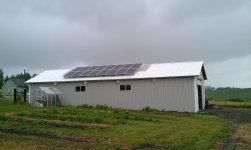
I installed 8 205 watt panels on my barn after learning that my electric supplier wanted almost 6k to bring in a meter from my neighbors transformer as my barn that sits back away from my house 600 feet

The neighbors transformer is only about 50 ft from my barn
they also wanted to charge me commercial rates (.38/kw) because my lot already had a residential meter

I picked up 10)205 watt evergreen panels with an Outback MX80 charge controller going into 32)91 amp/hr 12 volt batteries with a 6000 watt inverter
I run all my light in both barns LED 12 volt and have a 12 volt pump that I empty water troughs when ever it rains into 2 275 gal tanks
when the troughs are low I pump it back from the tanks to the troughs

with only running 12 volt you don't need to run wiring in conduit
the only conduit I had to run was from my inverter to my trough heaters and bucket heaters
also to a couple of outlets that run my hay elevator and my daughters radio

I use 12 volt LED tractor lights for floods outside and in the barns
I use 12 volt LED rope light in all the stalls and it looks like Christmas in the barn when I have everything on

I did this all with no previous experience at a cost of about $5500. 3 years ago and not a single bill from my electric supplier
I looked into the costs of ditching from the house and that was going to cost me about 5k doing everything myself and only yielding maybe 30 amps in the barns

just get on the internet and you'll find plenty of people willing to help
If you want I can give you some pointers and pictures of my set-up

heres the only picture I have here at work today and its actually of my daughters gator
IMG_20130527_130450.jpg
 
/ Solar power anyone ? #33  
You need to look at your installation and set the factors accordingly, rather than default.

For example, my inverter CEC rating is 95.5%, in our area soiling is minimal 0.98, system availability has been 100% so far, no shading throughout the day and age is at .99. Clouds, non-sunny days, etc are not included in these "installation" numbers since NREL will calculate based on the number of solar hours for your location, which takes into account those "non-installation" factors.

paul

Yes, local conditions are important but if you check the link and how they created their efficiency rating, soiling looks like it caused a big drop in their efficiency value. Soiling as they defined is:
The derate factor for soiling accounts for dirt, snow, and other foreign matter on the surface of the PV module that prevent solar radiation from reaching the solar cells. Dirt accumulation is location- and weather-dependent. There are greater soiling losses (up to 25% for some California locations) in high-trafffic, high-pollution areas with infrequent rain. For northern locations, snow reduces the energy produced, and the severity is a function of the amount of snow and how long it remains on the PV modules. Snow remains longest when sub-freezing temperatures prevail, small PV array tilt angles prevent snow from sliding off, the PV array is closely integrated into the roof, and the roof or another structure in the vicinity facilitates snow drift onto the modules. For a roof-mounted PV system in Minnesota with a tilt angle of 23ー, snow reduced the energy production during winter by 70%; a nearby roof-mounted PV system with a tilt angle of 40ー experienced a 40% reduction.

They used .95 as as soiling rating which seems reasonable, especially for my area. They also assume no shading, that the array is at the optimum angle, and that the panels have not aged and lost power generation.

Later,
Dan
 
/ Solar power anyone ? #34  
Sunny Boy (SMA America) now has a line of string inverters that will produce up to 1500 watts (at a dedicated outlet connected to the inverter) while the grid is down, and of course the sun is shining.

Now that one company offers that feature, I think others will follow. How useful 1500 watts are depends on one's individual situation.

That is a danged good idea. Do you know what model/product number that does this? I looked on their website and I can't find it. I am curious how they handle power drops. Do they just cut of the AC from the panels if the power drops beyond a given power point due to shading or time of day....

From a back up perspective, we would need a circuit for the fridge, freezer, living room and I suppose the study. The well would be a higher priority but 1500 watts is not going to power the well.

An inverter that could power a circuit in an outage would be VERY nice.

Later,
Dan
 
/ Solar power anyone ? #35  
That is a danged good idea. Do you know what model/product number that does this? I looked on their website and I can't find it. I am curious how they handle power drops. Do they just cut of the AC from the panels if the power drops beyond a given power point due to shading or time of day....

From a back up perspective, we would need a circuit for the fridge, freezer, living room and I suppose the study. The well would be a higher priority but 1500 watts is not going to power the well.

An inverter that could power a circuit in an outage would be VERY nice.

Later,
Dan

I don't have any info on the circuitry or what happens if a cloud passes over, for example.

It's a brand new product that may not be shipping yet.

SUNNY BOY 3000TL-US / 4000TL-US / 5000TL-US. SMA America, LLC
 
/ Solar power anyone ? #37  
From a back up perspective, we would need a circuit for the fridge, freezer, living room and I suppose the study. The well would be a higher priority but 1500 watts is not going to power the well.

The "powering of a well" Has been shown to be one of the biggest problems. A simple solution is a couple of totes.

8x6SAM_0422.jpg

An easy 300 gallon each solution usually $100 or less.

And as far as running fridges and a few lights a small backup generator does well.
 
/ Solar power anyone ?
  • Thread Starter
#39  
I'm guessing those totes aren't full, huh ?

:D
 
/ Solar power anyone ? #40  
I don't have any info on the circuitry or what happens if a cloud passes over, for example.

It's a brand new product that may not be shipping yet.

SUNNY BOY 3000TL-US / 4000TL-US / 5000TL-US.*SMA America, LLC

Ah, I was looking at the 1500ish models.

There solution is only sorta a solution.

22 SB3-5TLUS22-BA-en-11 User Manual
5 Secure Power Operation
If the inverter has a secure power supply, you can use the energy from the PV plant directly via the connected socket-outlet in the event of a grid failure. The inverter automatically regulates the energy supply of the secure power socket-outlet according to the solar irradiation on the PV plant. While the secure power socket-outlet is in use, the inverter is disconnected from the grid and does therefore not feed into the power distribution grid. The secure power socket-outlet can not be used over-night, because there is no solar irradiation available for the supply of the socket-outlet.

Do not connect any devices that require a stable electricity supply

The power available during secure power operation depends on the solar irradiation on the PV modules. Therefore, the power can fluctuate considerably depending on the weather or may not be available at all. In the event of solar irradiation being too low or overload of the socket-outlet, the voltage supply of the secure socket-outlet will also be interrupted. 20 seconds after interruption, re-establishment of the voltage supply will be attempted automatically. This can lead to the inadvertent starting of the connected loads.
Do not operate any devices via the secure power socket-outlet that are dependent on a stable electricity supply for their reliable operation.
Ensure that the loads that are connected to the secure power socket-outlet do not require more than 1,500 W.

Requirements
☐ The inverter must be showing
the error message 202, 203, 204,
205 or 801.
☐ There must be sufficient solar irradiation.
☐ Load with a maximum power of 1,500 W
Procedure for the secure power operation
1. Switch off the inverter miniature circuit-breaker.
2. Switch on the socket-outlet.
3. Plug in the load.
4. Switch on the load.
Do not connect any devices that require a stable electricity supply
The power available during secure power operation depends on the solar irradiation on the PV modules. Therefore, the power can fluctuate considerably depending on the weather or may not be available at all. In the event of solar irradiation being too low or overload of the socket-outlet, the voltage supply of the secure socket-outlet will also be interrupted. 20 seconds after interruption, re-establishment of the voltage supply will be attempted automatically. This can lead to the inadvertent starting of the connected loads.
Do not operate any devices via the secure power socket-outlet that are dependent on a stable electricity supply for their reliable operation.
Ensure that the loads that are connected to the secure power socket-outlet do not require more than 1,500 W.

So this has to be a dedicated socket, the socket cannot be wired to the house grid which makes perfect sense, otherwise it would be back feeding the power. Seems like running a fridge or freezer would be a no no. Looks like this could run lights and charge batteries.

Later,
Dan
 

Marketplace Items

2019 Peterbilt 520 Heil Side Loader Garbage Truck (A55973)
2019 Peterbilt 520...
WINCH CABLE DRUM (A58214)
WINCH CABLE DRUM...
Massey Ferguson 4608 (A53317)
Massey Ferguson...
2013 Ford C-Max Energi Hybrid PHEV Hatchback (A59231)
2013 Ford C-Max...
LOT LOCATIONS (A59905)
JOHN DEERE 850K LGP (A58214)
JOHN DEERE 850K...
 
Top