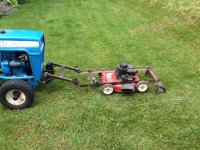
I mow the steep parts up and down now (except for bottom edge where I have turn around), and use suitcase weights.
How would a tilt meter help?
Is a flail more hazardous on a side hill than a rotary cutter? I've seen dire warnings about them on side hills.
============================================================================
The tilt meter was designed and based on the design of the protractor to measure angles and mounted on the hood of the mule shows the operator the exactly what the angle is that the tractor is operating on as the hood of the mule is positioned at the same angle that the front and rear axles are resting as they move provided the hood is not damaged and unhinged of course.
The tilt meter also has the danger area/angle for a roll over to occur outlined in red(if I remember correctly) on both sides of the protractor in relation to the actual zero angle of the protractor that the tilt meter is based upon. The general rule was 15 degrees maximum angle of slope for safe operation of a riding lawn mower mowing across the slope in this example.
A larger mule will have the effects of gravity and the angle of tilt compounded higher as it is taller than a riding lawn mower or garden tractor and the angle can become greater simply due to the tire size of the mule.
Any side hill is dangerous to operate on unless you have a side hill tractor,combine etc.
Do you remember where you read that about using a flail mower on side hills? The thing is that the entire mower stays on the ground riding on the rear roller and it is not more dangerous to use simply because any and all of the mowed brush/grass passes over the flail mower rotor and then falls to the ground.
If you turn a rotary cutter or for that matter any long implement on a slope it may end up lifting in many cases simply due to the length of the of the implement and the laws of physics affecting the overhanging implement.
The flail mower is not dangerous in using it on a side hill of 15 degrees as the mowers geometry is smaller in length and it is less effected by a turn and will weigh more in most cases and will have much less of a tendency to lift up as long as the tractor is operated properly AND SLOWLY in making turns if the operator intends to mow on the side hill. I always mowed up and down with ours anyway as it was heavy and a towed motorized unit.
Ideally you want to mow up hill in reverse and then down hill anyway with a steeper slope to overcome the potential for the potential of a side hill roll over accident.
Going from memory here:
The only way to overcome the problems with a mule with a higher center of gravity is to purchase smaller rims and tires if available to reduce the height of the center of gravity which is the rear axles center line height from side to side through the axle shafts.
Adding:
A low profile orchard and vineyard mule is perfect for mowing in many conditions and slope angles due to the nature of vineyards and orchards which are on slopes in many cases.
Going a bit slower is always a good idea in slope mowing anyway as the side hill maybe damp and the mule can slide sideways and scare the operator while working possibly causing the operator to overcompensate when controlling the mule while working.
Do not worry Terry you can mow safely with the flail mower and your rotary cutter will be so disgusted it may try to hit the flail mower with stones and by then you can sell it and have more room to store things.
Please let us know when you have received the the flail mower and then I can officially welcome you as the newest lifetime member of the Flail Mower Nations from the Great State of North Carolina.