Optimal Shape of Brush Fork tines?

   / Optimal Shape of Brush Fork tines? #1  

2manyrocks

Super Member
Joined
Jul 28, 2007
Messages
9,517
Many have built their own brush forks at TBN for years now sticking to pretty much straight lengths of stock probably for ease of fabrication, ready access to straight tubing, and cost.

Looking at the way grapples are being built, many have curved tines that would seem to resist bending and would seem to better nestle material than plain straight forks. Similar curved tines for brush forks could be cut with a plasma cutter.

I'm seriously thinking about making a set of forks and wondering if curved tines are the way to go?
 
   / Optimal Shape of Brush Fork tines? #2  
I suspect the curve serves multiple purposes, the two you mentioned PLUS just not being as likely to suddenly dig in and try to 'pole vault' the thing when you are just trying to skim along the ground.

Technically you could accomplish much the same thing with a simple angle/bend on the front of a straight piece. I suspect the curve is nice but not enough better to justify the extra work of creating it vs just putting one angle in the front of your otherwise straight simple forks and then just tilting the bucket down so that part is parallel to the ground when driving it under the pile you are trying to lift.

Definitely show us what you come up with!
 
   / Optimal Shape of Brush Fork tines? #3  
...and wondering if curved tines are the way to go?
Depends on what you need to do with the forks. If you need to rip things out of the ground, yes curved tines would be stronger and better. If you are picking up large piles of brush, longer straight ones work better.

I have a landscape rake to get things into a pile but does nothing to pick up the piles...

What do you need / want the brush forks to do???
 
   / Optimal Shape of Brush Fork tines? #4  
Grapples have curved tines that would seem to resist bending and would seem to better nestle material than plain straight forks.


Heavy work should be tackled with TPH implements.

An All Purpose Plow is perfect for your application if you do not have 2manyrocks.

 
Last edited:
   / Optimal Shape of Brush Fork tines?
  • Thread Starter
#5  
My needs are simple. I just want to be able to slide the forks under light brush, pick it up, and move it without it sliding off. The forks will be used on a 25hp Kubota L2501. So no heavy logs.

I have used straight forks. They are good for penetrating a pile of brush, but I am bad about digging them into the ground while trying to get under the pile. I've bent some lighter duty forks doing that.

Another option as mentioned by Vigo327 is to incorporate a retention tip like this one on the MTL Attachments grapple. https://www.mtlattachments.com/atta...pple-hydraulic-brush-grapple-attachment-wk53p

For me, it's no big deal to cut a curve with a plasma cutter. I would cut the profile on a piece of wood and then use it as a cutting template with the plasma cutter.

Part of what I'm wrestling with is using suitable tine material. I thought about hay spear points, but they seemed overpriced relative to what I can buy scrap metal for. The more I looked at various grapples, it seems that I should be able to make some pretty strong tines by using 3/8 thick metal and cutting it to an appropriate width for the length of the tine. Say 3/8 x 3 1/2 x 36.

The other design aspect I want to incorporate is some kind of headache rack to keep the material from sliding back onto the tractor. I have a front brush guard made with expanded metal, but I believe the headache rack feature will actually let me carry more material in bulk while keeping it further away from the tractor itself.

I believe the standard Kubota bucket is 240 lbs. Would like to keep the overall weight in that neighborhood. I suspect Kubota's engineers have already carefully thought through the weight issues.
 
   / Optimal Shape of Brush Fork tines? #6  
I have heard i think Ted at EA mention that part of the reason there is a round pipe set so close to the end of the tines is not just for strength but also as a 'depth stopper' so that you don't accidentally feed the tines far enough into the ground to 'hard stop' the tractor and potentially bend the loader. So the fact that it is round pipe and not just a flat/square/angle bar actually helps it serve as a sliding 'skid shoe' sort of thing in that role. So you may want to design in some kind of depth stopper pipe thing as well to keep from accidentally digging in too far if you're not trying to build a digging implement.
 
   / Optimal Shape of Brush Fork tines?
  • Thread Starter
#7  
I'm glad you brought that up. Traditional spaced tines would penetrate a brush pile more easily, but the round pipe you mention does act as a stop as well as reinforcing the tines. Tines that are cut to a curve from flat material would have resistance to downward bending, but I suspect have less resistance to sideward bending unless reinforced with tube and gussets. There seem to be some grapple designs where the tines only have gussets on the sides for more penetration. So there is that aspect to consider.
 
   / Optimal Shape of Brush Fork tines? #8  
When i bought my front loader bucket 15 years ago, i cut out five 2x1.5" bars which the previous owner intended to push silage up a clamp with. I kept these bars all these years to make a brush fork from them. My idea is that i want short tines, stuck through and welded in a square tube, and that my clamp will have a high hinge point so that the grapple clamps more horizontal than vertical, and pulls more brush on the forks, and not quite clamping down.

I will be following your efforts, as i have a tractor to restore, and a log splitter to build first 😉
 
   / Optimal Shape of Brush Fork tines? #9  
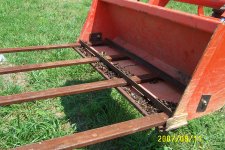
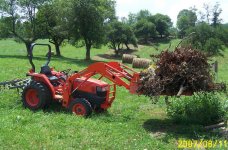
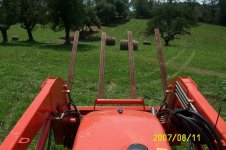
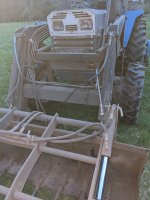
So my brush forks were a wee bit long but you can pick up a ton of stuff. It's rusting away (not sure where) once I got my grapple, these were forgotten about....
 

Attachments

  • DCP_0763.JPG
    DCP_0763.JPG
    2.7 MB · Views: 168
  • brush.forks.jpg
    brush.forks.jpg
    427.2 KB · Views: 158
  • Front.jpg
    Front.jpg
    303.3 KB · Views: 166
   / Optimal Shape of Brush Fork tines?
  • Thread Starter
#10  
Honestly, that's a good design and a great example of the kind of forks that many have built here. Do you remember how long these forks were and what wall thickness of tubing you used? The details are worth noting here for anyone else thinking through the design issues.

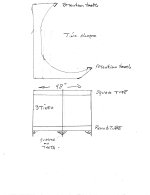
Because I keep stabbing the ground, I'm sort of leaning towards a design that would act as runners that could be run on the round under the material but have a round tube to limit the depth that I could run the tines into the ground. I'm also thinking that I want something with a curvature to act as a cradle so when I tilt the tines backwards for transport, the material is going to want to stay in place. I would also incorporate a retention tooth at each end of the tine.

I think I need at least one center tine to keep from bending the front tube. Maybe two center tines?

I should have mentioned that my L2501 has the quick attach loader. My intention is to build forks for the QA mount so I am not limited by having to adapt forks to the Kubota bucket.
 

Attachments

  • brush fork profile.jpg
    brush fork profile.jpg
    421.5 KB · Views: 121
Last edited:
   / Optimal Shape of Brush Fork tines? #11  
If you are not using a grapple curved tines are going to be difficult to use as you approach brush piles and have to rotate bucket to get a points under brush... I preferred to use square stock and straight tines....

dsc02207-jpg.707275


Radiator/grill guard added later....

tines-backstop-jpg.714716


Material is 1.5 x1.5 X.140 but I think I would go thicker wall or larger dimension (2 inch) if I build another... And the more tines the less brush will fall through...
 
Last edited:
   / Optimal Shape of Brush Fork tines? #12  
I have used straight forks. They are good for penetrating a pile of brush, but I am bad about digging them into the ground while trying to get under the pile. I've bent some lighter duty forks doing that.
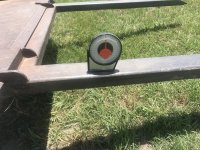
Bucket level indicator helps a bunch to keep tines from pointing down to much in front and digging in...
 
   / Optimal Shape of Brush Fork tines?
  • Thread Starter
#13  
If you are not using a grapple curved tines are going to be difficult to use as you approach brush piles and have to rotate bucket to get a points under brush... I preferred to use square stock and straight tines....

dsc02207-jpg.707275


Radiator/grill guard added later....

tines-backstop-jpg.714716


Material is 2x2x.140 but I think I would go thicker wall if I build another... And the more tines the less brush will fall through...
How long are your tines from end to end and how tall did you make your radiator guard, please?
 
   / Optimal Shape of Brush Fork tines? #14  
The tines are 48 inches overall with about 30 inches beyond edge of bucket (one 20 ft length of square tube)..... Grill guard is nothing more than some 1 inch angle iron (salvage) welded up and anchored to tines with nothing more then a couple of tabs with bolts through tabs... Guard rests against top of bucket and just a couple of short chains to hooks on top of bucket to stop it from flopping around... Guard is 36 inches tall.....Also there is a spacer and a section of flat stock welded to tines at front of bucket to create a slot to capture front edge of bucket to make the more or less solid to bucket (but can't find picture) ...

guard-2-jpg.701380


Method of attachment of tines to bucket...

bolt-3-jpg.686034


IF you get into any heavy lifting (sections of tree trunk) I suggest rear ballast...
 
Last edited:
   / Optimal Shape of Brush Fork tines? #15  
Maybe it is worth pointing out the Titan debris forks for design ideas. They're exceptionally highly reviewed for a clamp-on bucket attachment, and not just on their website. Youtube reviews are extremely favorable. Price is similar to a tooth bar at $300.

Clamp-on Debris Forks

191281_01.jpg


I wonder about the upside/downsides of flipping the angle cut on the front of the tines.

I have some 1.5" square stock I cut for a diy pallet fork attachment (not done to show you yet). I don't think you would call it square tube because it's solid 1.5" square. I think it was some kind of drill/boring rod. Anyway, i cut it at the steepest angle i could on my horizontal bandsaw and plan to run the angle opposite of what is shown on those debris forks. I get that it makes sense to face the angle the way it is faced in that picture but i suspect that flipping it helps a bit in not digging in, and doesn't really hurt in terms of picking things up either because just pushing down with the loader/bucket a bit will probably sink the front edges down almost flush in the ground and at that point they will 'float' in the dirt like some kind of skids. That's the theory, anyway..
 
   / Optimal Shape of Brush Fork tines? #16  
I like my straight round ones . easily replaceable and with no front bar they penetrate well.

They and the tractor are pretty dirty from pushing the burn pile back today . Cough.
At least we didn't fall in the pit :)
 

Attachments

  • PXL_20220504_234737323.jpg
    PXL_20220504_234737323.jpg
    4.6 MB · Views: 195
  • PXL_20220505_031509948.jpg
    PXL_20220505_031509948.jpg
    2.5 MB · Views: 192
   / Optimal Shape of Brush Fork tines? #17  
Maybe it is worth pointing out the Titan debris forks for design ideas. They're exceptionally highly reviewed for a clamp-on bucket attachment, and not just on their website. Youtube reviews are extremely favorable. Price is similar to a tooth bar at $300.

Clamp-on Debris Forks

191281_01.jpg


I wonder about the upside/downsides of flipping the angle cut on the front of the tines.

I have some 1.5" square stock I cut for a diy pallet fork attachment (not done to show you yet). I don't think you would call it square tube because it's solid 1.5" square. I think it was some kind of drill/boring rod. Anyway, i cut it at the steepest angle i could on my horizontal bandsaw and plan to run the angle opposite of what is shown on those debris forks. I get that it makes sense to face the angle the way it is faced in that picture but i suspect that flipping it helps a bit in not digging in, and doesn't really hurt in terms of picking things up either because just pushing down with the loader/bucket a bit will probably sink the front edges down almost flush in the ground and at that point they will 'float' in the dirt like some kind of skids. That's the theory, anyway..

I had massive logging forks and early Titan bucket clamp forks that have the bottom bevel. Think they work better off road with less digging. Kinder on picks when not level. Like the bottom bevel for tractor fork work. Don’t see them made that way as much any more. Best tool for digging sweet potatoes.
 
   / Optimal Shape of Brush Fork tines? #18  
This brush forks is about 25 years old. Made for moving 6´ round hay bales. Four feet long. Slips on front of bucket and 2 nuts hold it on the back side. Slip on and off. There is a rear cross member on back side that needs replacement now after all these years. One tine has a slight bend on it. Mostly used for logs and firewood now. It probably needs a third tine in center. I have a bucket level that tells me position of tips. I can’t see the tips unless I stand up.

6A4E95DE-20FC-4CF3-9978-4AE5B91E4AD7.jpeg
 
   / Optimal Shape of Brush Fork tines?
  • Thread Starter
#19  
I like the idea of round tines that are also replaceable, but I didn't find any round stock at the scrap yard. I looked at buying hay spear spikes, but they were going to be over $100.

Vigo327, I also wonder why the Titan forks put the bevel on top instead of under the forks.
 

Marketplace Items

2012 Ford F-250 Pickup Truck (A59230)
2012 Ford F-250...
2021 MULTIQUIP 25 WHISPERWATT DIESEL GENERATOR (A59823)
2021 MULTIQUIP 25...
2020 DRAGON ESP 150BBL ALUMINUM (A58214)
2020 DRAGON ESP...
2004 Saturn VUE SUV (A59231)
2004 Saturn VUE...
2006 Ford E-350 Enclosed Service Van (A59230)
2006 Ford E-350...
(20) WOOD PALLETS (A60432)
(20) WOOD PALLETS...
 
Top