360* Rotating Back Blade Project

   / 360* Rotating Back Blade Project #41  
Mornin Larry,
Looks like you have come up with a great idea ! And with Robs help Im sure it will turn into reality ! Glad to see you guys hooked up and put your collective minds to work together !

Reading through the thread, I thought I was serving my apprenticeship allover again ;)

One question on the keyway you broached. Couldnt you find anyone with a hydraulic press ? All you really needed to do was make a plug to fit the bore on your lathe, mill a keyway through the plug and use a keyway broach with shim stock for progressively deeper cuts !

Great thread, and I will be following along!
 
   / 360* Rotating Back Blade Project
  • Thread Starter
#42  
scott_vt said:
....."One question on the keyway you broached. Couldnt you find anyone with a hydraulic press ? All you really needed to do was make a plug to fit the bore on your lathe, mill a keyway through the plug and use a keyway broach with shim stock for progressively deeper cuts !

Great thread, and I will be following along!

Thanks Scott! -
Re the Keyway fiasco - your right - just goes to show you what I know :rolleyes: At least I've learned something and know better now.

Rob's made incredible progress since my last post - He's letting me compile all his efforts for posting here - I can barely keep up with him. :eek:

Larry
 
   / 360* Rotating Back Blade Project #43  
I am humbled by the machine work.

WOW!
 
   / 360* Rotating Back Blade Project #44  
GuglioLS said:
I guess I bored everyone ? no replies yet :confused:

Larry

No, not bored here, just found the thread. Very cool project. I want to be a machinist when I grow up and I'm running out of time :eek:

Monte
 
   / 360* Rotating Back Blade Project #45  
A masterpiece in the making ...but, there is one thing on which I am unclear. When you started the design, as I understand it, you had planned to use your pto, which drives "horizontal" so the worm gear is the cat's pajamas...but, once you switched concepts and decided on a hydraulic motor, couldn't you just mount it vertically and use rotary gears--your "flywheel" idea? or, perhaps sprocket and chain drive ...of course, it would have to be enclosed for safety, but might not need to be in an oil bath ...(naive questions, I'm sure... perhaps the issue then would be making sure ground forces couldn't change the angle of the blade?)
 
   / 360* Rotating Back Blade Project #46  
JoeL4330 said:
A masterpiece in the making ...but, there is one thing on which I am unclear. When you started the design, as I understand it, you had planned to use your pto, which drives "horizontal" so the worm gear is the cat's pajamas...but, once you switched concepts and decided on a hydraulic motor, couldn't you just mount it vertically and use rotary gears--your "flywheel" idea? or, perhaps sprocket and chain drive ...of course, it would have to be enclosed for safety, but might not need to be in an oil bath ...(naive questions, I'm sure... perhaps the issue then would be making sure ground forces couldn't change the angle of the blade?)

A worm gear (with the right worm angle) won't let the blade drive the motor. Once the motor has stopped turning, the blade can't move. No pins or other locking device needed to hold the blade angle. The motor doesn't even need to be locked.

Monte
 
   / 360* Rotating Back Blade Project #47  
montejw said:
A worm gear (with the right worm angle) won't let the blade drive the motor. Once the motor has stopped turning, the blade can't move. No pins or other locking device needed to hold the blade angle. The motor doesn't even need to be locked.

Monte
That's right Monte,
The worm which drives the worm gear has a helical angle of 4°-16' which is considered a "self locking angle" (generally under 5°). So the worm gear (attached to the blade) will not rotate the worm ... which is attached to the hydraulic motor. It locks there until the motor starts to drive it again.
 
   / 360* Rotating Back Blade Project #48  
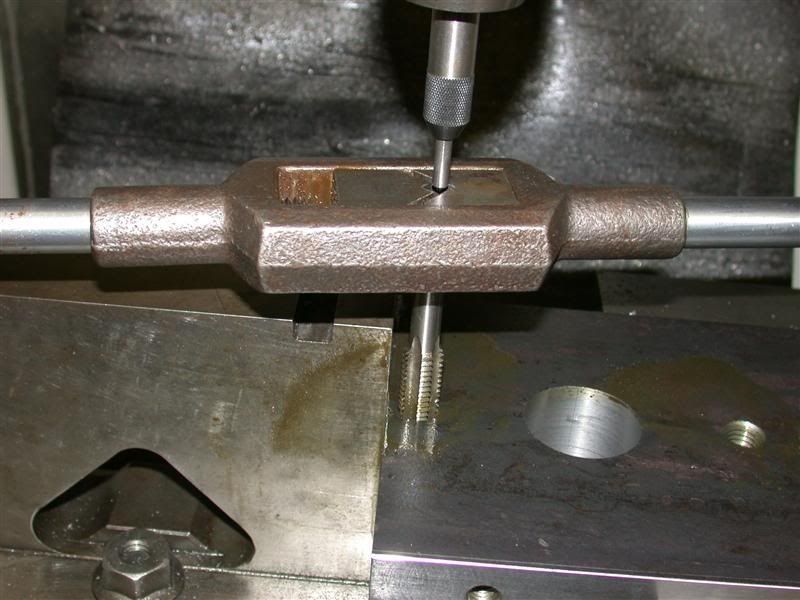
I got the side plates tapped 1/2-13 for the bolts that will hold the hydraulic cylinder on. This is a bottom tap and the holes are shallow so I started them by power tapping in the mill for a couple threads only. Then finished off by hand with a tap handle and a tap guide to keep it on location. The tap guide is spring loaded and keeps pressure on the end of the tap to keep it straight.


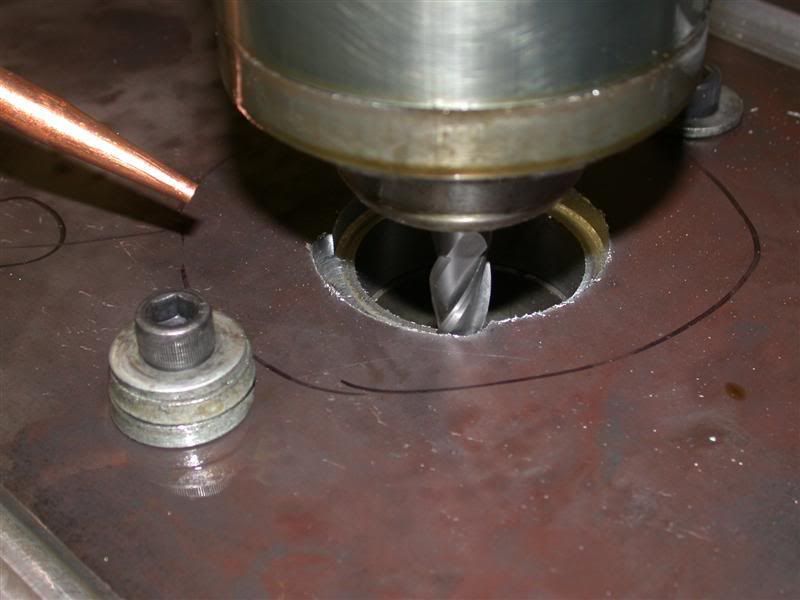
Next, I set up the bottom plate so I could rotary table out the counter bores for the bushing that hold the thrust bearings. I had to add 2 more holes to both top and bottom plates because I had no way to clamp the large plates to my 12" rotary table. ??? So I tapped them 1/4 NPT for additional fill and drain holes.

Here you can see how the plate hangs out over the rotary table. This is what we call a "knuckle buster" set-up, where when you rotate the handle, you get to smash your hands on the plate.

 
   / 360* Rotating Back Blade Project #49  
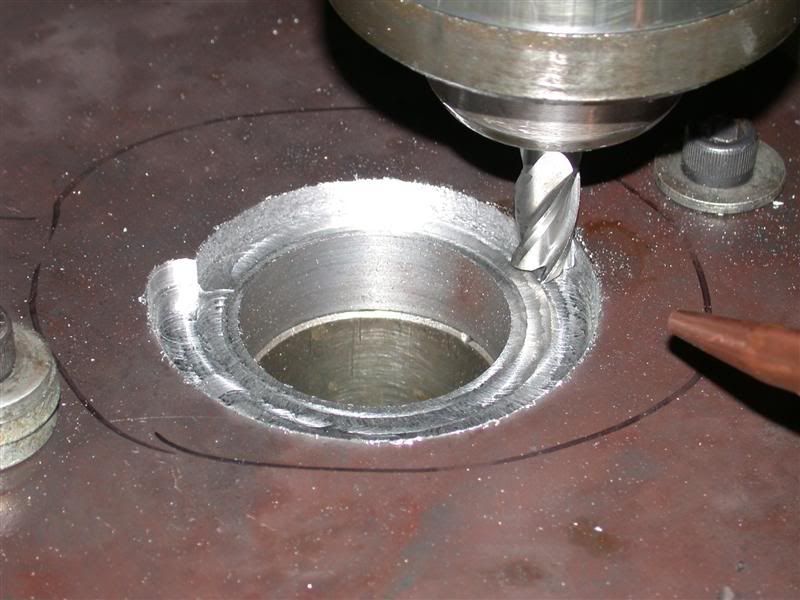
A couple more shots beginning the rotary table work for the counter bores.


I will switch cutters when I near the diameters (on all the RT work) to establish a nice flat bottom and cut the OD within .010" of finished size. Then I will re-indicate the original bored hole to be sure it is on center of the quill, and use the boring head to finish the OD right on size. I am shooting for a light press fit for the collar. Then I will TIG (heliarc) weld it permanently.


I'll have to do this to both sides of the top and bottom plates for collars and oil seals and also to the side plates for the worm collars and seals. I'll post more when I wake up.
 
Last edited:
   / 360* Rotating Back Blade Project #50  
The photos leave no doubt about the workmanship... Not to be the salt in your beer or something, but if i ever make a gearbox like that, i think i'd just weld up a box and then surface mill the mounting surfaces and drill the mounting holes... Off course that is a bit low tech compared to what you guys are making, but if it does the job, it's fine for me.

I assume it's all depending on the trade you work in. If you work daily at a precision machine shop, this is the most likely approach. If you work in the trailer fabricating industry (like myself) where tolerances are to the few mm, instead of to the nanometer, the approach gets a totally different reference point.
 
   / 360* Rotating Back Blade Project #51  
Renze,
I agree with you that if it does the job it's fine for me. I am a Dutchman too and appreciate your efficient way of thinking. You may have seen some of the other stuff I've made for my own tractor and I use that approach a lot.
But this project is a return favor for one that Larry did for me already. I place a lot of value in our friendship and this is exactly what he wanted. I promised him I'd help him with the machining aspect of it so he could finish his project he's been dreaming about for a long time. I am retired so this is fun for me and I appreciate the opportunity to help someone else for a change, especially after what Larry has done for me already.

Some of the details about machining are just to get my post count up.:D What's really fun that it's all being done on my stone age equipment in my garage shop, the old school way before CNC, EDM, Wire machines and automated equipment took over. It might take some guys back a few years to when they first started out in the trade like Scotty for example.
I'm glad you are enjoying Larry's thread. His home made project will be pretty cool when it's finished.
 
   / 360* Rotating Back Blade Project #52  
I know what CNC means, but what's EDM ???
I did get all that stuff at school, though we started on the old Deckel mills like mentioned in this thread before.

What can i expect to pay for an old but usable mill and lathe ? Lately i decided that i have exceeded the age to spend all my hard earned money in the pub and the dancing, but i'm young enough to be able to invest in workshop toys (because i dont have a wife and kids that need money too...)

I'm not sure what the best investment will be long term, but for now i'm happy buying metal working toys. :p
 
   / 360* Rotating Back Blade Project #53  
Renze said:
I know what CNC means, but what's EDM ???
I did get all that stuff at school, though we started on the old Deckel mills like mentioned in this thread before.

What can i expect to pay for an old but usable mill and lathe ? Lately i decided that i have exceeded the age to spend all my hard earned money in the pub and the dancing, but i'm young enough to be able to invest in workshop toys (because i dont have a wife and kids that need money too...)

I'm not sure what the best investment will be long term, but for now i'm happy buying metal working toys. :p

I'm a wannabee machinist. EDM is Electrical Discharge Machining. Basically you create an electrical circuit with your part and a shaped electrode. You point the electrode at your part and the electricity sparking between the electrode and your part eats away at the part. There's way more to it than that, but it's sparks for the most part.

More simply, have you every jumped a car starter, or directly across the battery? What happened? You probably lost a little bit of the tool you used to make the jump. EDM in action.

Monte
 
   / 360* Rotating Back Blade Project #54  
Hmm In Holland, literally translated, EDM is just spark machining. Well i think its only used to make microscopic holes in diesel fuel injectors and similar micro size, mega precision work.
 
   / 360* Rotating Back Blade Project #55  
Renze said:
Hmm In Holland, literally translated, EDM is just spark machining. Well i think its only used to make microscopic holes in diesel fuel injectors and similar micro size, mega precision work.

I don't think that's all it's used for. One example is machining very hard metals, tool making, etc.

Monte
 
   / 360* Rotating Back Blade Project #56  
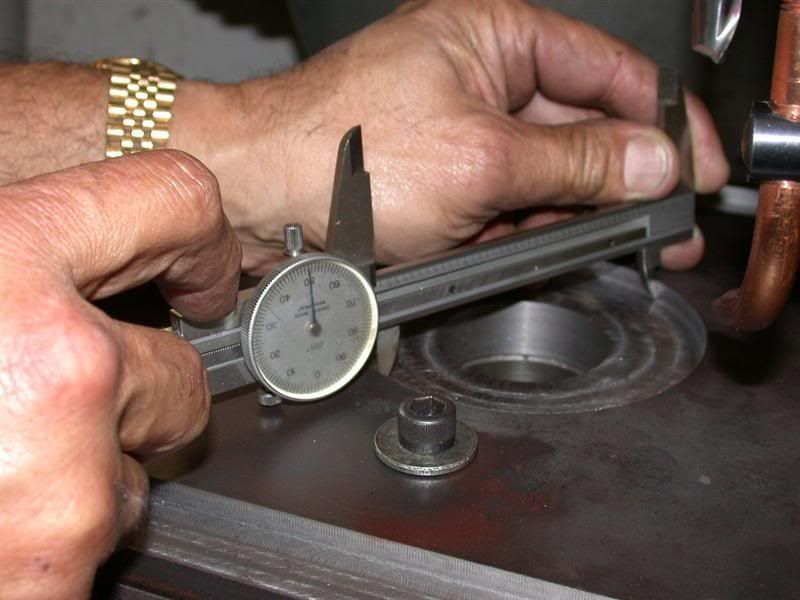
Before finishing the bores to the final size, I had to measure them accurately. Here are a couple ways that I use since I don't have a dial bore gage. Most of my stuff is stone age but still accurate.
This first one is checking with the dial calipers across the diameter, but that may not be the best way to do it. But if you are doing it without forcing, you can get a very good measurement that way. Double check a couple of readings with them and be sure the jaws are square to the bore.


Next way is a little more accurate. These are telescoping gages. They are spring loaded outwards and you move them around so they are expanded to the fullest inside the bore, but tilted a little so one end is deeper in the bore than the other and they are expanded larger than the bore. But on a shallow bore like this it's harder to do. Then you lock them and drag them out square to the bore so they collapse to the real bore diameter. With them locked, they stay in that position/dimension. Measure over the rounded tips with a micrometer and repeat to verify it is a good reading.


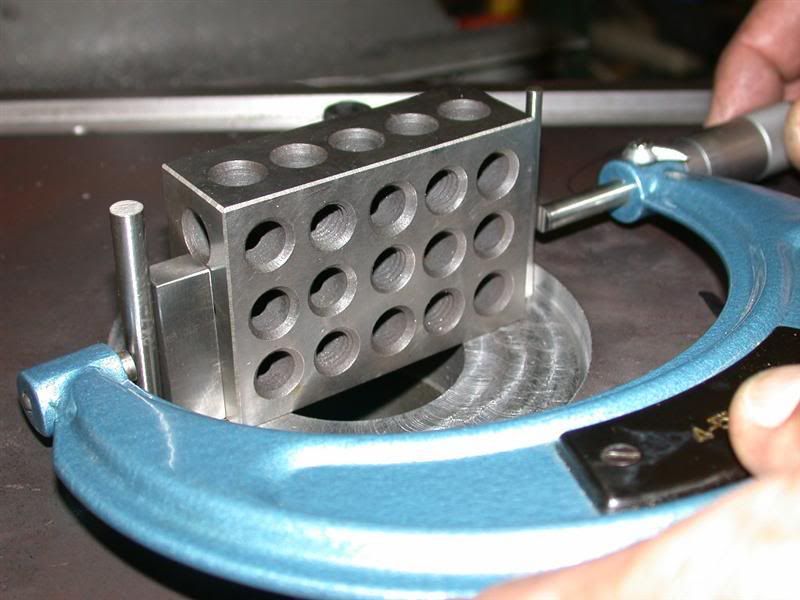
The last method and most accurate (that I have) is using gage blocks and gage pins. They are marked as to what size they are exactly and you fit them into the bore until you get a "snug" fit. Add them up and that's what the measurement is. The gage pins I have are a "minus" set so they are .0002" (2 ten thousands of an inch) under the size written on them. So I generally mic over the stack to verify the dimension. You can get excellent readings this way.

 
   / 360* Rotating Back Blade Project #57  
For reference, here is a set of gage pins. I have sets from .010" to .060" diameter, .061" to .250"diameter, and .251" to .500" diameter sets of these. There are large sets too, but as you saw above, I combine them with gage blocks or use more than one pin to check larger bores.


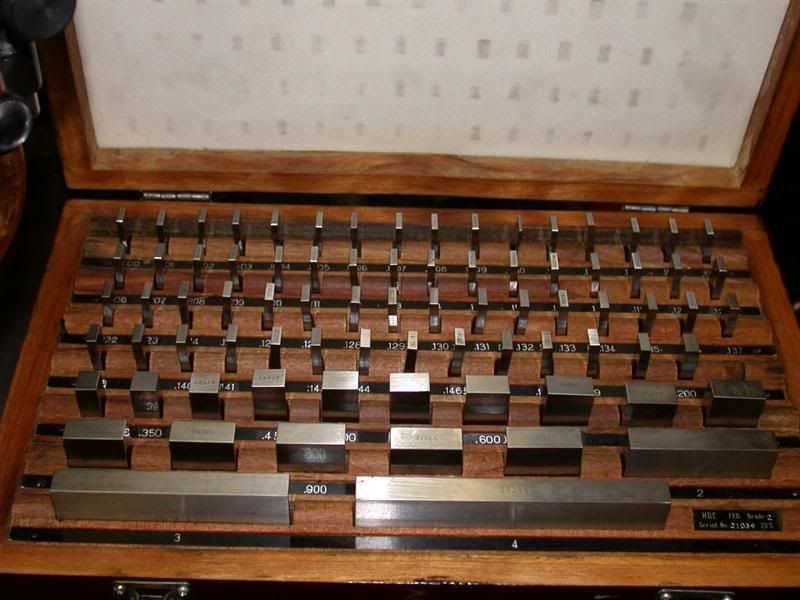
This is an 81 piece set of gage blocks that are accurate to .000050" (fifty millionth of an inch). They are certified ... or were and can trace the certs back to Bureau of National Standards. You can stack them together to measure larger pockets or whatever.

 
   / 360* Rotating Back Blade Project #58  
I flipped the plate over so I could start on the oil seal pockets. The first one went pretty quick and I made it a .005" press fit. I measured Ø2.570" and I made the pocket Ø2.565". I also made a tool to seat the oil seals.
Here is the first one.


Well that was easy so I did the second one but guess what? That oil seal was .005" smaller than the first one. So my pocket was a perfect slip fit instead of a press fit. DANG, should have measured them both!!! After all, I did that with those collars that were not the same diameter. I better fix it or Larry will have a cow.
So I TIG welded a small bead all along the inside of the bore and reset it up to re-machine again.


What a pain!!! But after re cutting it, the bead came out perfect with .005" press fit. I used 420SS rod so the cut would not be super hard. I stayed off the finished bottom and also avoided welding over the top edge. Had to stay between them on the .230" tall wall. Welding along the ID was hard job! But now he won't even know the difference.


Here they are both all pressed in and ready to go. That made me happy again.


BTW, I figure between all the rotary table pockets, roughing and finishing passes, I will make at least 80 to 100 passes or turns of the rotary table. You do the math on how many cranks that is ... just on the RT alone, not including the mill or lathe or surface grinder work. Gee thanks Larry. ;D
 
   / 360* Rotating Back Blade Project #59  
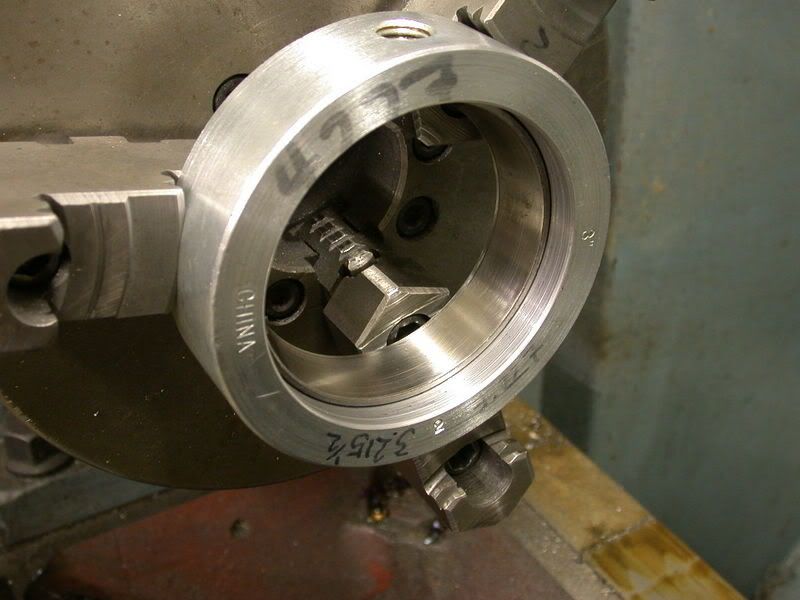
Next for my vacation project was to turn the collars to accept the thrust bearing races. Larry has 2 sizes and the larger 2" bearings did not fit the collars like the smaller 1-½" ones. Great.
So I set up in the lathe and indicated the pieces in. My 3-jaw chuck is not that great and decided not to use soft jaws, but rather shimming the collars if needed.
Here is some .001" shim stock I will use to get the collars dead center.


Since the collars are located by their OD, I indicated in the OD and didn't worry about the ID since I would cut that anyway and it would run true to the OD. I could not bear checking to see if their OD ran concentric to their ID anyway. That would drive me nuts if it didn't.


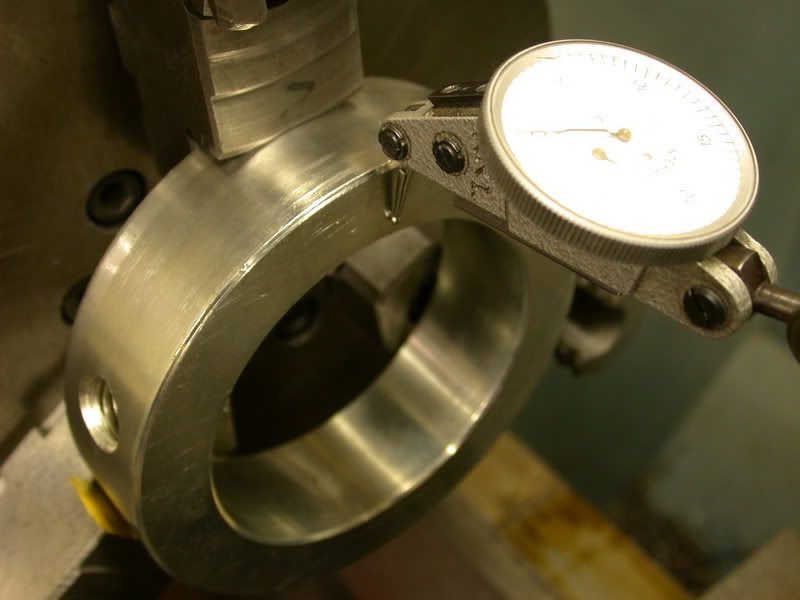
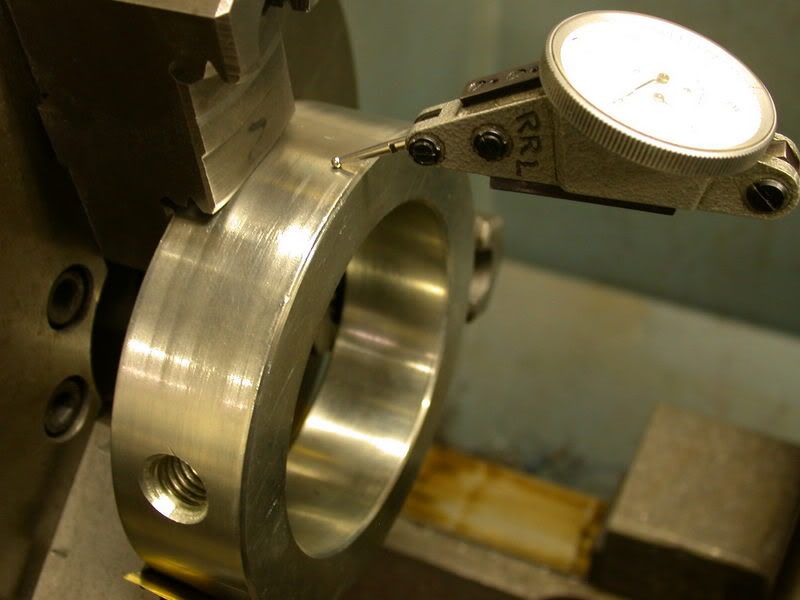
Not only does the OD have to run true in the chuck, but the face has to be flat too. So I had to indicate the face for flatness so the new bore is square to the face.


That's how you do that before you start cutting anything. I got the face dead flat and the OD to run within .001" total indicator reading meaning the MOSt it would be out of center is .0005" (five ten thousands of an inch). Not the greatest, but plenty good enough for these big slow turning gears. Another thing to remember is that one of these collars is held in the top lid. There will be a slight amount of clearance (.001") in the way it (the lid) fits the box anyway, so Larry can take it off and on.
 
   / 360* Rotating Back Blade Project #60  
Once I got everything indicated properly, I started boring out the collars. Turns out they are hardened!!! So I used an old 1" solid carbide end mill and put it in a boring bar holder. Now the tool and holder was short and stubby for maximum rigidity. My old AcraTurn lathe ate it up and never missed a beat.
Here I am checking the bore for size.


I wanted a very good fit here and the lathe repeated nicely. I mean when I dialed another .0005" it cut that exactly. I love my lathe.
Here is the bearing race tapped into the collar bore....Another perfect job done in record breaking time. ::)


Tractor & Equipment Auctions

KNOW BEFORE YOU BID - DO YOUR HOMEWORK AND BE HAPPY WITH YOUR PURCHASE (A60430)
KNOW BEFORE YOU...
2019 PJ TRAILER 32FT GOOSENECK (A55745)
2019 PJ TRAILER...
2018 BOBCAT E45 EXCAVATOR (A59823)
2018 BOBCAT E45...
Husqvarna Riding Mower (A56857)
Husqvarna Riding...
Caterpillar 906M (A53317)
Caterpillar 906M...
2008 INTERNATIONAL MA025 FLATBED (A55745)
2008 INTERNATIONAL...
 
Top