Backhoe Attachment for breaking bedrock

   / Attachment for breaking bedrock #1  

ransonjd

Bronze Member
Joined
Apr 16, 2017
Messages
53
Location
Rochester, NY
Tractor
BCS 605
I'm having a guy dig a 1000' long, 2' wide trench for several conduits for electrical and cable to my house. The utilities want them down 3'. Unfortunately, we have a strip, maybe 100' long where they hit bedrock at 1'. (Completely unexpectedly. We had deep hole tests that were 5' and 7'+) Is there a good tool for a small excavator that will let us break through the bedrock and get the trench depth that we need, without breaking the bank?

Thanks!

--John
 
   / Attachment for breaking bedrock #3  
My neighbor has an industrial, air powered jack hammer. He uses it to hammer holes in our basaltic lava and install T-posts for barbed wire fencing. He has helped me with this equipment - on my fence line - many times. But Lordy - we are hammering 2 1/2 inch diameter holes about 14" to 16" deep - every 14 feet. You are talking about a trench three feet deep by two feet wide by one hundred feet long. I don't think this is the kind of equipment you want.

I'm thinking more along the lines of a skid steer with a "rock cracker" that is front mounted.

I don't know what constitutes "breaking the bank" - BUT - I got a real strong feeling - that ditch is not going to come cheaply.
 
   / Attachment for breaking bedrock #4  
I would complete the ditch as much as you can with your excavator, then attack the remaining part by either renting a hydraulic jack hammer to fit your excavator or renting a skidster with a breaker attached to finish the job.
As said, finish the ditch so that you know that you don't have any other spots that may need to have the jack hammer.

On the cheap, you could rent or buy a 90# electric jack hammer to do the work manually while using your excavator to scoop out the broken rock. Not an impossible task to do by hand assuming you have a generator to run the jack hammer. Much depends on the strength of the rock though. I was working in Saudi Arabia where we needed to put an 8" diameter line in across some rock they called marl. It is a kind of limestone that is super hard. We had a large excavator (don't remember the model) fit with a hydraulic jack hammer. It would put the hammer down, lift the front of the tracks and hammer away. It worked on this for 2 days finally getting a trench about 12" wide by 6" deep about 20 feet long. The Aramco inspector finally agreed to just getting the pipe deep enough so a 1/2 ton pickup could drive over it would be acceptable. We couldn't drill and blast in the area due to existing well head and tanks so jack hammer was all we could use.

Hopefully your rock is softer than the marl we had in Saudi Arabia.
 
   / Attachment for breaking bedrock #5  
I saw an episode on TV where they had rock in trench, they cleared what they could and then laid conduit. After inspections, they poured concrete for the section that was less than required depth. Perhaps some concrete encasing the conduit would meet the requirements for that section.
 
   / Attachment for breaking bedrock #6  
Maybe talk to utility about a waiver.
Especially if you agree to put cable in a conduit (which may be pricey too).

Will cable go under a driveway or roadway? Is the cable coming from a pole mounted transformer Is it less than 600 volts? Does the cable come from a "Underground Secondary Service Riser Pole?" Probably a 120/240V secondary service? Does the name of your utility sound something like "National Greed"?

If so, ask them where in there Specifications for Electrical Installations (formerly ESB-750) does the 3' depth requirement come from? It may be (hint: Section 4.5) that the utility requires your service lateral depth to be as "per NEC Requirements" . NEC Section 300.5 allows cable to be anywhere from 4" to 24" deep depending if its direct burial, in conduit, under a concrete slab (or encasement), under vehicle traffic, etc...

nimo.jpg
 
   / Attachment for breaking bedrock #7  
I'm having a guy dig a 1000' long, 2' wide trench for several conduits for electrical and cable to my house. The utilities want them down 3'. Unfortunately, we have a strip, maybe 100' long where they hit bedrock at 1'. (Completely unexpectedly. We had deep hole tests that were 5' and 7'+) Is there a good tool for a small excavator that will let us break through the bedrock and get the trench depth that we need, without breaking the bank?

Thanks!
--John
for something like that, look into explosives, a hole is drilled every few feet, and dynamite is put into the holes, and exploded, it fractures the bedrock, making it easy to remove the broken pieces!.. this can, and has been done by experts.. they can topple a large skyscraper only a few tens of feet away from a new, and wanted building that can't be damaged..
 
   / Attachment for breaking bedrock #8  
When the power company ran power back here to my house - they used explosives. A skid steer with a long tip - chunked out a 4" hole about seven feet deep. Then some stick explosives and fill the hole almost to the top with high nitrogen fertilizer. I was building the house, here, at the time but they always came down the driveway and got me when they were ready. We would drive back - they would prepare the charge - we all crawled under one of their big utility truck - BOOM.

One hole per day - took two weeks to do the eleven poles. It was a fun break from the house building daily routine.

It took six utility vehicles - one skid steer with the rock chisel - eight utility workers. They left all their vehicles & equipment in my yard and drove home every day in two vehicles.
 
   / Attachment for breaking bedrock #9  
Code requires 4 inches of concrete extending on all sides and down to the rock if less than required depth. BUT, utility companies make their own rules and you must comply.
 
   / Attachment for breaking bedrock #11  
There's a whole line of explosive products called "PowerTrench". Or there's a rocksaw. I don't know which would be more expensive.

Rocksaw (1024x768).jpg
 
   / Attachment for breaking bedrock #12  
   / Attachment for breaking bedrock #13  
My dad used dynamite, back when the local hardware store sold it.
 
   / Attachment for breaking bedrock #14  
I see that you are in NY, is your bed rock shale, granite or a limestone.
Shale will sometimes peel up from one direction but be almost impossible in any other.
A rock saw on a ditcher would work on most any, and will leave a nice cut to work in.
Drilling and blasting also works well but will leave a bunch of jagged pieces.
 
   / Attachment for breaking bedrock #15  
Code requires 4 inches of concrete extending on all sides and down to the rock if less than required depth. BUT, utility companies make their own rules and you must comply.
also, the OP lives in New York, which has different codes than Florida or Georgia!..
 
   / Attachment for breaking bedrock #16  
When I dug the ditch for power to my house the utility company agreed to let me fill the ditch with concrete if I fails to get the 3 foot depth. I managed to get the 3 feet all the way across but it was surprising.
 
   / Attachment for breaking bedrock #17  
Ran into this years ago in Birmingham, AL. Much easier to drill and blast plus it's more fun!
 
   / Attachment for breaking bedrock #19  
That is too bad that you hit bedrock. When it is unexpected and halfway into a job, that is really frustrating! I am so sorry, I know the frustration of wanting to finish a job and can't due to circumstances out of your control.


But bedrock always fascinated me.

Being a welder by trade, I used to work construction, driving piles among other things. Test bores meant nothing, we might sink a pile in one spot and go down 4 feet, then in another sink it down to 120 feet before we hit bedrock, and it might only be 20 feet apart!!

On my own land, my well proved bedrock was 40 feet deep, but a mere 200 feet away it is on top of the ground.

In my gravel pit, back in 1969 they dug with a front shovel, but the bucket then was only 5/8 of a cubic yard. Whenever they hit "bedrock" they would move over and dig in another spot, making the location today pockmarked by craters. But having gone back in with excavators and loaders of todays, some machines hitting 5-6 cubic yards in size, we have found these outcroppings of bedrock were just massive boulders. In construction we had to pound the pile 2 feet into the bedrock to prove it was indeed bedrock and not just a big boulder.

 
   / Attachment for breaking bedrock
  • Thread Starter
#20  
I spent some time yesterday with the excavator operator. We found that while you can't get the excavator through the smooth areas, if you find a crack, you can slowly rip into it. The rock comes up in large, thick slabs.

He got a jackhammer on a bobcat after I left, and apparently was able to cut about 50' in a few hours with a helper. He opened a wide trench with the excavator, drove the bobcat down the trench with the jackhammer, and then cleared the trench with the excavator. The jackhammer cracks the rock enough that the excavator can get hold on it and rip it out.

Thanks for all the ideas. If my luck holds out, we should be through the rock today.

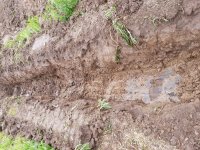
I've attached some photos of the trench and the bedrock after ripping it out. I think it's shale, which was probably a lucky break.

IMG_20180522_111656.jpgIMG_20180522_111706.jpgIMG_20180522_113322.jpg


Tractor & Equipment Auctions

2 - WEATHER GUARD TOOLBOXES (A55745)
2 - WEATHER GUARD...
500 BBL FRAC TANK (A58214)
500 BBL FRAC TANK...
Towable Dewatering Pump (A59228)
Towable Dewatering...
12FT X 20FT STEEL CARPORT (A58214)
12FT X 20FT STEEL...
2007 CATERPILLAR 725 OFF ROAD DUMP TRUCK (A52707)
2007 CATERPILLAR...
2019 CAT 259D (A60462)
 
Top