Concrete slab with 3pt mixer

   / Concrete slab with 3pt mixer #1  

sevilla

Silver Member
Joined
Feb 25, 2006
Messages
116
Location
New England
Tractor
L3830
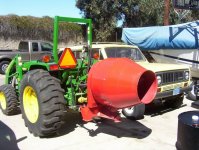
Hi everybody, I have a few questions for a project I will start this spring (hope at least): I intend to build a 12 x 16 feet concrete platform on my driveway. My plan is to build 4 inch of concrete on 4 inch of compressed 3/4inch-crushed stone. Since I'm going to do it alone or, better, with my kubota 3830, I intend to divide the platform in 4x4feet sections separated by 1.5 inch space (the thicknes of the 3x4 forms. I live in an area with frequent and severe freeze-thaw exposure. So my questions are: will this plan work? do I have to fill the gaps between the concrete sections with expansion joint compound or sand and gravel is ok? I'm inclined to think that ice buildup in the joints may move the concrete sections rather than cracking them. Also which is your experience with a 3 point mixer and would it work in my case? I'm considering the Northern or the Tractor Supply ones which seem identical. Thank you very much for any advice you could give me.
 
   / Concrete slab with 3pt mixer #2  
hi sevilla:

I used a 3 pt mixer this past summer with not so good results. while it technically WORKED it was only really good for very small pours, maybe a 3 cu foot job ( 30 shovels of gravel 20 sand and 10 mix) was all it would hold & mix. I have a 4500 lb tractor 28 hp unit, that amount of mix was all that the tractor & mixer would want on it with out fear of breaking stuff. the mixer I had spin too fast as well. with my PTO and engine at idel it turned fast enough that instead of mixing when it was sticky it would stick to sides of drum until it was nearly all way at top then fall off and drop to bottom of drum. this was a LOT of hammering stress on the 3 pt. while I suffered no damage it was apparent that with any more mix sticking like that and it would be easy top shear off something. Also that amount of mix was about enough for a footer for a pole in a pole barn, it wasn't enough to do much so had to make many small patches which is harder on every one involved and then small batch differences made the mix batches not stick all that great together. I was making a pour around an under ground tank for reinforcing only but was not impressed at all.

freeze thaw will push the slabs apart in the application you are looking for as well as mix may not be all that good. while they are better than HAND mixing, I would say only by a little bit. they are slow in my opinion as well.

SO if you want one rent one first, then try & buy a used one if you like it and finally as last resort get new... I don't think that you will be as happy with the result as if you did it as one solid reinforced pour using a truck to bring it in.

mark M
 
   / Concrete slab with 3pt mixer #3  
I poured a 8x12 pad last spring for a bathroom building. It was a lot of work. I bought the largest mixer I could get 1/3 yard I believe, but you can't get that much into it so it took forever. I also split the pour into fourths and used an expansion joint. The job took me over three days to pour. If I were to do it again I would just have a cement truck show up and pour it in a few hours.

I do like my mixer and have used it alot for smaller jobs, my tractor is a JD 990 and I have had no problems with the 3pt or the pto being too fast.
 

Attachments

  • mixer.jpg
    mixer.jpg
    210.7 KB · Views: 1,403
  • bathroom slab.jpg
    bathroom slab.jpg
    181.2 KB · Views: 979
   / Concrete slab with 3pt mixer #4  
I second the idea of having a cement truck come and pour. Mixing yourself with a drum mixer can be hard work. 12 X 16 isnt much but still you're talking about at least a couple of long days labour, followed by back ache and blisters.
Better to get a buddy or two to come and help spread and level the pour, have it done and dusted in a couple of hours and grab the deckchairs and beer to sit back and admire the cement as it dries...

I like the idea of 4ft X 4ft "tiles" you are going to make. Would you have grass grow in the 1.5 inch gap? I have a neighbour that has 2ft X 2ft squares with a 2" gap and he grows fescue grass in the gaps... Looks really well I have to say. Dont know how it would work out for you if you have really hot summers though...?

Good luck with what ever you decide to do!!
 
   / Concrete slab with 3pt mixer #5  
I 'third' the cement truck idea. With everything considered, it's not that much more expensive and it is a heck of a lot easier on the body. I've used mixers of all types, and they will work great for small jobs, but once you get above two or three yards of concrete, you're way better off with a cement truck. Your back will thank you... The mixing isn't the hard part, it's getting the mix into the mixer that kills you.

If you do go with a truck, you might consider doing a 6" slab instead of a 4". A 4" is a little under 2.5 yards, and the 6" will be about 3.5 yards. If you're using re-bar (you should), you could potentially forget about the complex expansion joints and that extra $100 for an extra yard of concrete will be money well spent.
 
   / Concrete slab with 3pt mixer #6  
I fourth the cement truck. You will still be doing it yourself, getting the area ready to be poured and setting your forms, but not having to mess with mixing batch after batch of cement. And as others have mentioned, it probably won't cost you much more, in fact subtract the cost of the mixer and you are money way ahead.
 
   / Concrete slab with 3pt mixer #7  
If you don't like the idea of a cement truck delivery due to costs (2.5cu yards is probably below their minimum) and or high labor involved in an instant pour, another alternative is to rent the portable wheel-barrow/trailer that many concrete providers have. It will hold 1 cu/yard and around here, costs no more than the cost of the concrete. You tow it home behind your truck and a hydraulic ram tilts the trailer/wheelbarrow up to spill the concrete. Of course your Kubota can still come in handy.... pour the concrete into your bucket and bring it to the slab. Aside from screeding and finishing the concrete, you should be able to complete this in a few hours (certainly in 1 day) with a minimum amount of back breaking work. Plus, this allows you to work by yourself if you like, at your pace. Rather than 4x4 sections, this method also allows you to do a single pour with rebar reinforcement although with the weather you have there, I recommend at least a 6" pour. If it is not a continuous slab, the sections most certainly will shift over time and create a trip hazard.
 
   / Concrete slab with 3pt mixer #8  
The secret to pouring concrete is to have a solid base underneith it. Is the dirt alreayd compacted? Will you be adding or removing any dirt? If so, you need to be sure to compact it. When you add gravel, it must be compacted. Most people don't do this right and just spread it out and drive over it with a car. This will work in time, but nobody will spend the hours and hours that it takes to get it right. Others use a plate compactor, which is more for patios and light duty compaction as in paver bricks. If you use a plate compactor, get the biggest one you can and spend a few hours with it. Four inches is about max for what it can compact.

Having four seperate pours increases your odds of movement in one or all of them. Concrete expands and contracts from tempature. It's always moving to some degree, which is why it always cracks. To make it as strong as possible, you need the rebar to connect all four pads if you do it this way. I would use PT 1x4 lumber in between the joints and drill holes through it for the rebar.

If you are set on buying a cement mixer, compare the price and size of an electric one from a place like Home Depot or other stores. They work really well and don't involve having to keep your tractor running. If you have electricy handy, it's allot easier way to do it. You can also sell it when you are done quickly as there are about impossible to find used.

I've done up to 2 yard pours mixing cement in a mixer. It's a long, back breaking day that you will wish you hadn't started. Buying the cement in sacks from the store is expensive and not as strong of cement as you get from a concrete truck. The aggrigate (rock) is just small pea stone in the sacks.

For small pours like what you are planning, I like to rent a cement buggy from US Rentals. You get one yard in the buggy already mixed and ready to pour. Here, the going rate is $145 a yard, which is expensive, but if you only need a few yards, it's cheaper then the minimum on a cement truck.

Cement is one of those things that is very dificult to get a good result fron without years of practice and experience. If you have a nice house and this is going to be done where others will see it, I'd hire it done. I'm a General Contractor and know my limits on what I can and cannot do with concrete. A nice, finished pour that people will see isnt' something that I'll tackle myself.

For what you will pay for the cement mixer, you can probably have the whole thing poured by a crew of experts who will get it done right the first time with results you will be proud of.

If you mess up on concrete, you are stuck with the results. There is no forgiving or fixing a bad pour.

Good luck,
Eddie
 
   / Concrete slab with 3pt mixer
  • Thread Starter
#9  
Thank you all for the replies: it looks like my idea was a little ambitious. I'll check with a contractor. Thanks again.
 
   / Concrete slab with 3pt mixer #10  
sevilla said:
Hi everybody, I have a few questions for a project I will start this spring (hope at least): I intend to build a 12 x 16 feet concrete platform on my driveway. My plan is to build 4 inch of concrete on 4 inch of compressed 3/4inch-crushed stone. Since I'm going to do it alone or, better, with my kubota 3830, I intend to divide the platform in 4x4feet sections separated by 1.5 inch space (the thicknes of the 3x4 forms. I live in an area with frequent and severe freeze-thaw exposure. So my questions are: will this plan work? do I have to fill the gaps between the concrete sections with expansion joint compound or sand and gravel is ok? I'm inclined to think that ice buildup in the joints may move the concrete sections rather than cracking them. Also which is your experience with a 3 point mixer and would it work in my case? I'm considering the Northern or the Tractor Supply ones which seem identical. Thank you very much for any advice you could give me.

Concrete slabs are hard work and, if you're a novice, you'll probably be less than satisfied with your DIY effort. My DIY limit was reached with a 4x8ftx4" thick slab for my masonry barbecue pit. That was one long day.

Spend the $$ and have a concrete contractor do the job right.

Or, if you really want to do it yourself, do the site prep and forms yourself and then hire a couple of concrete workers to moonlight and help you with the pour and the finishing. Getting a good surface finish is not easy unless you have the experience and the equipment (magnesium floats, etc).
 
   / Concrete slab with 3pt mixer #11  
I've done a lot bigger pours than that by hand, but you really need at least two and better three people. One to mix and dump and two to screed and trowel. This way it isn't too bad, and you can easily finish in a day. But one man doing it is a heck of a lot of work, and you will wish you wouldn't have done it this way!
 
   / Concrete slab with 3pt mixer #12  
sevilla said:
Thank you all for the replies: it looks like my idea was a little ambitious. I'll check with a contractor. Thanks again.

Actually, you can do a significant amount of the labor yourself & save quite a bit.

Instead of getting a concrete contractor to do the whole job, you can set the forms and rebar yourself and then hire an experienced concrete finisher for the day of the pour. About 4 months ago we did a 20' x 25' slab and an 8' x 8' x 12" thick slab in the same day. The finisher charged $400 for the day.

I am certainly no contractor, but I have done similar sized projects 8 or 10 times over the years and it has always worked out perfectly for me. I get the concrete delivered in a truck. The biggest job I ever did we used 3 truckloads.

I would never attempt to do the finishing myself, but all of the preparation and forming is actually pretty easy.

Building my new house, the contractor hired what he claimed were the best concrete guys he knew of, and I was appalled at their work. I could do better with my eyes closed.

For instance, they tried to just put the rebar on the ground and claimed they would "pull it up" into the center of the slab as they poured the concrete. I have taken apart a number of slabs poured this way and inevitably the rebar gets stepped on by someone working the wet mix and it ends up at the bottom of the slab, adding almost no strength. I made them used "dobies" which are small cubes of concrete with wires sticking out of one face to space the rebar off the ground. They knew all about them but were two lazy to use them.

And, their work has cracked more in 6 months than the stuff I did myself 20 years ago.
 
   / Concrete slab with 3pt mixer #13  
I'll just add one item to consider, if you build your forms yourself, you might consider a trench around the perimeter, so the concrete is thicker around all the edges. This strenght is helpful when driving things on and off that surface.
In my dad's feedlots, we used a true 4" thick w/wire mesh, but with this perimeter trench at 7"-8" and he as never had a break when driving tractors and heavy loaded manure speaders onto the concrete from the "dirt" areas. Note: Because cattle tend to carry dirt away from the edges, many times your tires have to drive UP to get back on the concrete(lots of stress).​
We did 13 truck loads in that lot, 30 years ago, and it is still in perfect shape. This may not really apply to your situation, but you probably understand the principle.
 
   / Concrete slab with 3pt mixer #14  
CATMAN said:
I'll just add one item to consider, if you build your forms yourself, you might consider a trench around the perimeter, so the concrete is thicker around all the edges. This strenght is helpful when driving things on and off that surface.
In my dad's feedlots, we used a true 4" thick w/wire mesh, but with this perimeter trench at 7"-8" and he as never had a break when driving tractors and heavy loaded manure speaders onto the concrete from the "dirt" areas. Note: Because cattle tend to carry dirt away from the edges, many times your tires have to drive UP to get back on the concrete(lots of stress).​
We did 13 truck loads in that lot, 30 years ago, and it is still in perfect shape. This may not really apply to your situation, but you probably understand the principle.

:D I see concrete guys around here use a 2 x 4 form (3 1/2") and then add more fill on the inside to save material costs :rolleyes: I like your dad's method better.
 
   / Concrete slab with 3pt mixer #15  
davitk: My older brother builds grain bins and pours the concrete floors also. 4" thick is standard, but he tries to talk all farmers into at least 5" thick pads. It really isn't that much more expensive(all material, labor is the same). Most farmers will do it.
 
   / Concrete slab with 3pt mixer #16  
I did a 12X30 slab a few years back. I did the trench around the perimeter, I believe 18"deep and 2 ft wide ( I like to overbuild ), and a 4" slab.
I hired out the finishing, but built the forms myself.
The prep involved removing the sod and organic matter from the ground, which is basically taking off 1-2 in. off the top. Then drive over the ground with the tractor and renting a compactor to compact the ground. Then lay out your form work with the 3-4-5 triangle method. Also take a string and measure from corner to caddy corner making sure they are the same length. Add 3-4" in. of crushed stone, you can use a variety, I think I use what they call 57 rock. Compact that. Lay a vapor barrier, a 6mil plastic sheet you can buy at your favorite home store. Use rebar for the perimeter and the slab. I think I used rebar for the perimeter and wire mesh for the slab. Make sure you keep the wire mesh off the barrier. They sell these plastic chairs that hold those off the ground about an inch or two. Then hire yourself a couple of guys to help you pour and finish. Make sure you vibrate the concrete as it starts to settle, that gets the bubbles out. You can also tap the sides of the forms or vibrate them with a concrete vibrator to get a nice finish on the sides.

As far as the depth of the concrete, I live in a warm climate with a non existent frost line ( 1" or so ), so I'm not sure. I think you may have to take your perimeter deeper in order to avoid cracking from the freeze/thaw cycles. I'm no expert on that but if you find out let us know. I'll be moving to a colder climate and would like to know myself.

Sam
 
   / Concrete slab with 3pt mixer
  • Thread Starter
#17  
Hi and thanks again. Yesterday i called a cement company that charges 104 $ per cu yard plus 125 for delivery if less than 7 cu yards. No delivery charges for at least 7 cu yards. This seems very inexpensive to me. They recommend 6 in thickness. I will contact a contractor soon and let you know. I have only one question that goes back to my original point. Since time is no big problem to me, what about doing one 48"x48" sections at a time with the sections independent from each other? I know that I can handle this kind of work (I have done by hand many concrete posts around the house all at least 42 nnch deep in a very rocky place). The goal is only to park the car near the house and avoid the mud and to use it when I need to work on the tractor. Thanks again.
 
   / Concrete slab with 3pt mixer #18  
4 foot squared are easily something that just about anybody should be able to handle on their own. Easy to scree, easy to float and small enough that you don't have to panic when there's not enough time to get it right because it's such a small area.

If you do this, then the price of having it delivered becomes a factor for such small amounts. Instead of paying allot of money for a 3pt cement mixer, buy an electric one. If you will need to mix concrete in other areas away from you souce of electricty, you can buy a generator. That's what I did. If you don't want a generator, then the 3pt mixer makes sense. I like my electric mixer and use it all the time, it's all steel and should last me for decades.

The only real problem to those 4ft squares is whether you will like the look of them or not? If the look is something you like, then there are other advantages to doing it this way too. If you decide that you want more area, it won't look odd to add on to it with more 4ft squares. You're just making giant pavers, so more of them will just add to the overall effect.

Spacing them and not having them touch means you are relying on each one for it's individual strength. It also means that each one will have the ability to move on it's own. Remember Murpheys law. With one solid slab, it's less likely for it to move due to it's sheer size. With a bunch of small slabs, the likelyhood of movement increases dramaticaly. The rock base will help and is a very good idea, but is still no garantee.

Every option has it's pros and cons.

Eddie
 
   / Concrete slab with 3pt mixer #19  
As someone else mentioned, you can 'pin' them together with rebar. I'd make it a single slab, but that's just me.

The 6" seems like a good idea. 5" is recommended for a garage floor, 6" if you have heavier vehicles.

I think what you want to ask for is 5000lb air-entrained concrete (I think the slang is '6 bag mix'). 'Air entrained' means that there are tiny bubbles in the concrete that helps it withstand freeze/thaw cycles. Rebar and mesh are OK, but also inquire about fiber mesh re-inforced concrete. They mix in millions of tiny fibers that end up incredibly strong. Not that expensive, either.

Use the vapor barrier, it helps prevent 'sweating', and don't make the mistake of polishing the surface, concrete can be awful slippery when smooth (and wet).

My 2 cents.
 
   / Concrete slab with 3pt mixer #20  
Years ago I poured a 12 x 24 foot patio (5") - using a large mortar box (~15 cu ft) and hoe. I simply poured it in two 12 x 12 slabs. Small visible seam, but look pretty good and held up for the 15 years I was there. Used one helper to load sand gravel and portland while I layed and help transport mud from pan while I was laying. Each slab took about 6 hours (Sat/Sun)

I am actually contemplating this again for toy barn/garage slab - like 24 x 36. The site is so far back in the woods and steep slopes, I'm not sure how to truck it in. I dread the idea, but if I go that route I think I would still use the pan v.s mixer. In my mind, unless I use a 9cu ft mixer, the pan will still be faster. Since I wouldn't buy a mixer that size ($$$) and since I would need to do this over extended period of time, renting would be a pain. Would definately use bulk sand and gravel with 90# of portland versus pre-mix. If I get two pans, get my two teenage boys humping, I should be able to pour footers and slab in 3 or 4 weekends...hmm teenager + 12 hr day...maybe 6 weekends
 

Tractor & Equipment Auctions

Deere 50D (A60462)
Deere 50D (A60462)
2012 TOP HAT TRAILER GOOSENECK FLATBED TRAILER (A58214)
2012 TOP HAT...
2015 Ford Escape SUV (A59231)
2015 Ford Escape...
2018 Husqvarna 21in. Push Mower (A59231)
2018 Husqvarna...
2000 Morbark Towable Brush Chipper (A59228)
2000 Morbark...
2016 KENWORTH T680 TANDEM AXLE DAY CAB (A59905)
2016 KENWORTH T680...
 
Top