International 444, 1968. Progress Thread, Getting Going

   / International 444, 1968. Progress Thread, Getting Going #1  

FlyFishn

Silver Member
Joined
Jul 17, 2024
Messages
180
Tractor
IH 444 gas
For quick reference here are a couple other related threads:
Pre-purchase - International 444 gas - been sitting for years.
Trailering - Trailer rails are 76" apart, tractor with wheels is 82" wide - take wheels off?

We just bought a 1968 International 444. For some of the details on condition see the 1st thread above. As I work through the machine I will log things here in this thread and see where the related discussions go.

For starters - the gear shift moves front to back, but not side to side in the neutral position. I can't tell if it is in R/1 or 2/3 yet.

Contrary to the sellers claim, the steering DOES work. We steered it getting it loaded. It doesn't move much without the hydraulics, but we were able to move it enough for what we needed.

The engine was cranked a few times to test the hydraulics. I noticed once we got it loaded it was leaking some fluid from under the transmission, maybe between the transmission and engine. I did not check close to see what kind of fluid, other than it appeared light colored and yellowish. I do not know how much of a leak there was prior to the cranking. Though, I'm sure there are many leaks on this old machine.

What ever is leaking, I hope I can slow it down. I need this for tillage and don't want that much oil getting in my soil.

The left wheel brake seems stiff/sticky. It is harder to push and does not return like the right one.

Here are a couple pictures of the dash. There are some missing knobs etc. I need to study what all they do. I know one of the rods is the choke.

20240728_141443.jpg
20240728_141438.jpg
 
Last edited:
   / International 444, 1968. Progress Thread, Getting Going #2  
Brake hanging up/sticking sounds like one of the springs, or more that hold the actuator plates together may be broken, and slotted ramps the ball bearings ride in may be rusted along with those ball bearings. They are pretty easy to service. Disconnect the brake rod, remove the bolts holding the brake housing to the tractor and everything comes off in your hands, except the back brake disc. It should stay on the bull pinion shaft. This is a link to the Case/IH online parts catalog showing the brake assembly in an exploded view. Case IH | Schematic, Manuals, Specifications and Diagrams for controls, brakes, brake lock and connections | MyCNH US Store

Hopefully the bull pinion shaft seal isn't leaking and have the brake discs soaked with oil. But, if they are unless totally worn out, you can literally boil the oil out of them with a propane torch. Hang them up somewhere outside, and heat with a propane torch, oil will drip out of them. Might want to place a catch pan underneath because they actually will hold a lot, and it will be a smokey job. Keep heating until oil stops dripping. Let them cool than hit with some spray brake cleaner. I went a step further and roughed the surface up with a 2" medium gasket removal Roloc disc on my 90º air die grinder. If you don't have one of these, it'd be a great investment and save you a lot of time and effort. I got mine at Harbor Freight 30-35 years ago, have used it a lot and still works great. The Roloc head you can get about anywhere, disc's I get generic one's at Flea Markets and last as long, or longer than the OEM Roloc discs. The fellow I get mine from sells on Ebay but see him at Flea Markets in our area. Flea Market price is 50 discs for $20 but may be more on Ebay. None the less, they are well worth it. VERY handy for just general cleanup of mating surfaces.

As for the leak coming from the mid-section I'd have to guess either the rear main engine seal or seeing that the hydraulic reservoir is in the mid-section behind the bell housing, and the drive shaft running through the middle of it all, the front seal, possibly the bearing is out. Only way you'll find out is to split it.

Here also is a link to the complete online parts book for your 444, assuming it is a North American version. They also made a European model. https://www.mycnhstore.com/us/en/ca...erica/cn/4CCF6496-EFBE-E111-9FCE-005056875BD6 Items are listed by function group, although a little different than other models I've searched for parts. Brakes are found under "controls" in the menu, most others have their own function group for brakes, go figure. You'll notice it says 444 diesel tractor, but there was no separate parts book for the gas version. It will state on certain parts groups for gas models, so I assume everything is the same on both for many parts.

I found years ago the easiest way to find parts for older models is to use the OEM part number. Like when you open the link for the brakes above, it will show the exploded view to the left, description and part # to the right. If on a PC, copy and paste the part # to a good search engine, I get the best results using Google. You can check the price of parts from Case/IH by selecting part on the site, then it will prompt you to select a dealer. If you select your local dealer, the price should appear. Most generally price will be the same at all dealers, although I've had them vary a few dollars. Now you can compare prices for aftermarket parts, by copy and pasting to Google. You can look up bearings and seals too through NAPA online, or Motion Industries. Their systems will cross reference the part numbers and you'll get the National Manufacturers part number. Usually, CR Seals or Timken bearings. Once you get that part number you can even do some comparison shopping by using Google to search for them that way. I've even gotten many U.S.A. Timken/SK bearings searching on ebay for a fraction of the cost of dealer, or a parts house. Using this method and taking 20 minutes to search can save you a LOT of money.

If you don't have a service/repair manual I'd say it'd be a good investment. I took a quick look on ebay where I get a lot of mine and you can get a new reprint from $46 and up. https://www.ebay.com/sch/i.html?_fr...at=0&_odkw=International+444+manual&_osacat=0 You'll thank yourself for getting one when you get into repairs. They also have Operator manuals which can come in handy.

Your tractor has the C-153 engine, which is not listed in the online 444 parts catalog. Here is the link to that: https://www.mycnhstore.com/us/en/ca...BE-E111-9FCE-005056875BD6?categorySearch=true That too will come in handy, I'm sure. It will list every part Case/IH still handles for them. Beyond that you're only alternative is to get an OEM hard copy parts manual. I've had to resort to that on some of my older IH's because several years back they went through catalogs and deleted parts & their numbers. Seems it would have been a lot simpler for them to just add N/A in the description and leave the part number for a person to search for them. But most generally it's for castings, hitch parts, etc. Take for example you need an axle housing, but they deleted the part number. Your hard copy will have it listed. Enter that part number in Google, TractorHouse, or Ebay and it may pop up. About all salvage yards list parts by the OEM part number. You'll find the exact part you're looking for, rather than just using a generic search term, for example a "444 axle housing".

Sorry to make this post so long, but just trying to help to find things you may need a lot easier. But always do remember the easiest way to find a part is by using the OEM part number. And just searching Google may not show all available, so you need to try Ebay, or TractorHouse. Hope this helps.
 
   / International 444, 1968. Progress Thread, Getting Going
  • Thread Starter
#3  
Thanks for all the info. I wasnt expecting all that right up front.

I may have a copy of the service manual headed my direction already.

As to splitting the tractor to address some potential leak points/seals - I am hoping I dont have to do that just to get it "going".

My hope is I can get this to run to get the necessities going on our property thru the fall. We do want another machine (kubota lx3520hsdc I think is what we're going to get) but we need something to do the necessities without a whole lot of $ invested/no payments for a while.

So if I have to limp it on 1 brake and deal with some leaking so be it. When we have another machine, or time between (like winter), then we will have more time to do more work on the machine.

We'll see where this all goes.
 
   / International 444, 1968. Progress Thread, Getting Going
  • Thread Starter
#4  
I am hoping I can have the machine off the trailer this week. If not, this weekend. When I get back to it I can check the fluid leak mentioned. The loader frame that goes under the trans is where it is pretty wet, but where it was coming from I am guessing was between the engine and trans above it.

depending on how much work it will take to rectify the leak - I may rig up a drip pan or sling of some kind to get going for now. If it is real bad or fluids are mixing that will cause bigger problems if run that way then Ill cross that bridge if I get to it.
 
   / International 444, 1968. Progress Thread, Getting Going #5  
The 414 uses the same basic brake system.

 
   / International 444, 1968. Progress Thread, Getting Going
  • Thread Starter
#6  
Here is the SN plate. It says USA on it. I am not sure on the SN, other than it shows up on Tractor Data as a 1968 model year.

Thoughts?

20240728_153637.jpg
 
   / International 444, 1968. Progress Thread, Getting Going #7  
Odd it has a "0" as the first number, technically making it a 5 digit serial number, instead of 4 making it a 70 model, which started the 5 digit serial numbers.

Can't say I've ever seen any serial number, on any brand start with a zero. Older IH's serial numbers generally start with 501.

There's a good chance there is no difference in any parts between the '68 and '70 models, just have to use the parts manual and be sure they didn't change a part number at a certain serial number break.
 
   / International 444, 1968. Progress Thread, Getting Going
  • Thread Starter
#8  
I got the tractor off the trailer last night. While I was poking around with it I started studying it.

The fuel line is rotted off of the carb and tank. I should have everything here I need to get something on it, with a filter. The question is getting the tank out and cleaned enough to use. I am not sure if the port on the tank will clean up enough and/or not leak.

There is coolant, lots of it, in the radiator - so it hasn't leaked out.

I didn't have time to do any wrenching last night, but the 2 areas for sure that I want to work on for sure are the slide on the gear shift and the fuel system/tank/carb. Those will be first to address this weekend. And the ignition/start wiring.

20240730_173224.jpg
20240730_173224.jpg
20240730_173233.jpg
20240730_200952.jpg
20240730_201100.jpg
 
   / International 444, 1968. Progress Thread, Getting Going
  • Thread Starter
#9  
I also got the following manuals:

Operators Manual PN 1082661R2
Service Manual PN IH-201

I have not studied either in detail yet to see if everything matches, however the controls are called out in the Op Manual - so that is a good help up front.
 
   / International 444, 1968. Progress Thread, Getting Going
  • Thread Starter
#10  
More progress.

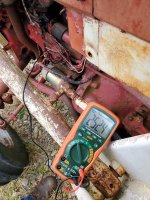
The only diagram I can find on the electrical is in, of all places, the Operators Manual. It calls out the previous parts that the online CNH site diagram had grayed out. So that is a bit more of a leg up. However, there are no "schematics" that I have come across yet. At least with the parts listed I can go to the rudimentary method of continuity and resistance checks with a multimeter...

On that subject -

The starter solenoid shows about 252 ohms across the coil. When I put power to the coil it did not engage. The battery on the machine is at about 11.5 volts. I also used a lithium battery that is about 13.5 volts. I got nothing but a little bit of spark. I had the ground connected directly and used the hot side as my contact.

However, I did not clean the terminals very well. So it is conceivable I did not get a good connection. However, with the spark you would think I would have had some better sense of the solenoid trying to engage...

That is not a high priority at the moment. We can jump the high current terminals and get the starter to go (and it goes strong) so there is a "way around it", just something to keep in mind down the road.

20240801_190427.jpg


20240801_191158.jpg


The distributor contacts don't look too bad. However, some ants have made a home there. I pulled some of the wires/plugs and they all are nice and shiny also. So I don't think I have that to worry about, but ya never know.

20240801_191940.jpg


20240801_191948.jpg


This was an earlier topic - the brakes. I did not get a whole lot of time yesterday to check much in detail, but I did get a picture underneath to show the linkages and springs.

20240801_192917.jpg


And last but not least for now - the fuel tank doesn't look bad on the inside at all. So it may work out OK. I will hose down the port with some brake cleaner when I get back to it to get the grease and gunk off and see what I got there. It may be OK.

I did find these gems in the tank, though. Anyone missing a maglite head? :D

20240801_193255.jpg


I got a fuel pump and some tubing coming. Unfortunately, they won't be here until next week. This weekend I am going to hammer on the machine as best I can - namely the carb and what I can of the electrical.

Speaking of which - I have not figured out the ignition just yet. I assume stopping the engine is by grounding out the power to the ignition coil. However, there is a voltage regulator listed on the diagram that I am not too sure on - where is the power coming from and what voltage is the regulator regulating at?

More later as I go.
 

Attachments

  • 20240801_190427.jpg
    20240801_190427.jpg
    729 KB · Views: 133
   / International 444, 1968. Progress Thread, Getting Going #11  
Hopefully this is a better wiring diagram than you have. Wiring Diagram 354-374-444 – International Harvester Heritage Association Note it is for a U.K. model so you'll have to compare to what you have. Looks like it'd be a lot easier to print those pages off if you're on a PC and have a printer.

I'm thinking VR output should be between 13.5- 14.5volts, depending on how low your battery is.

A quick look at the wiring diagram I'm seeing a ballast resistor. The 444 may be one of the models that when engaging the starter it puts 12 volts to the distributor for a good hot spark to get it to start. One the starter button is released it cuts that circuit then goes through another to run on 6 volts for longer contact points life. You've got some sorting out to do on that harness, but I'd be looking for the ballast resistor, and check voltage output.

Killing the engine is done simply by cutting current to the ignition. Not seeing a key switch, I assume one of the push/pull switches replaced a key switch.
 
   / International 444, 1968. Progress Thread, Getting Going
  • Thread Starter
#12  
Judging from the wiring I've been poking around with - I am not impressed at all with the integrity of it. The insulation is cracked and the copper inside is exposed/green pretty much all the way through the harness.

So I think the smarter way to go about this, unless I was to do a full tear down restoration, is to do all new wiring to the critical components to get it running.

I worked on it this weekend. I got the starter wired with a push button. I did have some issues with the starter - the gear wouldn't engage, it would just spin. I took the starter off and messed with it. I sprayed some penetrating lube on the clutch and shaft and now the gear will engage better, but still not 100% (has grinded some). Judging by the teeth on the gear - it has been doing that for a long while.

I also wired up the solenoid that is there. With actual crimps and screwing down on them making good contact the solenoid works. So that is a good thing.

Busy weekend. I will see if I can get some pictures up later.
 
   / International 444, 1968. Progress Thread, Getting Going
  • Thread Starter
#13  
Here is another mystery at the moment - the fuel shut off solenoid on the carb.

Is there a way to block that port? Or does the solenoid definitely have to be there and powered to get fuel thru the main jet?

Screenshot_20240805_092143.jpg
 
   / International 444, 1968. Progress Thread, Getting Going #14  
Welcome to the club. I've completely rewired more than several wiring harnesses over the years from small farm tractors to garden tractors. Some in the condition you have, to surgical bypasses which looks like yours may have one or two, to 12V conversion hack jobs.

The empty fuse holder seen on the lower dash is one point I see, along with a push/pull switch replacing the key switch possibly bypassing that fuse holder, unless there is an inline fuse holder that can't be seen under that dash. This is merely a suggestion, so take it for what it is worth. I'd put a couple inline fuse holders that use the AT (flat type) fuses in the wire that goes to what should be the key switch, but apparently push/pull switch, between where it picks up current to that switch, and another between that switch to the starter button. A few bucks now may save the entire tractor someday down the road, with all of the other wiring with the sheath exposed and possibly cause a short causing a fire.

Finding that starter gear in that condition, guarantee there are at least 2 spots on the flywheel ring gear that look about the same. I learned many years ago working with Dad that a 4 cylinder stops in 2 places, 6 cyl. in 3 places, and V-8 in 4 places. Both gears will need to be replaced to repair properly, but for now if you can turn the engine slightly to get passed that point it may very well let the starter gear fully mesh with the flywheel ring gear if you have the bendix freed up. I might also suggest once the bendix is freed up to use a spray graphite to lube it keeping things dry inside. Only suggestions from past experience.

You could have the starter rebuilt or get a rebuilt one but I wouldn't replace without replacing the ring gear too, or you'll only have the same thing later with the starter.

One thing I'd definitely check, which I believe I saw in the diagram is the wiring going to the coil. There should be 2 wires going to the coil, but one runs through a ballast resistor. It will put 12V to the points for a good hot spark to start when engaging the starter, but when you release the starter button current then will pass through the ballast resistor cutting back to 6V for extended contact points life. Since you have a multi-meter that should be easy enough to check the voltage.

That's a great idea taking pictures. I've been doing that ever since I got a digital camera, and now use my phone when tearing something down it may be a while before getting back to, or someday down the road. I save pics to a file on my PC and a couple even on a thumb drive for future reference.
 
   / International 444, 1968. Progress Thread, Getting Going #15  
Here is another mystery at the moment - the fuel shut off solenoid on the carb.

Is there a way to block that port? Or does the solenoid definitely have to be there and powered to get fuel thru the main jet?

View attachment 883657
I did a quick search for a fuel solenoid on the C-153 engine and by luck came upon a thread for one on a 444. Easier for me to post the link to that thread: 444 Fuel Shutoff Solenoid Then did a search for a "load adjusting needle" for a C-153: C-153 adjustable load needle - Google Search Then another search for a fuel solenoid for a C-153 engine and found this: 71358C92 Fuel Solenoid

In my mind I guess I always though the fuel solenoid was to cut fuel to keep them from dieseling when hot and seeing it that close to the exhaust sort of confirmed that. But seeing a load adjusting needle in the thread above shoots that out of the water.

Looking at your picture I'm not seeing a wire going to it. Either it's hidden or was removed/broken off. Either way, I'll assume it did run before. But also seeing that rubber fuel line that close to the exhaust looks like an accident waiting to happen. Personally, I'd figure out a way to make that connection with a metal line, but again merely a suggestion. If you choose to go with another rubber line I'd make some sort of heat shield, for what that would be worth. But a metal line that close to the exhaust sems like it would be pretty susceptible to vapor lock. Just my opinion. Engineers, gotta' love them...
 
   / International 444, 1968. Progress Thread, Getting Going
  • Thread Starter
#16  
The wire from the solenoid is broken off, the remnants are there inside the can.
 
   / International 444, 1968. Progress Thread, Getting Going
  • Thread Starter
#17  
One thing I'd definitely check, which I believe I saw in the diagram is the wiring going to the coil. There should be 2 wires going to the coil, but one runs through a ballast resistor. It will put 12V to the points for a good hot spark to start when engaging the starter, but when you release the starter button current then will pass through the ballast resistor cutting back to 6V for extended contact points life. Since you have a multi-meter that should be easy enough to check the voltage.

That's a great idea taking pictures. I've been doing that ever since I got a digital camera, and now use my phone when tearing something down it may be a while before getting back to, or someday down the road. I save pics to a file on my PC and a couple even on a thumb drive for future reference.
OK on all. As to the fuse idea - that is a valid one. I have a bunch of fuses, but not sure I have sutable holders. I can look, and order more if need-be.

The bit about the ignition you mention is really helpful.

That is what it looks like from the diagrams. And the 12v "hot start" comes from the start switch (button or key in "start" position) through the start solenoid. I find this a bit odd - Im not sure why that would pass through the start solenoid, other than for some kind of circuit protection/current limiting - but that is what the ballast resistor is for on the other leg of the ignition circuit.
 
   / International 444, 1968. Progress Thread, Getting Going
  • Thread Starter
#18  
OK, I need to add some humor to this thread. At least I about fell over laughing when I got the hood off the other day...

My God that is a Gorilla Weld if I've ever seen one :ROFLMAO:

But hey, if it works...

20240804_155544.jpg


Now to some other "uglies" - the exhaust portion of the manifold is cracked in 2 places.

It looks like the same weld treatment was attempted here also, but not to much success.

I'm thinking maybe a high temp JB Weld paste to seal these up with?

20240804_151929.jpg
20240804_151939.jpg
 
   / International 444, 1968. Progress Thread, Getting Going
  • Thread Starter
#19  
Finding that starter gear in that condition, guarantee there are at least 2 spots on the flywheel ring gear that look about the same. I learned many years ago working with Dad that a 4 cylinder stops in 2 places, 6 cyl. in 3 places, and V-8 in 4 places. Both gears will need to be replaced to repair properly, but for now if you can turn the engine slightly to get passed that point it may very well let the starter gear fully mesh with the flywheel ring gear if you have the bendix freed up. I might also suggest once the bendix is freed up to use a spray graphite to lube it keeping things dry inside. Only suggestions from past experience.
Here are a couple pictures showing the ring gear and starter. They aren't the greatest, but the ring gear doesn't appear to have any "missing teeth" in the area that is exposed. Just the gear on the starter seems like the tips of the teeth are worn down.

20240804_180843.jpg
20240804_180835.jpg
 
   / International 444, 1968. Progress Thread, Getting Going
  • Thread Starter
#20  
In my mind I guess I always though the fuel solenoid was to cut fuel to keep them from dieseling when hot and seeing it that close to the exhaust sort of confirmed that. But seeing a load adjusting needle in the thread above shoots that out of the water.
I am still chewing through this one.

Looking at the info (and thanks a bunch for the links) - if I were to guess - the solenoid actually controls air, not fuel, in that when it is open (off) it allows the vacuum of the engine running to draw air through the main jet, instead of fuel, there by starving the engine of fuel during shut down. The opposite would be true when the solenoid is closed (on) - the vacuum of the engine (with the assistance of the choke flap) puts suction on the main jet instead, puling fuel in to the intake.

Just a hypothesis at the moment.

If that is the case - then simply blocking that port would do the same thing - it would create a hard block to draw only fuel. That would line up with the link you posted on the replacement non-adjustable solenoid - one that doesn't have a needle valve in it.
 
Last edited:

Tractor & Equipment Auctions

2024 CATERPILLAR 255 SKID STEER (A60429)
2024 CATERPILLAR...
2017 Freightliner M2 106 AWD Terex Hi-Ranger 5TC-55 55ft Insulated Material Handling Bucket Truck (A60460)
2017 Freightliner...
2006 INTERNATIONAL 7400 6X4 DUMP TRUCK (A52706)
2006 INTERNATIONAL...
2008 JCB 190 ROBOT SKID STEER (A60429)
2008 JCB 190 ROBOT...
2020 PETERBILT 567 (A58214)
2020 PETERBILT 567...
2014 Ford F-250 4x4 Ext. Cab Pickup Truck (A59230)
2014 Ford F-250...
 
Top