stump speech

/ stump speech #61  
Just curious, if you have a backhoe why didn't you just dig them out?

 
/ stump speech
  • Thread Starter
#62  
Just curious, if you have a backhoe why didn't you just dig them out?

It's an experiment, as much as anything. It should be alot quicker than digging.
My personal reasons? the big JD is 2 wd, ground is muddy, BX is too small for that, JD blows hoses, and I'm too lazy to fix them all the time.
 
/ stump speech
  • Thread Starter
#64  
I'm wondering about the actual forces involved now. If I could do it with single chain on each end it would make it alot simpler. I need a way to set the pressure to the chain strength to avoid breaking expensive chain. I guess the gauge and the throttle will do it.
 
/ stump speech #65  
As far as the pressure gage, you can tee it in anywhere. For a permanent mounting, I would tee it in before the first valve. Then you can use it as a reference, and to trouble shoot your hyd system.

If you did the solenoid valve thing, you could stand off to the side or close up to adjust the chain. A toggle switch would extend and retract the hyd cyl.

Your cyl has a lot more force than the chain. This is grade 100 specs

http://www.1st-chainsupply.com/chain/gr43_spec.htm
 
/ stump speech #66  
If you have 2000 psi, and your cyl, you have a pull force of 21,598 lbs, and if you have 3000 psi, you have 32,398 lbs.

How old were those stumps?
 
/ stump speech #67  
Jake98, as I'm sure you know the greatest risk with this method of stump removal is the chain flying off the stump as it tilts. That said I had removed many stumps using this method and prefer to using a heavy cable since it cut into the stump and is less likely fly off the stump. If you're going to remove many stumps using the method you want to consider building a log winch frame/shield for your 3-point hitch and mount the hydraulic cylinder it. Design the frame to dig into the ground. This will create one anchor point that will not fail and is easy the move around and should save you time.
 

Attachments

  • logwinch.jpg
    logwinch.jpg
    55 KB · Views: 297
/ stump speech
  • Thread Starter
#68  
the one that came out was cut last year. I think to make it simple I'll put the gauge right on the rear remote line. Maybe just put a QA on it and plug it in temp. before I use a certain size chain to get an rpm setting that works for that setup.
J J you're the guy to ask, how variable is the pressure going to be by changing the rpm? am I going to get a good selection, or is it more of an on/off thing? thanks.
 
/ stump speech #69  
Jake, A guy who has decades in municipal equipment gave me a neat tip that not only helped me purge the long hyd hose lines for a project I did recently, but it also makes the lines, hoses useful for other things, easier to move and store AND protects the integrity of the hyd "implement" you just created.

the tip: install quick disconnects in each line a couple of feet from the cylinder, male on one line, female on the other. each stub hose on the cylinder has the opposing male or female fitting, ie one of each, so they too can be connected up to eachother when not using the cylinder.

That way, 1) to purge the new lines, you connect the ends of the "extension lines together and cycle the valve at the tractor, until all the air is out of the whole circuit. When you disconnect the lines at the implement end, they are full of clean filtered oil.

Then when done 2)The hoses can be disconnected from the cylinder and reconnected and then rolled up as one piece with the male and female connectors connected to keep eachother clean until the next use, and the length of hose is seperate from the cylinder so it can be moved easy and perhaps used for some other task. Finally as I mentioned, connecting the hose stubs coming from the cylinder keeps them clean ADN out of the way while you handle, move and store that device.

I thought is was a very slick idea and it sure did make me feel better about the purging process with the new hose. Not only that but I can leave the hose length attached to the tractor, sans the plow and cylinders, without worring about accidently hitting a hyd lever and "loading up" a dead headed line. For me is saves having to unthread the extension hyd lines off the tractor in the winter when I take the power angle plow off the FEL every once in a while to use the loader.

Also, I second the idea about getting a length of square, 120 grade, logging, choker chain. I use the stuff with my Farmi JL 601 logging winch and once it bites into a log, it ain't letting go, no matter what....... ONE WRAP.
 
/ stump speech
  • Thread Starter
#70  
Jake98, as I'm sure you know the greatest risk with this method of stump removal is the chain flying off the stump as it tilts. That said I had removed many stumps using this method and prefer to using a heavy cable since it cut into the stump and is less likely fly off the stump. If you're going to remove many stumps using the method you want to consider building a log winch frame/shield for your 3-point hitch and mount the hydraulic cylinder it. Design the frame to dig into the ground. This will create one anchor point that will not fail and is easy the move around and should save you time.

How did you remove stumps like that, did you chain the tractor to another tree? I was just out there trying to drag the stump out to get rid of it and I can't even get enough traction to pull it out of the hole.
Positioning of the cylinder is looking like a hand-truck job now. It was just about what I could lift untill I put the plates and shackles on it, now it's hurt the back territory.. I guess the fluid weighs something too.
I need the hooks to arrive, had I pulled it completely out of the hole I'm sure I'd be able to drag it down the hill.
 
/ stump speech
  • Thread Starter
#71  
Jake, A guy who has decades in municipal equipment gave me a neat tip that not only helped me purge the long hyd hose lines for a project I did recently, but it also makes the lines, hoses useful for other things, easier to move and store AND protects the integrity of the hyd "implement" you just created.

the tip: install quick disconnects in each line a couple of feet from the cylinder, male on one line, female on the other. each stub hose on the cylinder has the opposing male or female fitting, ie one of each, so they too can be connected up to eachother when not using the cylinder.

That way, 1) to purge the new lines, you connect the ends of the "extension lines together and cycle the valve at the tractor, until all the air is out of the whole circuit. When you disconnect the lines at the implement end, they are full of clean filtered oil.

Then when done 2)The hoses can be disconnected from the cylinder and reconnected and then rolled up as one piece with the male and female connectors connected to keep eachother clean until the next use, and the length of hose is seperate from the cylinder so it can be moved easy and perhaps used for some other task. Finally as I mentioned, connecting the hose stubs coming from the cylinder keeps them clean ADN out of the way while you handle, move and store that device.

I thought is was a very slick idea and it sure did make me feel better about the purging process with the new hose.nNot only that but i can leave the hose length attached to the tractor, sans the cylinders, without worring about accidently hitting a hyd leaver and "loading up" a dead headed line. For me is saves having to unthread the extension hys lined off the tractor in the winter when I take the power angle plow off the FEL every once in a while during winter.

That sounds good, especially not having the hoses in the way while setting up. I didn't purge them, didn't know about that. Wonder if I'm wrecking something..
 
/ stump speech #72  
Jake, use forks attached to the FEL to position the cylinder. Back the tractor up, attached the hyd hoses and you are good to go........

re purging, once the air is out, it is out. if the cylinder works in both directions well, then you should be ok.
 
/ stump speech #73  
The pressure is produced by the resistance to the force applied. As soon as the pump is turning, you have pressure. As more resistance is felt, the pressure builds, until the resistance is so great that it caused the relief valve to relieve. The rpm controls the volume/GPM to the cyl, and dictates the speed at which the cylinder works.

You may get a stump that will trigger the relief valve, and you will have to help the stump somewhat. Like digging on one side, or pulling from another direction. You could make a deadman pull also if no other stump is nearby.
 
/ stump speech #74  
Jake, use forks attached to the FEL to position the cylinder. Back the tractor up, attached the hyd hoses and you are good to go........

How about mounting the cylinder on say a 4"x4" wood frame, like a dolley without wheels, to protect it, keep it off the ground, make it easily pick up-able, etc. ... make it like a heavy duty pallet.

Actually if you did that, & your hoses are long enough, you could just leave it on pallet forks the whole time & operate it right from there. Just drive the tractor into position & drop the FEL to the ground before operating it. This will of course be after you're comfortable with how much & how far your pulled stumps fly all around.

(I feel like a Monday morning quarterback, making suggestions, while Jake is actually doing stuff!!)
 
/ stump speech
  • Thread Starter
#75  
Jake, use forks attached to the FEL to position the cylinder. Back the tractor up, attached the hyd hoses and you are good to go........

re purging, once the air is out, it is out. if the cylinder works in both directions well, then you should be ok.

I was thinking about a bracket or something where the cylinder would pick itself up, but that's getting ahead of the game..

I saw the cylinder had spit some fluid onto the rod the first time I used it so I guess that's where the air went. I was thinking it was because it was a cheap chineese cylinder, oops. Seems to be ok.
 
/ stump speech #76  
(I feel like a Monday morning quarterback, making suggestions, while Jake is actually doing stuff!!)

Bep, that is because "success has a thousand fathers, failure is an orphan"

:laughing:

Jake, I can imagine if the cylinder seals are expelling air, that SOME hyd fluid would go with it.......... If it stopped leaking...............good for you.
 
/ stump speech #77  
:laughing::laughing:
You beat me to the post Beppington, exactly what I was thinking but I was even too lazy to make the frame would just go with a good pallet with some boxes to store the chains n hoses.

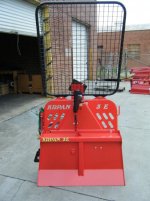
I wonder if the guy with the KRPAN forestry winch just uses his winch to pull stumps thru a couple of snatch blocks tied to another stump?

Rick
 
/ stump speech #78  
How did you remove stumps like that, did you chain the tractor to another tree? I was just out there trying to drag the stump out to get rid of it and I can't even get enough traction to pull it out of the hole.
Positioning of the cylinder is looking like a hand-truck job now. It was just about what I could lift untill I put the plates and shackles on it, now it's hurt the back territory.. I guess the fluid weighs something too.
I need the hooks to arrive, had I pulled it completely out of the hole I'm sure I'd be able to drag it down the hill.

I don't have log winch, wish I did. I have a neighbor who has a farm/landscaping business that has one it work great. Rips most stumps right out. The pto powered log cable winch digs into the ground so it becomes the anchor not the tractor. Winch frame bottom is curve like a plow so it will dig into ground when pull towards the log or stump. I bet if you could find some used "I" or "box" beams and some plating you could weld up a frame that would work.

Over the years I had to do it like you're doing, but I would away try to use a large live tree for the anchor. At least the anchor end could not fly off! If I was clearing an area I cut a few trees in a line, then winch the stumps. The winch would be anchor to the next line of live tree to be cut. Very manual tiring process. Chains are normally easier to remove from the stumps then cable, but I rarely have a cable fly off the stump. Chains had a tendency to roll off the stump if not wrapped well.
 
/ stump speech #79  
:laughing::laughing:
You beat me to the post Beppington, exactly what I was thinking but I was even too lazy to make the frame would just go with a good pallet with some boxes to store the chains n hoses.

I wonder if the guy with the KRPAN forestry winch just uses his winch to pull stumps thru a couple of snatch blocks tied to another stump?

Rick

I have Farmi JL 601 which is a BIG winch and it is rated at 13,200 pounds, less than half of the pullng power of Jake's 28,000 # set up. You could use snatch blocks to get to that point, but the force on the tractor may begin moving it around.. and it is a BIG tractor.
 
/ stump speech
  • Thread Starter
#80  
The pressure is produced by the resistance to the force applied. As soon as the pump is turning, you have pressure. As more resistance is felt, the pressure builds, until the resistance is so great that it caused the relief valve to relieve. The rpm controls the volume/GPM to the cyl, and dictates the speed at which the cylinder works.

You may get a stump that will trigger the relief valve, and you will have to help the stump somewhat. Like digging on one side, or pulling from another direction. You could make a deadman pull also if no other stump is nearby.
JJ, I'm wondering about a way to lessen the pressure, so that after I break the stump loose I can lower the pressure and switch to single chain to 'ratchet' it out of the hole. Any suggestion as to how to do that? Thanks again.


Marketplace Items

2016 Chevrolet Silverado 1500 Crew Cab Pickup Truck (A61573)
2016 Chevrolet...
1998 CHEVEROLET 1500 LONG BED PICKUP TRUCK (A59905)
1998 CHEVEROLET...
2019 JCB 3TS-8T Compact Track Loader Skid Steer (A61572)
2019 JCB 3TS-8T...
2000 FORD F-650 SUPER DUTY (A63569)
2000 FORD F-650...
UNUSED WOLVERINE 6' SLIP ON FORK EXTENSIONS (A64281)
UNUSED WOLVERINE...
2018 Ram 1500 4x4 Crew Cab Pickup Truck (A61573)
2018 Ram 1500 4x4...
 
Top