Want to get into haying - need some advice.

   / Want to get into haying - need some advice. #41  
My uncle feeds round bales to his horses. However, all of my horse customers only want small squares. I think the biggest thing is who has the equipment to handle the bales and the setup to feed and store them.
 
   / Want to get into haying - need some advice. #42  
You have to worry about mold when feeding round bales to horses. If the round bales have been stored inside and not rained on they should be safe to feed. If they have been outside long enough for mold to grow I'd be hesitant to feed the hay to horses. Cows don't seem to care. You can set out the oldest, moldiest hay you have to fill a ditch in the summer and the cows will leave lush green grass to eat the hay.
 
   / Want to get into haying - need some advice. #43  
There are a lot of misconceptions about horses and hay. For one thing, hay don't produce weight, grain does. People who have horses want square bales simply because that's what they were told to use, they saw fed on television or read in a book or by a "friend", I've heard from many folks that rounds are no good for horses. That's false, completely false. If a horse is stalled, squares work, but I have a question for you and all the other horse people here and that is in a natural environment is a horse stalled? Of course not. Horses are herd animals and they prefer to be outside so long as they have a sheltered area to get out of the weather. Horses don't like hail or rain driven wind. Other than that, nothing affects them. It's actually better to let a horse run. Horses develop bad habits like cribbing because they are bored and they don't like being contained in a stall. Horses on free range develop a better immune system, suffer fewer health problems and are much happier. My wife has a 32 year old old style Morgan who has never seen a stall until this winter and he just a spry as a yearling most of the time.

People build elaborate hoarse quarters, indoor riding areans and so on. For what? So the horses can, in boredom, chew it apart. Morton builds some fancy barns and stalls and a good horse can and will masticate it away in short order. /forums/images/graemlins/grin.gif

Our horses aren't treated like a "Herd". On the contrary. Our Percherons are very expensive, pure bred horses. One of our mares is a Salerno Degas granddaughter and she is one of 2 left in the world. We do stall the Percherons but only during foaling and only so that the vet and my wife and I can make sure the foal is okay, delivery went as planned, the placenta is expelled and so on. As soon as the foal has it's "sea legs" and is reasonably secure and is nursing, we turn the mare and foal out, only bringing them in at night and for the proper veterinary procedures. That nightly confinement is eliminated as soon as possible, that is, as soon as the mare/foal combination is accepted into the group and the mare has set her territory.

We have 13 stalls available at all times but we seldom use any stalls.

Back to rounds. Horse people for the most part don't have the equipment to feed rounds anyway and that's good for me and good for any hay grower, however, 99% of the horse people I deal with haven't the faintest idea what the difference is between good hay and poor hay. We perform either Near Infrared or Wet Chemistry on our hay segregating fields and cuts and can provide scientific analysis on all our forage if need be but that 99% wouldn't have any idea what they are looking at anyway. The prime reason we do chemistry is because we were selling rounds for dry cows and certain minerals in those rounds have to be below a pre-described level.

Our horses, because they free range, are very affectionate toward humans. We have never tried in any way to control or confine them and because of that, you can go in the pasture, any one of the pastures and they will come right up. You don't need a treat, they just like to be, should I say, groomed. Percherons weight in the excess of 2000 pounds each so you have to be very careful about where they place their feet. Their hooves on your feet, without steel toes can result in a trip to the emergency room and a cast. /forums/images/graemlins/grin.gif

I find that peoples misconceptions about horses are to my advantage in so much as forage sales. I chuckle about them though.
 
   / Want to get into haying - need some advice. #44  
I'm with you 5030 on it being to your financial gain about the horse folks wanting sqaures! Even with all the labor involved here I can make 3 times as much on sqaures as rolls. For my horses (Tennessee Walking Horses) they get the rolls.
 
   / Want to get into haying - need some advice. #45  
5030 sounds like a real hoot.Just seems to go against the grain to see a nice tb or warmblood getting all potbellied on hay.Seems I never stop learning things.
 
   / Want to get into haying - need some advice. #46  
That's referred to as a "hay belly". It does happen, especially with stalled horses but not with horses that free range. Again, grain and processed high nutrition feeds are what causes fat production, not forage.

Another widespread misconception is that if you feed a horse dusty hay it causes respiratory problems. It does, and a stalled horse confined and "force" fed dusty moldy hay can and will have problems. However, horses are smarter than their owners think they are. Horses haven't lived for thousands of years eating poor feed. Given a free choice and not a forced choice, horses will pick through bad forage and eat the good forage. I feed the same round bales that the feeder steers get to the horses and in 20 years I have never had any problems.

For amusement I like to go to hay auctions and watch the "cowgirls" and "cowboys" buy squares. Again, 99% of them buy hay on color and weight of the bale. To them, a good heavy green bale is what they want and pay an exorbitant price for it. Of course that heavy green high moisture bale is a time bomb for a confined horse but they think they are getting a deal.

There is a whole industry just devoted to horse owners selling them remedies, tack, clothes and whatever to fuel their misconceptions about horses but that's another story.

If I were to go to a hay auction (and I do buy hay on occasion), I always go with my Dlemhorst Digital Moisture meter and probes and I know the difference between good hay and poor hay. An informed buyer is a smart buyer but a smart buyer has to be educated and have the proper tools to make a wise purchase.

Many time I have made a liar out of a hay seller with the Delmhorst. It has a very loud threshold alarm that can be set for a predetermined maximum moisture. Just stick in the probe and when it starts screaming, everyone hears it. /forums/images/graemlins/grin.gif
 
   / Want to get into haying - need some advice. #47  
Interesting post.... I'd like to expand on this observation...
</font><font color="blue" class="small">( that 99% wouldn't have any idea what they are looking at anyway. )</font>

Even if one does their homework, learning about good quality hay is not easy. Sending out for test results will usually come back with scientific jargon attached. It takes real time, effort and dedication to become educated in all things horses.....

-Mike Z. /forums/images/graemlins/grin.gif
 
   / Want to get into haying - need some advice. #48  
I am in agreement with 5030 on the round bales to horses...we do it all the time, our horses don't get fat and don't suffer from it at all.

I have to watch the horses during the warm part of the year, the constant grazing on green pastures will plump them up a bit to much, at that point they get put in half of the corral and fed hay to thin them down a bit.

Dusty hay is a hazard for barn kept horses, the lack of air circulation makes for respiratory concerns, but so does just putting them in a stall all the time. Horses can get respiratory problems from dusty shavings put in for bedding as well.
 
   / Want to get into haying - need some advice. #49  
Plumboy,

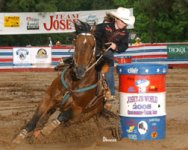
The picture attached shows the 2005 World Champion Barrel Horse and Rider, 2005 National NBHA Champion, 2005 IRCA Rodeo Champion, 2005 Youth Rodeo Midwest Champion, and winner of about $60,000, 22 buckles, a horse trailer, and a basement full of prizes from 2005. When not on the road this horse is turned out on pasture or roundbales in the winter. If you can see the potbelly please let me know. I also have the 2005 Little Britches World Champion and her barrel and pole horse if you'd like to see them. /forums/images/graemlins/wink.gif

BTW square bales will put a potbelly on horses too. What puts a potbelly on horses is grass hay that is cut too late. A good quality round bale that was cut and put up right will be just the same as a square bale. I also suggest you look up studies from CSU, Colorado State University. When left to their own devices out on pasture with free choice to hay or grass horses do not overeat. They self-regulate themselves. The study showed that horses in stalls consumed more hay than horses who were in a pasture with free choice to hay.
 

Attachments

  • 824730-mesaworldchamp.jpg
    824730-mesaworldchamp.jpg
    22.5 KB · Views: 257
   / Want to get into haying - need some advice. #50  
Seems to me that most(not all) hay for round bales are cut late around here for cattle out of convenience.It just doesnt start out horse quality anyways.Horses,maybe stalled more so,have a delicate digestive system tuned to a schedule and domestication also, and turning one loose on rounds just seems to me like a good way to colic one.Wonder how the digestive tract of a tb compares to a mustang?I used to be into horses when I was young,going to jumping camps and enjoyed them,but got out in my teens so I make statements on what I've been around and taught and read you guys as I do any useful info on the web.So lets try not to get too snotty.
 
   / Want to get into haying - need some advice. #51  
I think the snotty was started with this:

<font color="green"> 5030 sounds like a real hoot.Just seems to go against the grain to see a nice tb or warmblood getting all potbellied on hay. </font>

If you didn't notice the wink I was trying to be funny with what I said. /forums/images/graemlins/grin.gif I wasn't trying to be snotty. /forums/images/graemlins/tongue.gif Sorry you took it that way. Just wanted to show you that world champions do just as good or better than horses on squares.

<font color="green">Horses,maybe stalled more so,have a delicate digestive system tuned to a schedule and domestication also, and turning one loose on rounds just seems to me like a good way to colic one. </font>

This couldn't be further from the truth. A good way to colic a horse is to put them in a stall and feed them twice a day and confine them. The best thing you can do for a horse's digestive tract is to put them on pasture and secondly on free choice hay. It's our "domestication" of horses that has led to colic. Outside on pasture and allowed to free range horses will rarely colic. It is rich feed, too much carbs, sugars, and poor quality hay either in squares or rounds, etc. is what leads to colic. Stress from strange horses, altered feed schedules, boredom, etc. all lead to colic.

<font color="green">Wonder how the digestive tract of a tb compares to a mustang? </font>

They are exactly the same.

It's not good for cattle to have poor hay either. They won't gain good, won't get good calving weights, and can abort from being fed poor quality hay. Good hay is good hay and poor hay is poor hay.
 
   / Want to get into haying - need some advice. #52  
On all these forum boards I allways taken the wink as smug.I dont know why maybe its just an abused gremlin in fueds.Looks like I have a lot to learn about all things equine.The horse farms here would not be the best place to start.It will take a while to get the land I just bought up to spec anyways if I go that route.Seems like the 'western' way is better for the horse than the 'english' way-stall fed,worked daily, and turned loose on mowed pastures.

Hey,I dont think using the word 'hoot' was out of line,it was in reference of him chuckling. /forums/images/graemlins/wink.gif .... oops,sorry --> /forums/images/graemlins/smile.gif
 
   / Want to get into haying - need some advice. #53  
There's nothing at all wrong with feeding a horse in a stall, working them, and turning them out on mowed pastures. Having a horse on pasutre great for them. What's bad is keeping a horse in a stall 23/7 and working them maybe an hour/day and feeding twice/day confined in a stall. Certainly putting a horse on pasture is the best thing for them but it's not that much different than turning them loose with a round bale.
 
   / Want to get into haying - need some advice. #54  
23/7.If a horse is racing or at an event, maybe training they would spend more time in sthe stall.Horses can be bedded/fed in the stall but would spend most of the day outside when not training I would think.Thats like keeping a bird in a birdcage.The summer pastures are seemed to be mowed for aesthetics as well to keep the horses grazing close to where it would be in the winter.I understand the roundbale compared to summer pasture thing.But roundbale (to me) is mouthfull after mouthful standing there in one spot,maybe it doesnt have the energy to founder but couldnt it lead to impaction/colic.I would think they are supplemented with more hay throughout the winter day but 1500lb in one spot is where I'm having the prob.Espeacially in winter when they are fooled with less.
 
   / Want to get into haying - need some advice. #55  
<font color="red">But roundbale (to me) is mouthfull after mouthful standing there in one spot,maybe it doesnt have the energy to founder but couldnt it lead to impaction/colic.I would think they are supplemented with more hay throughout the winter day but 1500lb in one spot is where I'm having the prob.Espeacially in winter when they are fooled with less. </font>

Please read the above post plumboy. Horses DO NOT sit there and eat mouthful after mouthful. They eat a little and go on. Horses are not as stupid as we give them credit for. They go out and play, run around, etc. and come back eat a little more and go on. They aren't like us smart humans that sit in front of the tv for 8 hours/day eating chips, candy, and other junkfood non-stop. /forums/images/graemlins/grin.gif Most of the time when we come up to the pastures the horses are not even eating on the roundbales. It's not like they stand there in one place and just eat all day. If it is a problem, usually with an older horse that can't get around as good, put the roundbale at the far end of the pasture from the water and turnout shelter. It is really a non-issue. They don't get fat and they don't get pot bellies for the most part. I'm not saying you won't have a fat horse here and there but for the most part they don't overeat, they don't get fat, and the chance for impaction and colic is reduced over 300% by keeping horses on a grass/hay mix constantly over feeding them twice/day. That's a fact. A horse's digestive system was meant to eat constantly. It is when they don't eat constantly and the gorge themselves, by eating grain and high protein hay, in a little amount of time that they have their greatest risk of colic. AS simply as I can say it STALL LIFE IS the biggest risk of colic, period.

And no offense to you or snotty but VERY few horses are kept outside when not training. Most horses in training are kept in a stall 23/7. Just go visit any racetrack in the country. Go visit any big reining, cutting, jumping, dressage, etc. training barn in the country. Those horses are NOT out on pasture. They are in a 10x10 or 12x12 stall 90% of their life.

And another one just for the record. You DO NOT want a horse grazing close to the ground. The ideal height to graze on is around 6". Grazing close to the ground leads to sand colic and it's very hard on your pasture.
 
   / Want to get into haying - need some advice. #56  
I'm not really sure but would think the large round bales should be of better average quality as compared to the small square ones. It's a matter of logistics, size and knowledge of haymaker and getting stuff under cover. Not saying small square bales cannot be a quality product.

From away back in the past I've heard horses can founder on too much fresh alphalfa or getting too much grain. Never on too much hay.

Egon /forums/images/graemlins/grin.gif
 
   / Want to get into haying - need some advice. #57  
</font><font color="blue" class="small">( From away back in the past I've heard horses can founder on too much fresh alphalfa or getting too much grain. Never on too much hay.)</font>

Like anything else, moderation, and controlled introduction to new foods. Big pastures with rotation helps too.

-Mike Z. /forums/images/graemlins/grin.gif
 
   / Want to get into haying - need some advice. #58  
<font color="red"> </font> <font color="green">From away back in the past I've heard horses can founder on too much fresh alphalfa or getting too much grain. Never on too much hay.
</font>

You are exactly right Egon and it's still true today. They also founder rather easily on spring grasses if they haven't been out on pasture for the winter. Alfalfa that hasn't gone through the curing stage can be deadly on horses or cattle.
 
   / Want to get into haying - need some advice. #59  
</font><font color="blue" class="small">( What puts a potbelly on horses is grass hay that is cut too late. )</font>

This has been a great crash course,but one more question doc. Alfalfa and timothy lose power when cut to late.All the energy goes to the flower/seeds(right?).What is it that makes grass hay give the potbelly when cut late?The stems and seeds?
 
   / Want to get into haying - need some advice. #60  
There is an enzyme that is released in grass after it goes through the heading out stage. It's not the stem or the seeds. I am at a loss right now to think of what that enzyme is but I will track it down and let you know. You are right that they both lose their nutritional value. Grass loses it faster than alfalfa. Basically by the time it's done headed out it's not alot better than feeding straw. /forums/images/graemlins/frown.gif
 

Tractor & Equipment Auctions

1969 Lincoln Continental Mark III (A56857)
1969 Lincoln...
2018 CATERPILLAR 305E2 CR EXCAVATOR (A60429)
2018 CATERPILLAR...
Pat's QH and hydraulic top-link.
Pat's QH and...
KOMATSU WA270 (A58214)
500 BBL FRAC TANK (A58214)
500 BBL FRAC TANK...
1459 (A57192)
1459 (A57192)
 
Top