Weight Distribution Hitch Question

/ Weight Distribution Hitch Question #61  
Sorry for the late reply, I was looking back and realized that I didn't reply when I thought I had.
Not necessarily true.
Although you can upgrade the hitch to one that will carry more weight directly, that may not translate directly for the vehicle. The extra weight can / will still have additional impact on things like the reduced weight on the front axle. If there's too much weight on the back causing too little on the front, it won't matter if you have a drop-forged hitch capable of handling 100,000 pounds of tongue weight.
True, that's what axle limits are there for. If you have enough weight behind the rear axle to appreciably lighten the front axle, you are probbaly over the rear axle limits.

The other thing is that changing the hitch doesn't change the rating from the manufacturer. In an accident, you could be on the hook to prove that either your tongue didn't exceed the manufacturer's rating, or that the weight didn't exceed a "safe value." If you've changed the hitch, you may need documentation from the manufacturer stating that your rating has been changed to "X" as a result.
You would be on the hook that you were within 2 ratings:
1. Vehicle/trailer ratings (axle loads, GCWR, etc)
2. Hitch ratings (ie: within the limits for your properly installed receiver)
The hitch manufacture is responsible to determine that their hitch ratings will be safe for your vehicle. For that they have someone who puts a PE stamp on the drawings and they carry liability insurance.

Aaron Z
 
/ Weight Distribution Hitch Question #62  
Sort of, but not really.

He was not overweight in terms of the max towing capacity. He was overweight only with respect to how much tongue weight he should have been carrying with a 10k load and no WDH.

This has been said before, but it's worth pointing out again... a WDH does NOT increase the towing capacity for a vehicle. Max towing is max towing is max towing. PERIOD.

This particular truck has a max tongue weight rating of 500 lbs. If the tongue is targeted to carry 10% of the total trailer weight, that translates to 5000 lbs for the trailer. The vehicle is rated to pull 10,000 - always. The 5000 "limit" is artificial in that it is derived from the max tongue weight that the truck is rated for.

I am not trying to say that the manufacturer labels are wrong... I am only trying to help everyone understand how those numbers are arrived at for this vehicle so that everyone can understand what these numbers really mean.

Safe towing is something that's actually reasonably easy to understand how to do. But, trailer dealers, vehicle dealers, and even hitch manufacturers / dealers don't take the time to explain to people what the ratings mean and why they need to heed the numbers. I'd love to see trailer manufacturers "sponsor" education through the dealers so that people will know how to tow safely.

There are two semi-independent factors here that you may not be fully getting. On the one point - towing capacity of the vehicle - you are exactly correct (whatever the rating is, it is most certainly high enough for the trailer/load described). But the second part you are perhaps not fully getting - the hitch itself is overloaded. Both in tongue weight and total trailer load. Think of it as putting a weenie little hitch from a Subaru on this 3/4 ton (not too far from reality it seems... :D ) Yes, the vehicle is still rated for 10-12-14k lbs (whatever it is) but no way the hitch can handle that load. That is the case with many of the stock hitches on these trucks (mine included, which is why I went WD once I found this out on my F250).
 
/ Weight Distribution Hitch Question #63  
There are two semi-independent factors here that you may not be fully getting. On the one point - towing capacity of the vehicle - you are exactly correct (whatever the rating is, it is most certainly high enough for the trailer/load described). But the second part you are perhaps not fully getting - the hitch itself is overloaded. Both in tongue weight and total trailer load. Think of it as putting a weenie little hitch from a Subaru on this 3/4 ton (not too far from reality it seems... :D ) Yes, the vehicle is still rated for 10-12-14k lbs (whatever it is) but no way the hitch can handle that load. That is the case with many of the stock hitches on these trucks (mine included, which is why I went WD once I found this out on my F250).

There are two directions for bearing the load... Horizontal (GTWR) and vertical (max tongue weight). The horizontal max rating will never change, and that's the point I'm making.

Your comment about exceeding the weight rating of the hitch may, or may not, be true. The hitch itself may well be rated higher than, say, 500 lbs but the vehicle might not be. Or, there may be 10k of trailer weight with only 5% on the tongue. This is not over limit at all, but it is immensely unsafe. In order to properly and safely tow a 10k trailer, you need 10% of the weight on the tongue. At that point, without a WDH, this vehicle is overloaded.
 
/ Weight Distribution Hitch Question #64  
My inlaws broke ground today building a house adjacent to mine. One contractor shows up towing a nice 12000 pound tilt trailer with a tracked skid steer on it. I was drooling over his trailer and noticed it wasn't using a WD hitch. During a break, I asked him if he knew the capacity of his stock hitch on his 2500 dodge ram, with cummins diesel. He said he didn't. I told him it probably wasn't rated to tow what he was towing and sure enough, the sticker on the hitch said 500/5000 without a WD and 1000/10000 with. He didn't even know what a weight distribution hitch was. He was probably 4000 over his limit and had no idea. Scares me to think of what people are towing without towing knowledge. Not that I want the government to get more involved, but maybe an additional stamp on someone's license wouldn't be a bad thing. I have to be endorsed to ride a motorcycle but not to tow these weights? Also, that hitch was attached with six bolts approximately 7/16" in size.

There are two directions for bearing the load... Horizontal (GTWR) and vertical (max tongue weight). The horizontal max rating will never change, and that's the point I'm making.

Your comment about exceeding the weight rating of the hitch may, or may not, be true. The hitch itself may well be rated higher than, say, 500 lbs but the vehicle might not be. Or, there may be 10k of trailer weight with only 5% on the tongue. This is not over limit at all, but it is immensely unsafe. In order to properly and safely tow a 10k trailer, you need 10% of the weight on the tongue. At that point, without a WDH, this vehicle is overloaded.

Sorry - I was not clear, perhaps. You were replying to post #57 (above) which was the reference I was using. The hitch is rated 500 lb tongue, 5000 lbs max trailer in weight carrying mode. The hitch is not rated high enough to carry the trailer it was towing in weight carrying mode in this case. It is often true of stock OEM hitches on this class of truck. He is over tongue load and hitch capacity but probably not over vehicle capacity. The hitch is the weak link here.
 
/ Weight Distribution Hitch Question #65  
Sorry - I was not clear, perhaps. You were replying to post #57 (above) which was the reference I was using. The hitch is rated 500 lb tongue, 5000 lbs max trailer in weight carrying mode. The hitch is not rated high enough to carry the trailer it was towing in weight carrying mode in this case. It is often true of stock OEM hitches on this class of truck. He is over tongue load and hitch capacity but probably not over vehicle capacity. The hitch is the weak link here.

No... The hitch is capable of taking 10,000 trailer weight as is evidenced by the second rating "with" a WDH. My point is that the reason there is a 5k limit without the WDH is because the hitch/frame/axle/etc is because the hitch can only handle 500 lbs of tongue weight. Using the "10% rule", 500 lbs of tongue weight is available for trailer weights up to 5000 lbs. Going above that weight requires more tongue weight than the hitch can carry, so a WDH is necessary to transfer some of that tongue weight back to the trailer and some to the front axle of the tow vehicle.
 
/ Weight Distribution Hitch Question #66  
I think this is worth repeating. It doesn't matter how much weight you can legally tow or manufacturer says you can tow - the biggest thing about using weight distributing equipment is that it moves the center of gravity from behind the rear axles of towing vehicle when loaded to over the rear axles towards the center of the towing vehicle. This REALLY spreads the weight on the towing vehicle for safety.
 
/ Weight Distribution Hitch Question #67  
meburdick said:
Sort of, but not really.

He was not overweight in terms of the max towing capacity. He was overweight only with respect to how much tongue weight he should have been carrying with a 10k load and no WDH.

He really was over the 5000 lb limit by about 4000 lbs. Think of all these limits as links in a chain: axle ratings, hitch ratings, draw bar ratings, ball ratings, tongue ratings, tow ratings, tire ratings, payload ratings, etc. If any of these ratings are exceeded, the chain may break or unsafe conditions exist. End of story.

For some reason you are thinking that the manufacturer is calculating the trailer weight rating using the tongue rating times ten. Who knows, maybe they calculate the tongue rating by trailer rating divided by ten. I don't know or care. He has exceeded a limit. Pulling a skid steer weighing 7000 lbs on a 2000 lb trailer from a "bumper style" hitch without a WD hitch using a 3/4 ton truck is not safe in my mind no matter what the hitch ratings are. As I have said in other threads which I have seen posted in this one as well, the rear hitch bolts are taking all the load without a WD hitch and the front tires (which are responsible for a majority of the braking) of the truck are being relieved of vital weight.


meburdick said:
This has been said before, but it's worth pointing out again... a WDH does NOT increase the towing capacity for a vehicle. Max towing is max towing is max towing. PERIOD.

WRONG!
WDH does increase the towing capacity of a vehicle when using a "bumper style" hitch. Goose necks and 5th wheels have to adhere to payload limits. Posts like this could give readers the wrong information and create even more unsafe conditions. It should be easy to understand that one needs to have at least 10% tongue weight, not unload the front tires of the tow vehicle, and not put all the load on the rear most two bolts of the hitch (where the truck frame is also the weakest). If this is not true, why do they print the separate limits, just for fun?

I would think it would be real easy for manufactures to install a hitch that has the same rating as the tow vehicle without a WD hitch but they don't. Obviously they don't or do they? Who knows, the hitches may already be strong enough and they print these ratings because of the other safety reasons I mentioned.

Jeff
 
Last edited:
/ Weight Distribution Hitch Question #68  
WRONG!
WDH does increase the towing capacity of a vehicle when using a "bumper style" hitch.

This is sort of true and sort of not true. When some people say the "tow capacity of the vehicle," they are referring to things like suspension, brakes, frame, axle rating, and so forth. They are referring to the vehicle and not the hitch, ball, and so forth. They think of those as two separate systems. From that perspective, adding a WD system does not change the tow capacity of the vehicle. Other people, when referring to the "tow capacity of the vehicle," are referring to everything attached to the vehicle, short of the trailer. From that perspective, the WD system may increase the tow capacity of the vehicle, if it was the hitch's weight rating that was the limiting factor. In other words, if your vehicle (with factory hitch) has a tow rating of 5000 lbs without a WD system and a 10000 lb rating with a WD system, then adding a WD system could be said to increase the tow rating of the vehicle. But I know for my truck, the specs say the truck itself is rated for 13k, but the hitch is only rated for 10k (with WD). So I would say that with or without a WD system, my truck is rated for 13k, but I can only tow up to 10k (with a WD system), and with my current trailer, I can only tow up to 7k, because it's a 7k trailer.

I would think it would be real easy for manufactures to install a hitch that has the same rating as the tow vehicle without a WD hitch but they don't. Obviously they don't or do they? Who knows, the hitches may already be strong enough and they print these ratings because of the other safety reasons I mentioned.

They usually don't, and I don't know why. Probably money. There are a few exceptions. A regular poster on TBN (sorry--don't remember who) talks about his Tundra, which has a frame-integral hitch that can tow the truck's full 10k weight without a WD system. But most factory hitches require a WD system to achieve anything close to the truck's full rated capacity. And it's not "other safety reasons," because you can swap the factory hitch with an aftermarket one that equals or exceeds the truck's towing capacity without a WD system.
 
/ Weight Distribution Hitch Question #69  
WRONG!
WDH does increase the towing capacity of a vehicle when using a "bumper style" hitch. Goose necks and 5th wheels have to adhere to payload limits. Posts like this could give readers the wrong information and create even more unsafe conditions. It should be easy to understand that one needs to have at least 10% tongue weight, not unload the front tires of the tow vehicle, and not put all the load on the rear most two bolts of the hitch (where the truck frame is also the weakest). If this is not true, why do they print the separate limits, just for fun?
This is sort of true and sort of not true. When some people say the "tow capacity of the vehicle," they are referring to things like suspension, brakes, frame, axle rating, and so forth. They are referring to the vehicle and not the hitch, ball, and so forth. They think of those as two separate systems. From that perspective, adding a WD system does not change the tow capacity of the vehicle. Other people, when referring to the "tow capacity of the vehicle," are referring to everything attached to the vehicle, short of the trailer. From that perspective, the WD system may increase the tow capacity of the vehicle, if it was the hitch's weight rating that was the limiting factor. In other words, if your vehicle (with factory hitch) has a tow rating of 5000 lbs without a WD system and a 10000 lb rating with a WD system, then adding a WD system could be said to increase the tow rating of the vehicle. But I know for my truck, the specs say the truck itself is rated for 13k, but the hitch is only rated for 10k (with WD). So I would say that with or without a WD system, my truck is rated for 13k, but I can only tow up to 10k (with a WD system), and with my current trailer, I can only tow up to 7k, because it's a 7k trailer.
Exactly, WD can help reduce rear axle loads by adding weight to the front axle, but it cannot change the GCWR or the vehicle axle limits.

I would think it would be real easy for manufactures to install a hitch that has the same rating as the tow vehicle without a WD hitch but they don't. Obviously they don't or do they? Who knows, the hitches may already be strong enough and they print these ratings because of the other safety reasons I mentioned.
They usually don't, and I don't know why. Probably money. There are a few exceptions. A regular poster on TBN (sorry--don't remember who) talks about his Tundra, which has a frame-integral hitch that can tow the truck's full 10k weight without a WD system. But most factory hitches require a WD system to achieve anything close to the truck's full rated capacity. And it's not "other safety reasons," because you can swap the factory hitch with an aftermarket one that equals or exceeds the truck's towing capacity without a WD system.
I posted several links to Putman and Reese hitches which are rated for the truck's full load. I think Diamondpilot is the member who you are thinking of with one on his Tundra. Those hitches (as you say) do not change the vehicle ratings, but do allow you to haul a heavier trailer as long as you stay withing the manufacture's axle/vehicle weight ratings.

Aaron Z
 
/ Weight Distribution Hitch Question #70  
You know, it occurs to me that one reason manufacturers often ship bumper-pull hitches that can't reach the truck's full capacity is that, for higher-capacity trucks, it's kind of expected that a gooseneck or 5th-wheel will be used. Dunno. Just a thought.
 
/ Weight Distribution Hitch Question #71  
Exactly, WD can help reduce rear axle loads by adding weight to the front axle, but it cannot change the GCWR or the vehicle axle limits.


I posted several links to Putman and Reese hitches which are rated for the truck's full load. I think Diamondpilot is the member who you are thinking of with one on his Tundra. Those hitches (as you say) do not change the vehicle ratings, but do allow you to haul a heavier trailer as long as you stay withing the manufacture's axle/vehicle weight ratings.

Aaron Z

I have been a part of many of these discussions. I have seen what Diamondpilot has posted in the past. I usually am on the same side of the arguement with Diamondpilot (high five) but disagree with putting on a heavier hitch to avoid using a WD hitch for the reasons I have stated. In addidtion, who has tested the truck frame to be strong enough for these higher loads?


This is sort of true and sort of not true. When some people say the "tow capacity of the vehicle," they are referring to things like suspension, brakes, frame, axle rating, and so forth. They are referring to the vehicle and not the hitch, ball, and so forth. They think of those as two separate systems. From that perspective, adding a WD system does not change the tow capacity of the vehicle. Other people, when referring to the "tow capacity of the vehicle," are referring to everything attached to the vehicle, short of the trailer. From that perspective, the WD system may increase the tow capacity of the vehicle, if it was the hitch's weight rating that was the limiting factor. In other words, if your vehicle (with factory hitch) has a tow rating of 5000 lbs without a WD system and a 10000 lb rating with a WD system, then adding a WD system could be said to increase the tow rating of the vehicle. But I know for my truck, the specs say the truck itself is rated for 13k, but the hitch is only rated for 10k (with WD). So I would say that with or without a WD system, my truck is rated for 13k, but I can only tow up to 10k (with a WD system), and with my current trailer, I can only tow up to 7k, because it's a 7k trailer.


They usually don't, and I don't know why. Probably money. There are a few exceptions. A regular poster on TBN (sorry--don't remember who) talks about his Tundra, which has a frame-integral hitch that can tow the truck's full 10k weight without a WD system. But most factory hitches require a WD system to achieve anything close to the truck's full rated capacity. And it's not "other safety reasons," because you can swap the factory hitch with an aftermarket one that equals or exceeds the truck's towing capacity without a WD system.

Joshuabadrwell, remember me on this post?: http://www.tractorbynet.com/forums/trailers-transportation/244387-axle-location-question-3.html
I am fully aware of towing guidelines. I see that you are correctly posting many good things since this eye opening experience that I helped you with. I am just pointing out that the towing capacity of any rig is equal to the weakest link of the chain. If you have a F450 pulling a load with an 1 7/8" ball rated at 3500 lbs, the towing capacity of that setup is 3500 lbs even though every other limit is much higher in the equation.
 
/ Weight Distribution Hitch Question #72  
In addidtion, who has tested the truck frame to be strong enough for these higher loads?

Presumably the manufacturer of the hitch, no? When I buy a hitch, I buy one specifically for my make/model of truck. Presumably its weight rating is based on its load-carrying capability on that specific truck. If the truck's frame was going to be damaged by the increased weight of the hitch, it doesn't seem like the hitch manufacturer would be in business very long.

I am just pointing out that the towing capacity of any rig is equal to the weakest link of the chain. If you have a F450 pulling a load with an 1 7/8" ball rated at 3500 lbs, the towing capacity of that setup is 3500 lbs even though every other limit is much higher in the equation.

100% agree.
 
/ Weight Distribution Hitch Question #73  
Presumably the manufacturer of the hitch, no? When I buy a hitch, I buy one specifically for my make/model of truck. Presumably its weight rating is based on its load-carrying capability on that specific truck. If the truck's frame was going to be damaged by the increased weight of the hitch, it doesn't seem like the hitch manufacturer would be in business very long.

I really doubt this is the case. They are probably testing the hitches in a solid rig for failure rates. Are you saying it is safe to pull these large loads using a 3/4 ton pickup without a WD setup even after all the discussion of distributing some of the weight to the front tires of the tow vehicle?
 
/ Weight Distribution Hitch Question #74  
I have been a part of many of these discussions. I have seen what Diamondpilot has posted in the past. I usually am on the same side of the arguement with Diamondpilot (high five) but disagree with putting on a heavier hitch to avoid using a WD hitch for the reasons I have stated. In addidtion, who has tested the truck frame to be strong enough for these higher loads?
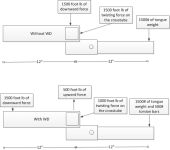
A WD hitch is going to put at least as much strain on the frame as a non-WD hitch. Think about the loading, instead of vertical downward loading in the back of the hitch, you now have upward loading on the back of the hitch and at least as much downward loading on the the front of the hitch. See below for an illustration
Hitch loading.png
What WD gives you is less bending movement on the hitch which allows a lighter (and cheaper) crosstube.

I am fully aware of towing guidelines. I see that you are correctly posting many good things since this eye opening experience that I helped you with. I am just pointing out that the towing capacity of any rig is equal to the weakest link of the chain. If you have a F450 pulling a load with an 1 7/8" ball rated at 3500 lbs, the towing capacity of that setup is 3500 lbs even though every other limit is much higher in the equation.
Agree 100%.

Aaron Z
 
/ Weight Distribution Hitch Question #75  
I really doubt this is the case. They are probably testing the hitches in a solid rig for failure rates. Are you saying it is safe to pull these large loads using a 3/4 ton pickup without a WD setup even after all the discussion of distributing some of the weight to the front tires of the tow vehicle?

I'm familiar with that effect of a WD system, and I really don't mean to be making any bold statements here about what is or isn't safe. The manufacturer of the hitch probably hasn't tested to see whether a given truck is safe to drive with a given tongue weight, no. But you asked specifically about damaging the frame. And I gotta say, if the manufacturer says I can put a certain hitch on my truck and have a certain tongue weight, I'd be shocked if they hadn't found out whether that was going to damage the frame or not--if not through rigorous testing, then through the number of warranty claims and lawsuits they would get if it did. If Jim-Bob is towing down the road with his front wheels in the air and he gets into an accident, it's obviously his own dang fault. But if he hitches up his trailer (under rated weight, of course) and his frame bends, he's going to go back to the manufacturer and point to the placard on the hitch and ask for compensation.
 
/ Weight Distribution Hitch Question #76  
Not really since it is actually reversing the conventional torque load on the tube to the other direction to load the front tires. Can't really make it lighter.

What WD gives you is less bending movement on the hitch which allows a lighter (and cheaper) crosstube.
 
/ Weight Distribution Hitch Question #77  
The truck manufacturers provide a maximum moment accessories can put on the truck frame broken out by which frame (different options get you different thickness and tensile strength). You may not realize but slight differences in trucks result is different wall thickness and tensile strength steel being used.
 
/ Weight Distribution Hitch Question #78  
To fully understand why there are two ratings for the hitch, you need to read and understand SAE J684. It defines the load and testing criteria for hitches. Because the ball is not in a straight line parallel to the ground, there will be a moment around the hitch that will be offset to some extent by the WD setup. This results in a higher overall trailer weight capacity for the WD vs. Weight Carrying condition. The V5 label on the hitch is required by federal regulations for all newer hitches and lists the hitch capacity. It will be used against you in court if you are overloaded and have an accident and get sued. When in doubt, stick the manufacturers published limits. They are there to protect us all.
 
/ Weight Distribution Hitch Question #79  
Every manufacturer advertises their vehicle's "max towing capacity" as what it is... the "max" capacity. That 2500 has a max towing capacity of 10,000 lbs. The "fine print" will tell you that you will need to achieve this limit by way of using a WDH, and if you do not, you will not be able to tow a trailer with a GTWR of over 5,000 lbs. That number is NOT the max towing capacity.

If the max tongue weight were 700 lbs, the max trailer weight without a WDH would be 7,000 lbs. It is EXACTLY a factor of 10 between the two because of the max tongue weight and the fact that it must represent no less than 10% of the GTWR.

I understand that a limit was exceeded, I understand that "weakest link in the chain" notion. I've said this before, and I will say it again... I'm not trying to tell anyone that the numbers advertised by the manufacturer are wrong... I am merely trying to help people understand WHY the numbers without a WDH come out as they do. I am in complete agreement with Wolfpack2 and the statement about adhering to guidelines.

The comment about a WDH being there to "change the center of gravity" isn't really correct. It's referred to as a "weight distributing" hitch for a reason... It's purpose is to distribute some of the tongue weight of the trailer to axles other than the rear axle of the tow vehicle. As a result, the center of gravity will change, but that isn't its sole purpose.

I can't speak for DiamondPilot, but I have a '11 Tundra with the integrated hitch. Maybe the comments you're thinking of are mine.
 
/ Weight Distribution Hitch Question #80  
joshuabardwell said:
I'm familiar with that effect of a WD system, and I really don't mean to be making any bold statements here about what is or isn't safe. The manufacturer of the hitch probably hasn't tested to see whether a given truck is safe to drive with a given tongue weight, no. But you asked specifically about damaging the frame. And I gotta say, if the manufacturer says I can put a certain hitch on my truck and have a certain tongue weight, I'd be shocked if they hadn't found out whether that was going to damage the frame or not--if not through rigorous testing, then through the number of warranty claims and lawsuits they would get if it did. If Jim-Bob is towing down the road with his front wheels in the air and he gets into an accident, it's obviously his own dang fault. But if he hitches up his trailer (under rated weight, of course) and his frame bends, he's going to go back to the manufacturer and point to the placard on the hitch and ask for compensation.

I have read some of the manuals that come with these aftermarket hitches and they all say that you should follow the vehicle manufactures recommended weights as published in the manual. That is an easy out for these hitch manufacturers. I agree that your dodge truck should be rated higher than the 350 lb tongue limit that is stated in your manual but to up it with an aftermarket hitch rated for 1500 lbs without a WD in play is flirting with disaster not just in the stress on the frame but the handling characteristics of that setup. Here is a good article on this subject. Don't be afraid to be bold if your think something is not safe. It might be an innocent life you are protecting. Not that I want to over dramatize the issue but I am seeing a lot of people towing dangerous setups and not even knowing it. If Jim-Bob kills a family member I will be even more active.

http://m.trucktrend.com/features/tech/163_0812_towing_liabulity_and_equippment_issues/viewall.html
 

Marketplace Items

2008 CAT 928H WHEEL LOADER (A60736)
2008 CAT 928H...
2018 FORREST RIVER WILDCAT BUMPER PULL (A60736)
2018 FORREST RIVER...
2021 BMW 1200RT (A55853)
2021 BMW 1200RT...
2007 FRAC TANK 500BBL WHEELED (A60736)
2007 FRAC TANK...
Big Tex T/A Flatbed Trailer (A56857)
Big Tex T/A...
2018 Ford Taurus Sedan (A61569)
2018 Ford Taurus...
 
Top