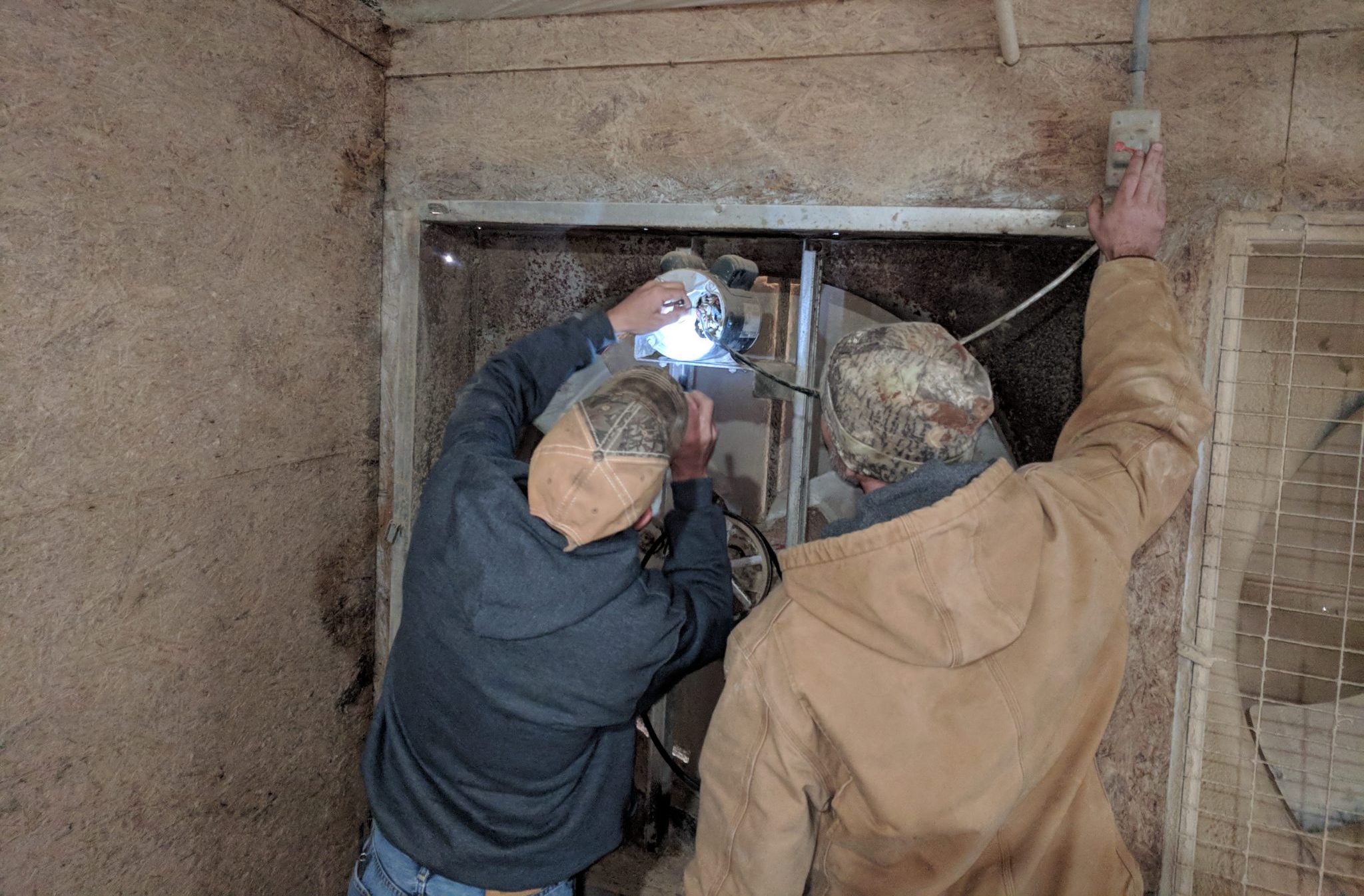
Lightning strike, well pump box failed

   / Lightning strike, well pump box failed #21  
A few start cap's laying around is always a good idea. We lose them more often on our HVAC systens (we have several) than anything else, but also the air compressor and well pump. Nailing the "uF" or "MFD" value isn't critical for an emergency stop-gap when something dies on a Sunday, as long as the voltage rating is sufficiently high, but you'll want to replace it with the proper value for permanent replacement.

Between all of our HVAC outdoor and indoor units, air compressor, and a few big machines in the shop with cap start motors, I'd bet I replace at least one start capacitor on something every year.

Note, many HVAC outdoor units can have 3-terminal dual capacitors, but they can be easily replaced by two singles, if you have them.
 
Last edited:
   / Lightning strike, well pump box failed #22  
I think The check valve is good. It only cycles when a faucet is open. I moved in may of 23. The cycling was pretty fast. Shower on the other side of house would cycle every 9 seconds. The same thing happened when using yard hydrants outside to run a sprinkler. I wrote to support and they helped me adjust the pressure switch higher so that it cycled slower. It was a 60 psi switch and increasing to 70 slowed it down.
I am watching it right now. With kitchen faucet open and on cold, I’m running 69 psi and steady. No cycles. Bathroom sink doesn’t flow that fast so with just the bathroom sink open on cold, it cycles on for 23 seconds. Hot water will always be faster because the hot doesn’t flow as fast. There is a spin filter on the hot which restricts the flow as well as the boiler itself. I need to put a larger spin filter on the whole thing because I’m seeing some sediment in the toilet tanks and a few aerators on the faucets.
But the point is the check valve is solid. I think my pressure is just so high, that it overwhelms the csv and short cycles
The 60 PSI Cycle Stop Valve will regulate on the high side of about 64 PSI. If the kitchen sink keeps the pump running continuously at 69 PSI, the pressure gauge could just be off by 5 PSI. I would just tighten the large screw in the pressure switch so the pump shuts off higher than 75 PSI according to that gauge. Maybe all it is.
 
   / Lightning strike, well pump box failed #23  
We see that coincidence frequently after lightning, bad relays and caps.
Lightning can do crazy things. I have seen it hit the ground a half mile from a well that didn't even have electric service yet and it took out the motor. But I still think lightning taking out a start cap is a coincidence. The cap was probably already weak from cycling and the lighting caused the power to flicker off/on quickly which finally took it out.
 
   / Lightning strike, well pump box failed #24  
A start cap, relay, and a pressure switch for the well pump and the HVAC unit are a good thing to have on the shelf during a Christmas holiday. :)
 
   / Lightning strike, well pump box failed #25  
A start cap, relay, and a pressure switch for the well pump and the HVAC unit are a good thing to have on the shelf during a Christmas holiday. :)
Last summer, while core-drilling a plumbing hole thru the stone wall above my pressure switch, I caught the shoelace loop of my work boot on the pressure switch housing as I was backing out of that tight corner with a core drill in hand. Somehow, the 1/4" brass nipple to which it was mounted was nearly corroded thru where it was threaded into the tank tee, and it just came with my boot, only stopped when I ran out of wire. :ROFLMAO:

Of course then the pump kicked on and started spouting water like a gyser thru the open fitting, until I could get my shoelace free of the pressure switch, run over to the breaker panel, identify the correct breaker, and shut it down. Even then, the 20 gallons sitting in the pressure tank had to drain back out thru that open fitting, after shutting the main valve to the rest of the house.

As it happened, I did have a spare pressure switch, but not a spare 1/4" brass pipe nipple! :oops:

Luckily, I have threading dies and was able to cut and re-thread what was left of the original nipple. After modifying an easy-out extraction tool to get the remainder of the old broken end out of the tee, I think I had the house back up and running within 90 minutes. And of course it was a Sunday, when nothing real local was open.
 
   / Lightning strike, well pump box failed #26  
Last summer, while core-drilling a plumbing hole thru the stone wall above my pressure switch, I caught the shoelace loop of my work boot on the pressure switch housing as I was backing out of that tight corner with a core drill in hand. Somehow, the 1/4" brass nipple to which it was mounted was nearly corroded thru where it was threaded into the tank tee, and it just came with my boot, only stopped when I ran out of wire. :ROFLMAO:

Of course then the pump kicked on and started spouting water like a gyser thru the open fitting, until I could get my shoelace free of the pressure switch, run over to the breaker panel, identify the correct breaker, and shut it down. Even then, the 20 gallons sitting in the pressure tank had to drain back out thru that open fitting, after shutting the main valve to the rest of the house.

As it happened, I did have a spare pressure switch, but not a spare 1/4" brass pipe nipple! :oops:

Luckily, I have threading dies and was able to cut and re-thread what was left of the original nipple. After modifying an easy-out extraction tool to get the remainder of the old broken end out of the tee, I think I had the house back up and running within 90 minutes. And of course it was a Sunday, when nothing real local was open.
Made my day! :ROFLMAO: I'm adding a 1/4X3 brass nipple to my spare parts. Lol!
 
   / Lightning strike, well pump box failed #27  
If I were you, I'd call your service provider as there is an issue on the pole(s). 300 plus acv is not right in ANY residential situation.
 
   / Lightning strike, well pump box failed #28  
He has 240 VAC going to his well head. He's good.
 
   / Lightning strike, well pump box failed #29  
@eptm vacuum sealing parts with instructions is a great idea!
That is genius. I have some replacement items for other important things around the farm, in my connex that are ziplocked with identification of the parts. I think I need to add instructions. I kept the control box that failed and plan to replace the start cap. And the relay. I’ve been watching some videos about the multi-meter because, I really don’t know my way around the multi-meter very well. I always say I’m going to learn but I muddle thru a task and then move on. I also need to get an amperage meter that has the clamp. I really don’t know how I have justified not buying one with everything I built here and with all the things that require troubleshooting.
I am surprised that nobody offers a one or two night class where they teach you to use them, along with some practical troubleshooting.

Back to the cSV cycling, I am not sure if I should put another tank in-line, or if I should put some kind of flow or pressure restrictor in. But I definitely have more pump cycling than In planned on having.
@WoodChuckDad have you tried YouTube? I have learned a fair bit from this channel; "Electrican U", but there are many others. Here is one of his how to use a DVM.

All the best,

Peter
 
   / Lightning strike, well pump box failed #30  
If I were you, I'd call your service provider as there is an issue on the pole(s). 300 plus acv is not right in ANY residential situation.
It's possible to measure voltages above line voltage in circuits containing VFD's or reactive elements (capacitors, inductors).
 
   / Lightning strike, well pump box failed #31  
It's possible to measure voltages above line voltage in circuits containing VFD's or reactive elements (capacitors, inductors).
Yeah upping the 240V to 370V on the run leg is just what a run capacitor is supposed to do.

VFD's are a different story. You would need an RMS meter to read the voltage. But a 240V pump running on a VFD see's about 1000V spikes. It is a pulsing DC voltage trying to simulate an AC sign wave. Just can't chop the pulses off at 240V and they hit 1000V at the top of each sign wave. The longer the wire down the well the more voltage the motor sees, which is called a "reflective wave" or "ringing". These 1000+V spikes from a VFD greatly shorten the life of the motor and wire, which has insulation for 600V max.
 
   / Lightning strike, well pump box failed #32  
@WoodChuckDad In the FWIW category

If you are curious about capacitors, and the differences between "start capacitors" and "run capacitors", and why run capacitors tend to require at least 370V ratings for a 240V circuit.
There is a nice (I thought) summary here;

(I got curious about how you came to have 370V on a pump lead while running. (240V*(2)^1/2)*1.1 ~=370 (voltage times the square root of 2 times a 10% safety factor))

All the best,

Peter
 
   / Lightning strike, well pump box failed
  • Thread Starter
#33  
@WoodChuckDad In the FWIW category

If you are curious about capacitors, and the differences between "start capacitors" and "run capacitors", and why run capacitors tend to require at least 370V ratings for a 240V circuit.
There is a nice (I thought) summary here;

(I got curious about how you came to have 370V on a pump lead while running. (240V*(2)^1/2)*1.1 ~=370 (voltage times the square root of 2 times a 10% safety factor))

All the best,

Peter

Thank you. Gonna dig into this after I work on the fence for a bit.
 
   / Lightning strike, well pump box failed
  • Thread Starter
#34  
The 60 PSI Cycle Stop Valve will regulate on the high side of about 64 PSI. If the kitchen sink keeps the pump running continuously at 69 PSI, the pressure gauge could just be off by 5 PSI. I would just tighten the large screw in the pressure switch so the pump shuts off higher than 75 PSI according to that gauge. Maybe all it is.

My concern with that, is the 80 PSI safety relief valve. Setting for 70 was already getting kinda close.
 
   / Lightning strike, well pump box failed #35  
OP, you really should check the air charge in your tank.
My VFD driven well pump has been in for 18 years. It runs my domestic water, my geothermal heat pumps and irrigation.
 
   / Lightning strike, well pump box failed #36  
For folks who may be worried about capacitor voltage ratings, because they can be confusing, the voltage rating of a capacitor can be higher than specified but never lower. Capacitors can be rated at a DC voltage or an AC voltage. The capacitor will usually have printed on it that it is rated at so many volts AC or DC. Sometimes starting capacitors, which are only for AC motors, will nevertheless have a DC rating. The capacitor will have printed on it, for example, 200 volts DC. This all gets confusing and I have seen capacitors blow up because they were installed according to their DC rating. It's stupid, I know. So, to avoid problems, if the cap just has a voltage rating and doesn't specify AC or DC just assume DC and multiply the AC voltage by 1.6 for the proper DC voltage rating. So if you have a 220 AC volt motor look for a cap with a voltage rating higher than 352. 370 volts is a common cap voltage. You would be safe with the 370 volt rating. Some AC motors will have starting caps that just go across the one leg of the 220 volt supply and so the caps will have a lower voltage rating. When shopping for a new cap don't worry if you can't find a cap rated for about 200 volts, just go with the 370 volt caps. The higher voltage rating just makes the cap more robust, it does not change the starting characteristics, the motor will start just the same with a higher voltage rated cap.
Eric
 
   / Lightning strike, well pump box failed #37  
My concern with that, is the 80 PSI safety relief valve. Setting for 70 was already getting kinda close.
Take the cap off the pressure relief valve and you can tighten the adjustment screw to make it work at higher pressure.
 
   / Lightning strike, well pump box failed #38  
OP, you really should check the air charge in your tank.
My VFD driven well pump has been in for 18 years. It runs my domestic water, my geothermal heat pumps and irrigation.
18 years is a good run for a VFD. I have seen some last 30 years. The ones that last that long help extend the average life to like 3-5 years, taking into account all the VFD's that didn't last a year or even a month. To get a VFD pump system to last a while the controller needs to be in a clean and cool environment, the control and power wires cannot be crossed, the drop wire needs to be as short as possible, all the parameters need to be set correctly, and many other things need to be correct. Even then they are temperamental to lightning, dust, and other things. Many VFD's do not even maintain constant pressure. I am currently helping a couple people with a Goulds Solo2 and a Pentair PID, and neither will hold a constant pressure. Many VFD's have a "bump feature" or just cycle on/off every minute or so because of the complexity of figuring the minimum frequency required for each different system. That is just one of the many ways VFD's do not function as you would think they should, on top of a high cost and high failure rate.

Then if you find a brand of VFD that has lasted a few years, that model will no longer be available. New model VFD's come on the market as fast a new cell phones. Each new model promising to have solved all the problems associated with the previous models. I have been waiting for more than 30 years for them to solve all the problems with variable speed pumps and controllers. I quit holding my breath long ago. In the meantime I continue to sell Cycle Stop Valves to solve the problems people have with VFD's and large pressure tanks.

But if I was still in the pump business I would sell a VFD to anyone who ask for it. Mad customers spend a lot of money keeping VFD systems working. Happy customers never call the pump man. :)
 
   / Lightning strike, well pump box failed #39  
18 years is a good run for a VFD. I have seen some last 30 years. The ones that last that long help extend the average life to like 3-5 years, taking into account all the VFD's that didn't last a year or even a month. To get a VFD pump system to last a while the controller needs to be in a clean and cool environment, the control and power wires cannot be crossed, the drop wire needs to be as short as possible, all the parameters need to be set correctly, and many other things need to be correct. Even then they are temperamental to lightning, dust, and other things. Many VFD's do not even maintain constant pressure. I am currently helping a couple people with a Goulds Solo2 and a Pentair PID, and neither will hold a constant pressure. Many VFD's have a "bump feature" or just cycle on/off every minute or so because of the complexity of figuring the minimum frequency required for each different system. That is just one of the many ways VFD's do not function as you would think they should, on top of a high cost and high failure rate.

Then if you find a brand of VFD that has lasted a few years, that model will no longer be available. New model VFD's come on the market as fast a new cell phones. Each new model promising to have solved all the problems associated with the previous models. I have been waiting for more than 30 years for them to solve all the problems with variable speed pumps and controllers. I quit holding my breath long ago. In the meantime I continue to sell Cycle Stop Valves to solve the problems people have with VFD's and large pressure tanks.

But if I was still in the pump business I would sell a VFD to anyone who ask for it. Mad customers spend a lot of money keeping VFD systems working. Happy customers never call the pump man. :)
Did you really just suggest he override or modify one of the safety systems?
 
   / Lightning strike, well pump box failed #40  
Did you really just suggest he override or modify one of the safety systems?
I don't think so. I believe you were talking about this quote instead.
Take the cap off the pressure relief valve and you can tighten the adjustment screw to make it work at higher pressure.
Adjusting the pressure relief valve higher as needed is normal operation. With a 55/75 pressure switch setting I would adjust the prv up to 90 PSI. But it is important to not adjust the prv to a higher pressure than the pump can build.
 

Tractor & Equipment Auctions

2008 Ford Fusion SE Sedan (A59231)
2008 Ford Fusion...
2019 LOAD TRAIL 35+5 GOOSENECK TRAILER (A58214)
2019 LOAD TRAIL...
2020 DRAGON 150BBL ALUMINUM (A58214)
2020 DRAGON 150BBL...
2008 CAT 305C (A53317)
2025 AGT YC-32G Saw Mill (A53317)
2025 AGT YC-32G...
2012 HYUNDAI  HL740-9 WHEEL LOADER (A58214)
2012 HYUNDAI...
 
Top