1963 Case 530CK Backhoe/Loader

   / 1963 Case 530CK Backhoe/Loader
  • Thread Starter
#81  
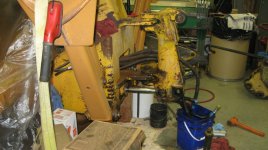
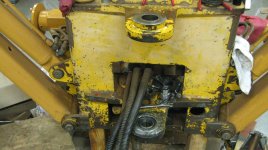
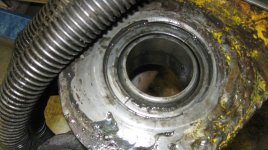
I was up in Northern Az, but came from the Phoenix area before that. Very little rust on it. I pulled the front pump off today to take a look at the seal. Somebody had it apart before, only a couple of the case bolts were tight. The spider gasket was shot and missing pieces, and the gears had ingested one of the check valve sprigs that was put in wrong. Too bad too, because the side plates and gear sides were flawless. Had to order a new pump, so am down for a week or more.
I did get the new rear tires installed and it rides much better now.

Yeah, when I looked at your machine it appeared to have little or no rust. I really envy the condition of your tractor, I sure would have liked to start with a machine that is in the condition you show in your two pictures!

Sorry to hear about the pump on your Case. It really is unfortunate to wind up with a problem that could have been avoided if the person that worked on the machine before you knew what the heck he was doing. By the way, who did you wind up ordering your pump from? Good luck on the replacement and thanks for including another picture!

What brand of tires are those, and if you don't mind me asking; how much?
 
   / 1963 Case 530CK Backhoe/Loader
  • Thread Starter
#82  
Do you have any rough guesstimate of the number of hours you have invested in this project up to this point?

My poor old '65 530CK must NEVER see any of these photos-she would either develop an irreparable inferiority complex or else sulk and refuse to start at all without ether because I haven't done the same sort of TLC on her.

She's lucky to have fresh paint on the wheels, some used rear tires with w/w fluid [with new tubes-doesn't that count as some sort of boob job?], fresh filters, new hoses, a new cutting edge and cylinder packings.

Well MEMEMEME, I would only be guessing at the time, but figuring from a standard 2000 man hr. year (what a person works at a regular yearly job, 8hrs. a day), I would say after a year and a half working on the tractor, I have about 2000 hrs. invested. I have been absent from this project numerous times in the 1 1/2 years for various reasons; so, I'd say about 2000hr. I know I'd never recover that if I were to sell but it's something I wanted to do. I guess I had something to prove to myself, but my friends frequently remind me that "You're not building a piano". Now that's funny, not wanting to show your old '65 CK my photos! Ha Ha.

Show us some pictures of yours. By the way, both my wife and I were born and raised next door to you in Kalispell, MT. We're originally from Troy, Idaho. Moved to Nevada in the 80's because of work. I'm sure you take fine care of your hoe!
 
   / 1963 Case 530CK Backhoe/Loader #83  
The winter of 1969 I partied in Kalispell every Sunday in a bar with entertainment. I was logging N. of the boarder at the time .
 
   / 1963 Case 530CK Backhoe/Loader
  • Thread Starter
#84  
The winter of 1969 I partied in Kalispell every Sunday in a bar with entertainment. I was logging N. of the boarder at the time .

Yeah, 1969 was a great time to be alive up in that Northern area, also around Bonners Ferry, Id.
 
   / 1963 Case 530CK Backhoe/Loader #85  
Small world, huh? My ex-wife and I nearly moved to Troy rather than Kalispell 30+ years ago. Although I confess to not being a MT native, I was born and raised in the People's Republic of Kalifornia but escaped in '84 up here to God's country.

I'll get around to posting a few pics of my old gal here one of these days. Gotta poke around and find the patch cord to allow me to upload pics from my digital camera.

I'm a true cellphone Luddite, I refuse to give up my old $10 camera-less TracFone until they pry it from my lifeless hands or it gets obsoleted to the point of unusability by advancing technology.

It was 30 degrees this morning when I went out to fire up the old girl and though it took a couple of tries, she did fire up without ether. I don't have the heater in the intake manifold connected or I'm sure it would light off faster. My 93 yr old Mom lives just across the road and she said she thought my house was on fire the diesel smoke was so thick...
 
   / 1963 Case 530CK Backhoe/Loader
  • Thread Starter
#86  
Guess it's time to post more on my project and this will be mostly about the hoe assembly. Mine is the Case model 32 backhoe group. It will include the disassembly and all of the repairs and finally the reassembly and painting of all the groups contained in the model 32. Here is the first part of stripping it down:
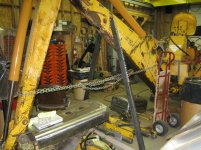
IMG_1484_rs.jpg
I know this picture shows an earlier condition because you can tell the hood and tank are not painted and installed on the tractor, but I forgot to start taking pictures at the start of dismantling it all and I wanted to show you that I had tacked a temporary A-frame to the boom to keep it stable while I was working on the loader and tractor. So, the first thing I had to do was cut off the weld tacks and remove the bucket. That's where my crane came in real handy. After removing the bucket I was able to, along with the crane, lower the boom and crowd and by stretching it out, drop it enough to work on. You can see in the pictures that the crowd and bucket cylinders are painted, that is because they were the first thing I restored before bringing it inside the shop. So, that's one of the few things that I won't have to do before I put it back together, yaay!
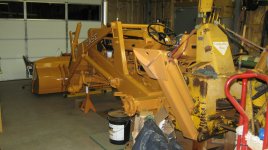
IMG_2135_rs.jpg
Of course this one shows just before lowering both stabilizers and removal from the rear of the tractor. I had also removed and rebuilt both right and left stabilizers before bringing the machine into the shop for start of restore. The problem was; most of the hoses, cylinders, and anything that contained fluid was leaking so bad I had to do those repairs before even moving it. Fluid was leaking out of the swing cylinders so bad that it left a steady stream right onto the shop floor. Every pin and bushing on the hoe was so worn that it would swing to and fro like it was dancing at a hoe-down, pun intended!
IMG_2165_rs.jpg
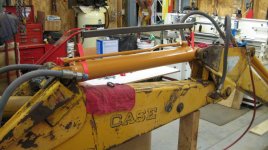
Here, you can see the removal of the crowd cylinder and I used my gambol that I fabricated for handling the loader arms. I've had to make or invent so many tools to make the project easier that I've lost count of their number. At the end of this project I'm going to spread them all out on my fab table and show you the number of tools that I've made. The one thing that was nice about this part was that I had pre-lubed all of the pins-bushings and hydraulic connections (JIC fittings), so they came apart easily. If you look close on the crowd (stick) plates you can see the fish plates that were welded for re-enforcement. Also, I will not be using the old boom or crowd, I found replacements and have had them for a long time now. They are in way better condition than these.
IMG_2180_rs.jpg
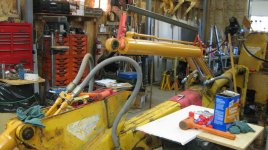
Got the pins out and the cylinder loose and ready for the next step. In this perspective you'll notice the fish plates that I talked about earlier. Also you can see the plastic JIC fitting plugs that are on the table, I screw in to keep the hoses that I leave attached from leaking fluid. Because of the condition of all of the backhoe pins and bushings, I will be machining both pins & bushings for most of the hoe. I will be using 1018 low carbon and 1045 medium carbon cold rolled steel, and 8620 alloy steel for pins. The bushings will all be machined out of DOM 1020 low carbon cold rolled steel. And in each instance I will use a picture and description with the exact metal that I used and why. Like I told you guys at the front of this project I'm not a professional mechanic or machinist, but because of my background and a lot of reading I'm trying to use the best guess estimate for all of this. If some of my processes turn into mistakes I'll be sure and post and explain to the best of my ability why it failed and what I'm going to do to correct it.
IMG_2183_rs.jpg
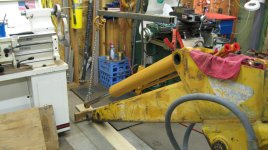
Got the hoses removed and capped and cylinder sling in place for removing the bucket cylinder. Got the pin removed (top pin is 1 3/4" diameter & the lower bucket pin is 1 1/2") so time to take it off. The actual bucket pins and bushings were the worst, but I think that is pretty normal, they get the most dirt, water, grit and such. I put a piece of pine on the floor to protect the concrete while it was sliding outward.
IMG_2190_rs.jpg
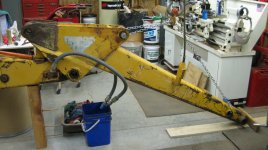
Now I'm picking the crowd (stick), and removed the pin, by the way the pivot pin for this is 2" diameter. This part will just turn into scrap metal. The hoses for both the crowd and bucket were replaced around 1999 or 2000. They were Caterpillar type, the kind that you can reuse the fittings and only replacing hose material. The guy who had them made up for me was the main shop foreman at Cashman Equipment here in Reno. They really are a tougher hose material and a layer or two more than standard made hydraulic hoses.
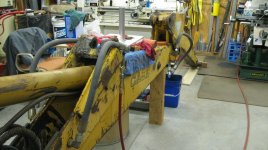
IMG_2192_rs.jpg
If you look closely at the high point of the boom where both hoses are draped over, you can see the serious amount of weld build up on both sides of the bosses and plates and you can see at the bottom left in the picture the 3/4" rod that was welded as re-enforcement to the boom. And take a look at that hard tube coming from the front of the boom cylinder, it's bent like a pretzel, that's not flex hose! I'm in the process of detaching the pins for that cylinder.
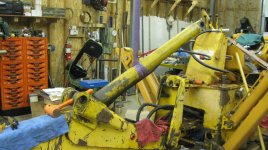
IMG_2194_rs.jpg
Got the cylinder loose and removing with a continuous sling. You can see the bent up hard tube better in this picture. The tube was never attached to the hoses correctly and got tangled up with the other hoses with their wound armor and bent the crap out of it. You kind of have to thread it out of the boom, lifting then moving back then lifting and so on. Got no idea what kind of trick it will be to re-install.
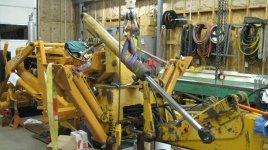
IMG_2204_rs.jpg
Finally out and hanging, I moved it down to the saw horses and cleaned it up and then put it on the fab table where I'll take it apart and re seal and pack it. You know, it was interesting to note that the piston rod on the cylinder was real nice condition, no scratches or dents, I think because it's always protected inside the boom.
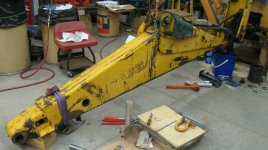
IMG_2207_rs.jpg
I removed the boom pivot pin (which is 2" diameter) and craned it away from the tower. This too, will become scrap metal! Once the hoses are all disconnected it was real easy to handle the boom. Also I noticed that the pivot pin is special in that it had a welded flat on one end and threaded bore on the other. It's one of the many I'm going to have to make. I chose 2" dia. 8620 alloy round bar to replace the old worn out pin. It is weldable and machinable, and that's important and along with those characteristics it has high strength and good wear features.
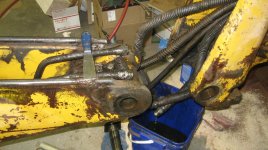
IMG_2208_rs.jpg
In this perspective you can see all of the welded areas. They had welded cold rolled rod on each side of the boom and welded up each plate where it had cracked from the bosses to the edge, my putty knife is laying on top of each stiff back rod. The two hard tubes are no longer connected to hoses and are just setting there, it is not the position that they are in when connected, they lay on the bottom of the boom body.
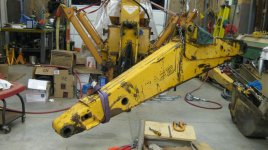
IMG_2218_rs.jpg
Booms off and going to be set down out of the way.
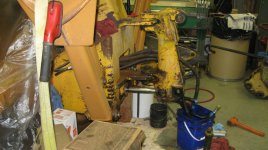
IMG_2234_rs.jpg
Finally got to the tower and just hoses to remove now. I took one of the swing cylinders off and put it up on the bench. Unbelievable how badly the pins and bushings were, it was no wonder that the boom and stick would move back and forth about 2 and half feet when I was operating it. Shucks, you just had to hunt the trench and drop it when you got close.
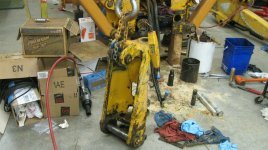
IMG_2241_rs.jpg
I've got the tower off and it too will go to the scrap heap. If you look closely near the top of the tower edges you can see some more rod welded as stiff backs or re enforcement. There were also fish plates formed and welded to the top sides of the tower. But since I won't be using this part again it won't matter how much it has been repaired. Also if you look at the pin with the shoulder on it nearest the black paint bucket, that is the bottom threaded pin that connects the tower to the hoe frame. It had wallowed out the self centering bushing (which I will show you in a later post) to the point that the tower was now riding on the bottom frame member which gouged out and dropped the boss probably 1/4". It was ground down into the boss weld.
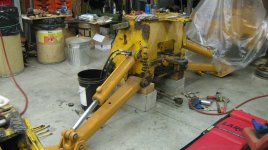
IMG_2262_rs.jpg
Ok, here is the last picture of the disassembly. The hoe frame is now disconnected from the tractor and setting for the time being for a re-weld of the lower bushing boss and removal of the stabilizers. I made a tool to press out the old bushing in the up arm and also pressed out the lower self aligning bushing. I removed the valve body that was bolted to the inside frame, and almost took my arm off in the process. That valve body is all cast and it's pretty heavy. I'll probably tip the frame forward with my crane after the stabilizers are removed to make it easier to re-install the valve body.
 
   / 1963 Case 530CK Backhoe/Loader #87  
Enjoying every post. Actually look forward to reading every line along with the pics.

Thanks - PA Guy
 
   / 1963 Case 530CK Backhoe/Loader #88  
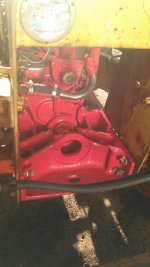
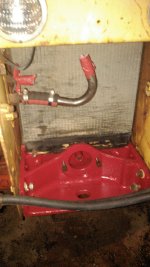
I ended up getting the Alliance 14.9-24 R-1s for it. I paid $295 each from Dealers Tire in Phoenix. Would have preferred Firestones or Goodyears, but at double the price I didn't think it would be worth it for the limited use that I have.
The pump is coming from All States Ag parts. I ordered it on eBay as the shipping was less there. Ended up paying $390 shipped.
This is generally how I end up doing my restoration type work. Clean up the area I am working in, make any additional needed repairs, and paint the affected area. Usually after a year or two everything is is decent shape and looks good enough to satisfy me. Certainly not a show stopper like yours though. I didn't end up painting the radiator, as I am not real happy with it, and it will end up coming back out for repairs at a later date.
 

Attachments

  • image.jpeg
    image.jpeg
    233.7 KB · Views: 628
  • image.jpeg
    image.jpeg
    255.7 KB · Views: 346
   / 1963 Case 530CK Backhoe/Loader
  • Thread Starter
#89  
I'm a true cellphone Luddite, I refuse to give up my old $10 camera-less TracFone until they pry it from my lifeless hands or it gets obsoleted to the point of un-usability by advancing technology.

I'm with you, that's all I've ever used, couldn't stand to pay the big money for a phone that continually monitors then reports every phone call or site visited like a smart phone. Besides, it drives me crazy to watch people text.......... mine is just used for a plain phone call. You know, it must be a sign that I'm getting really old!
 
   / 1963 Case 530CK Backhoe/Loader
  • Thread Starter
#90  
Enjoying every post. Actually look forward to reading every line along with the pics.

Thanks - PA Guy

That's really gratifying to hear that the time I take to post is of some use and enjoyed by you and others...............
 
   / 1963 Case 530CK Backhoe/Loader
  • Thread Starter
#91  
Walker1, thanks for that information. The price you payed was similar to what I paid for mine and I sourced mine through eBay. Also thanks for the time to post tire price and the pictures, I really enjoy them, thanks...............
 
   / 1963 Case 530CK Backhoe/Loader
  • Thread Starter
#92  
Well, I guess it's time for another post regarding the progress of the backhoe rebuild. I thought this would be simpler and maybe more straight forward than the tractor and loader. And it appears that there is more damage to all of the frame, components, pins and bushings than I reckoned. It's fortunate that I rebuilt the stabilizers and cylinders before even starting on the hoe, it's just one more thing that I don't have to do. As I disassembled all of the components, I found really extensive damage to some of the important parts that aren't readily visible until you take them apart. One of the components in particular was the lower self-centering bushing that connects the tower to the frame arm extension. It, was not only broken, but the bore boss that holds the retaining ring had been ground down to the point that half of the ring was gone. The tower had dropped down on that boss to the point that the weld fastening the ring to the frame arm extension was half gone. But again, fortunately, the bore that holds that self-centering bushing was still intact and aligned with the upper bore. I won't include it with this post but will show you in the next post how I dealt with it, but in this post I'll just show you some of the pins and bushings I machined, along with the corresponding metal grades.

IMG_2281_rs.jpg
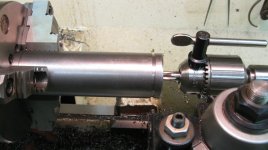
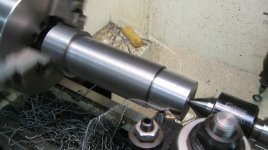
This is the start of the upper pin for the backhoe tower, you can see the groove that I'm machining in that accepts the retaining snap-ring. There are grooves on each end, and when installed will have a large washer and then the snap-ring which keeps the pin in place. I chose 1045 mid carbon, 2"diameter steel to machine. It winds up being a little hard to machine, but had a correspondingly higher tensile strength and better wear characteristics than straight 1018 cold rolled steel. But keep in mind, 1045 isn't a real good choice if you have to weld it, the carbon content makes it a bad choice. A guy wants to turn it a little slower and feed it a little slower as well, with plenty of lubricant.

IMG_2286_rs.jpg
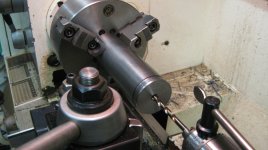
Here I'm boring the grease hole which will penetrate to the center of the pin, and lubricate the upper joint when installed, again remember it drills a little harder too.

IMG_2287_rs.jpg
Now, I'm threading with an 1/8" pipe tap and will thread in the grease zerk after inserting the pin through the yoke and bushings. It tapped just fine but with plenty of cutting oil. I think this will work fine for the upper pin.

IMG_2296_rs.jpg
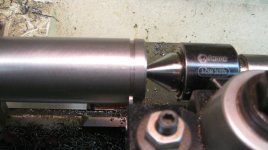
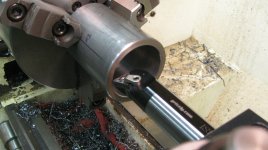
I'm down to the last couple of thousandth's cut and really have to be careful not to take off too much metal. It's a real dance to get just the right amount of slack between bushing and pin, because if you don't have enough clearance between bushing and pin when you press the bushing into the boss, the metal compresses ever so slightly and will keep the pin from going in and conversely; if you have too much clearance s a person will have a sloppy fit and it will cause excessive ware of the pin. I used DOM for all my bushing; which is usually 1020 carbon steel. It machines well and finishes up with a smooth appearance. By the way, I learned that in most cases the bushings should be softer material than the pins and should be the wear part that is replaced for a pressed or friction fit the outside circumference of that bushing should be .001 oversized to the bore that you are going to seat it into. As a rule of thumb; if the bore is 1" then the bushing should be a thousands over, if it is 2" it should be 1 1/2-2 thousands over and so on.

IMG_2292_rs.jpg
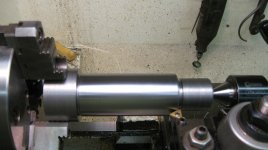
Here are the two together and they fit real nice. And now I have to cut the bushing down to the right length and then press it into place. You always have to have more material than you actually need so that the lathe has something to hold onto while machining. By the way, that isn't rust on my ways, it's just the cutting fluid with some fine particles of metal mixed in.

IMG_2308_rs.jpg
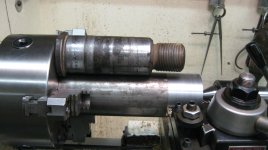
You can see the old pin stacked on top of the new billet and that's what shape it's supposed to look like when I'm finished. I'm starting the lower threaded pin and just starting the truing cut. A guy has to prep each end so that you can get the work piece concentric with the center axis of the lathe. In this picture you can see that I've taken off a few thousand's and will turn it end for end and re-chuck it up to start the work. Now that I have a round surface for the chuck to grab it will be true to turn. Also notice how much larger the diameter of the billet is than the pattern pin, I need that extra metal to form the flange on the end of the pin. And in this case I am using 2 1/2" diameter, 8620 alloy steel for my pin stock. The tensile rating for 8620 is around 100,000 psi and the real bonus is that it is weldable and not overly expensive. At least for me, I had to really pay attention to my rpm and feed rate to machine it, it's hard.

IMG_2310_rs.jpg
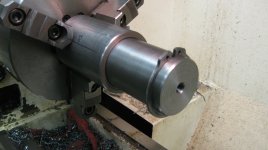
After a lot of passes, you can see what I mean by the larger end in the chuck. The center part is the journal that bears on the self centering bushing and yoke and the end captured by the tail stock will soon become the threads of this pin.

IMG_2318_rs.jpg
Finally got it turned to size and polished on the main journal and ready to cut threads on the end.

IMG_2321_rs.jpg
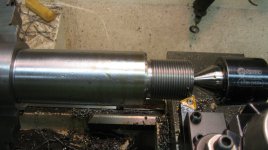
Threads are cut and both reliefs grooves have been machined at each end of the center journal. I'm chamfering the end of the threads to make for an easy start of the nut that I thread on.

IMG_2328_rs.jpg
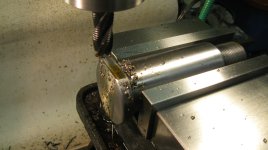
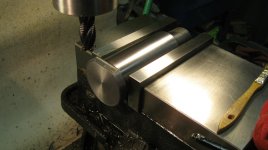
At this point I've cut off the excess end that was what the chuck held onto, to turn the work and I'm cutting flats on each side with the mill for my wrench to fit on. What I did was use a parting tool to get the right dimension for the thickness of the flange, while it was still chucked up in my lathe, then cut the rest of the way through with my band saw, then trued up the end on the lathe.

IMG_2331_rs.jpg
Here is a finished view of one half completed. I just have to un-clamp it from the vise and flip it 180 degrees and do the same to the opposite side.

IMG_2336_rs.jpg
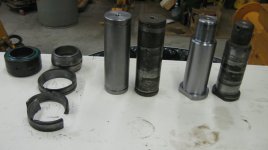
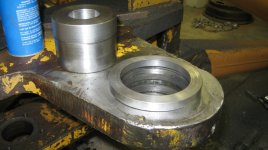
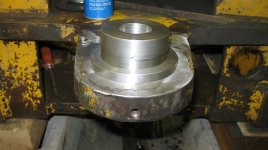
Here are the finished products and you can see how they compare with the old worn out pins. Also you can see how broken the self-centering bushing housing was that I removed from the frame. The new one is to the left of it for comparison. I felt real fortunate to find a new replacement bushing, because I don't think they use that type of bushing any more in the newer hoes and that's something that I could never have manufactured!

IMG_2340_rs.jpg
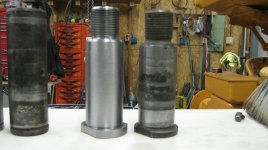
Just a close up comparison of the old and new. I made mine a little heftier at the base flange and the upper shoulder a tad longer for better engagement of the bore of the tower.

IMG_2341_rs.jpg
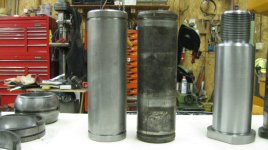
This picture just gives a closer look of those pins. Remember, the straight one with the grooves at each end is for the upper part and the one with the threads is for the lower part.
 
   / 1963 Case 530CK Backhoe/Loader #93  
Beautiful work.

I can only imagine what it would cost to have these parts made by a machine shop.

You are remarkable.

PAGUY
 
   / 1963 Case 530CK Backhoe/Loader
  • Thread Starter
#94  
I can only imagine what it would cost to have these parts made by a machine shop.
PAGUY

PAGUY

You know PAGUY, the cost of outsourcing the machining of that part or buying it from a Case dealer, would be prohibitive. I went into my local dealer and had him quote me the cost of the lower boom pivot pin, which I have not made yet (2" dia. x about 12" long) and he said there was only one in stock on the East coast, Pennsylvania in fact. The cost was: $600.00 and change. Now, I know that the one he was quoting was hardened and heat treated and better than the one I can create, but I think the one I manufacture will still suffice and not cost that much.......... My tractor is too old to be spending that much money for something that is not used commercially.
 
   / 1963 Case 530CK Backhoe/Loader #95  
PAGUY

You know PAGUY, the cost of outsourcing the machining of that part or buying it from a Case dealer, would be prohibitive. I went into my local dealer and had him quote me the cost of the lower boom pivot pin, which I have not made yet (2" dia. x about 12" long) and he said there was only one in stock on the East coast, Pennsylvania in fact. The cost was: $600.00 and change. Now, I know that the one he was quoting was hardened and heat treated and better than the one I can create, but I think the one I manufacture will still suffice and not cost that much.......... My tractor is too old to be spending that much money for something that is not used commercially.

Not dissing you and probably do the same but do you have a way to get that pin out if it bent? ?
 
   / 1963 Case 530CK Backhoe/Loader
  • Thread Starter
#96  
Not dissing you and probably do the same but do you have a way to get that pin out if it bent? ?

Well farm boy00, I'm not sure I understand your question, but if you mean my boom pin? I already have it removed from the boom. It was so loose from wear that it just came scooting out after I removed the keeper bolt on the end of the pin. If you're asking how to remove a bent pin from the same boom, I'd have to know more.

You see, when I ask the parts counter person how much a new pin would cost, it was at the front end of my project and I had not attempted to machine my pins yet. But when he told me how expensive it would be, I did some research and decided to make my own. Now, I've heard about 4140 and some of the other steels, but most of them are not easily welded and my boom pin has a piece of 1/4" or 5/16" plate stock welded to one end and threaded on the other. So I needed a steel that is strong and easily welded, so I picked 8620 alloy steel. I hope that answers you question.

Stan.
 
   / 1963 Case 530CK Backhoe/Loader #97  
Well farm boy00, I'm not sure I understand your question, but if you mean my boom pin? I already have it removed from the boom. It was so loose from wear that it just came scooting out after I removed the keeper bolt on the end of the pin. If you're asking how to remove a bent pin from the same boom, I'd have to know more.

You see, when I ask the parts counter person how much a new pin would cost, it was at the front end of my project and I had not attempted to machine my pins yet. But when he told me how expensive it would be, I did some research and decided to make my own. Now, I've heard about 4140 and some of the other steels, but most of them are not easily welded and my boom pin has a piece of 1/4" or 5/16" plate stock welded to one end and threaded on the other. So I needed a steel that is strong and easily welded, so I picked 8620 alloy steel. I hope that answers you question.

Stan.

All I meant was that if your using a weaker steel for the pin when you finish the project is that you may want to have a way to remove the pin if it bends
 
   / 1963 Case 530CK Backhoe/Loader
  • Thread Starter
#98  
All I meant was that if your using a weaker steel for the pin when you finish the project is that you may want to have a way to remove the pin if it bends

Thanks for the clarification you bring up a fair point, I'm using 8620 alloy pin stock, it's 2" dia., I don't think a 530ck has enough power to ever bend that bar. It might wear sooner than a heat treated and normalized pin, but tensile and yield strength of 8620 are much higher than the hydraulic power of that tractor. But if it did, yes, I would know how to remove it.

Here is list of it's uses: 8620 applications include gears, pinions, cams, cranks, clutch shafts, shafting, axles, tie bars, collets, bushings, heavy duty pins, bolting, springs, hand tools, die cases, and a multitude of machinery parts and components.

I do appreciate your input, thanks.
 
   / 1963 Case 530CK Backhoe/Loader #99  
Thanks for the update. I really enjoy this thread and watching your machining skills.
 
   / 1963 Case 530CK Backhoe/Loader
  • Thread Starter
#100  
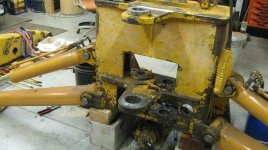
Thought I would show you what I did on the backhoe frame. After removing boom, crowd and bucket this is what was left. The cylinders and flanged pins on top and bottom were so worn and egg shaped that I had to re-lathe and bush everything. I know that I showed you this previously but I thought it would keep in context the next steps that were done.

IMG_2234_rs.jpg
Here is the worn and cracked pieces just before removing pins and bolts.

IMG_2248_rs.jpg
Frame is now separated from docking bars, but both bushings are still in the frame.

IMG_2245_rs.jpg
Close up of the damaged self-centering bushing, but with half the housing boss ground down. As I showed you in a previous post the eyeball bushing housing or race was cracked and broken.

IMG_2265_rs.jpg
I pulled back to show both the upper and lower tower extensions, clean enough to finally see the damage. If you look closely at the bottom swing cylinder bar you can see the deep wear into the metal where the cylinder was moving and grinding into that metal as well. This was part of the reason that the boom, when fully extended would swing about 2' and would have to hunt for the trench.

IMG_2251_rs.jpg
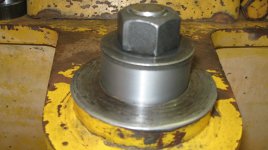
In this picture you can see the bushing sleeve that I made to remove the bushing from the boss. You can also see the wear in the boss with some metal at the outer edge distorted and misshapen. I used an AVOS pad to grind and blend that metal with the rest of the boss. I'll probably put a wear washer that I can replace if it wears in the future.

IMG_2255_rs.jpg
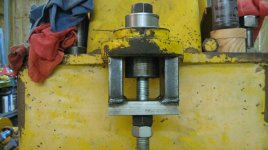
Thought I would include the tool that I made up to remove the bigger bushings. It is made out of 1"x3" flat bar A36 steel for the body and 1"x8 dia. all thread that I had laying around and I turned the bushing sleeve out of some heavy DOM 1020 steel. Before welding the legs, I mounded them up in my mill and machined them to the same length for even extraction. If you look at the lines on the old bushing coming out you can tell where it stopped and started again with every turn of the wrench, it was in there pretty tight!

IMG_2343_rs.jpg
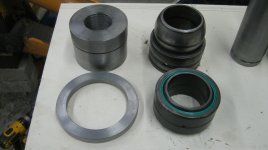
This one shows new self-centering bushing (lower right) and the old one (upper right). On the lower left is the new boss ring that I machined that will eventually welded to the lower frame extension. Above it on the left is a boss guide that I turned that will only be used to align the boss ring when I weld it. That boss ring has a groove machined into it, though it doesn't show in this picture that, when in place will hold the retainer snap ring, which then holds the self-centering bushing in place.

IMG_2346_rs.jpg
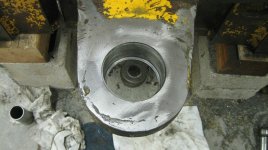
I've ground the damaged face flat and am prepping it for the boss ring. If you look close you can see the partial groove left in the top of the bore which will mate up with the boss ring that I'll weld in place. The flange at the bottom of the bore keeps the bushing from sliding on through, which means you can only install or remove the bushing from the top.

IMG_2351_rs.jpg
This close up shows how fit up and position of the final assembly. If you look closely in the lower part of the arm extension you can see where someone has welded up with a cross stitch weld. I figure it has probably been fatigued or cracked before, there is one on the opposite side too. When I'm done I'll re-enforce it in those spots...........

IMG_2349_rs.jpg
Now you can see the ring in place and the centering device (which will be pressed clear to the shoulder) and I'll tack weld the ring in 8 or 10 equal spaced places then remove it before final weld. I figure if the ring shrinks at all during welding I don't want that centering bushing pressed all the way in, it might be a little hard to remove. Next time I'll show you some of the machining I did on the swing cylinder flanged pins and bushing.
 

Tractor & Equipment Auctions

500 BBL FRAC TANK (A58214)
500 BBL FRAC TANK...
Case-IH 160 Puma (A57148)
Case-IH 160 Puma...
2020 MACK GRANITE (A58214)
2020 MACK GRANITE...
2017 Scag Cheetah 61in Zero Turn Commercial Mower (A59228)
2017 Scag Cheetah...
1990 Bayliner 19ft Trophy Center Console Boat w/ S/A 20ft Boat Trailer (A59231)
1990 Bayliner 19ft...
2014 MultiQuip WhisperWatt 40kW Three-Phase Diesel Generator (A55973)
2014 MultiQuip...
 
Top