Grid-tied solar

   / Grid-tied solar #1  

dave1949

Super Star Member
Joined
Apr 17, 2009
Messages
12,461
Location
nowhere, md
Tractor
Hanomag
I have been thinking about using some solar electric for a couple of years. The time seemed right this summer.

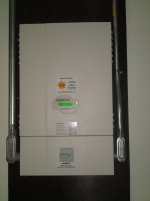
The system is rated at 4.3 KW annually using the NREL PVWATTS calculator. The panels are made by Canadian Solar and the inverter is a Solectria Renewables PVI 4000 model.

The installation was completed yesterday afternoon and the electric utility is supposed to swap-out our not-so-smart meter for one that does net metering on Monday. I am looking forward to getting some generating history built up. So far, it says it has generated 7 KW, 2 KW yesterday afternoon and 5 KW today which was heavy overcast all day long.

The system was purchased from and installed by Revision Energy based in Portland and Liberty, Maine. A really great A-1 crew from start to finish.

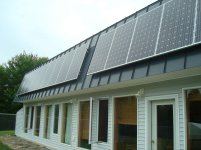
The close-up pic of the panel mounting shows the clamp-on brackets used on standing seam metal roofs.
 

Attachments

  • DSC02211.jpg
    DSC02211.jpg
    142.5 KB · Views: 555
  • DSC02214.jpg
    DSC02214.jpg
    287.4 KB · Views: 726
  • DSC02218.JPG
    DSC02218.JPG
    849.5 KB · Views: 642
   / Grid-tied solar #2  
Looks great.

Costs? Estimated payback time?
 
   / Grid-tied solar
  • Thread Starter
#3  
The upfront cost is $19,774. That includes all parts and labor. Also includes purchase and complete install of a 58 gal. Rheem/Marathon electric water heater, and removing our old indirect boiler-heated tank. So, there was wiring and plumbing to mess with for that part of it.

The system qualifies for Maine's energy efficiency rebate maximum of $2000 and a 30% federal tax credit (which can be carried-over if you cannot use all of it in one tax year) that is worth $5,932. My net cost for everything is $11,842. I can probably sell the old water heater tank for $500-$600. It's a 60 gal SuperStor in great shape, 5 years old.

I estimate the payback period at around 17-18 years but won't really know until I have some actual history. Our electric rates here are $0.15 per KW and the old water heater accounted for at least 260 gal. of propane per year by my best guesstimate. We used right around 315 gal of propane a year for our range cooktop (elec. oven) and domestic hot water for two people.

Propane is pretty cheap now with the gas glut, but I expect it will climb depending on how many LNG gas compression plants get built.

The 72 degree mounting angle on the panels does hurt the output, but to buy or have fabricated special mounts to help the angle is more expensive than adding a few panels to the system. They were concerned too that if the panels stood off the roof too far, they could catch too much wind behind them for the roof to withstand.

I checked with the roofer that did our roofs, he thought with the weight distributed across there (the 18 panels are 45 lb each) it shouldn't be a problem. The roof is 24 GA. They put a clamp on every standing seam rather than every third as would be normal for a flatter install. The installers were standing on the rails like on ladder rungs and nothing seemed to be giving at all.

We looked at ground A-frame rack and pole mounts but decided in the end to go with the roof. Couldn't find a location I really liked on the ground, ironically the best spot would have had our power lines throwing a shadow on them which would have led to burying our service line for about 400 feet. We have to think about snow build-up here too. I don't think snow will stick on the panels at that angle very long once the sun hits them. It doesn't stick to that roof surface now.
 
   / Grid-tied solar #4  
I am thinking about solar too. Can you say how much was the hardware and how much was the labor?
 
   / Grid-tied solar
  • Thread Starter
#5  
Hi Ladia, Sorry, no I never asked for a break down on that. I can tell you two guys worked 5 hours each the first day and four guys worked 6.5 hours each the second day. They put up staging due to the steepness of the roof, made it much easier to get the panels in place and fastened down. Anyways, something like 36 man-hours total. They have to charging at least $60/man-hour I would think. Plus they had 1.5 hours each way in travel time to get here and back.

The panels are mono-crystaline 240 watts from Canadian Solar. The Inverter is the PVI 4000 model from Solectria Renewables. The standing seam clamps are made from aluminum and the panel rails are extruded aluminum. The overall length of the panel array is about 59 feet. Two extruded rails run parallel that entire distance. I guess you could price those things or similar out on-line and get a good idea.

It's a really clean setup, tie the panels together in two strings, 9 panels per string. Connect those to the inverter. Connect the inverter to any service panel using a 240v double slot breaker. They put everything from the junction box on the roof (mounted behind the first panel) to the inverter in heavy metal conduit and the same from the inverter to the service panel. I was impressed with their attention to detail.
 
   / Grid-tied solar #6  
Sounds good. Good luck, I like reading threads like these. Keep us posted on your system ups/downs.
 
   / Grid-tied solar
  • Thread Starter
#7  
Sounds good. Good luck, I like reading threads like these. Keep us posted on your system ups/downs.

Thanks. So far, the inverter says the system has generated 30.6 KW in 40 operating hours. I plan on recording the accumulated output on the same day each month for a year or so until I see what's what. My electric bill will have some info too regarding credits and debits to the net usage.

In a net-metering system, you never want to generate more power than you use since most state utility regs don't require the utility to pay you for any excess. Basically, the excess credits generated in summer's long days get used up during winter's short days. My utility banks any credits for up to 1 year, then they delete the oldest credits in a FIFO method. The credits will be worth different amounts as/if rates change.

For those thinking about solar hot water or electric, geothermal heat pumps or small wind turbines, the 30% federal tax credits for consumer energy are scheduled out to the end of 2016: Federal Tax Credits for Energy Efficiency : ENERGY STAR. It applies to existing and new construction principal residences only, not to second homes or rentals.
 
   / Grid-tied solar
  • Thread Starter
#8  
Generation update.

After 13 days of operation, the inverter says the system has generated 182.5 kwh in 179 operating (daylight) hours. It got a real boost today with the crystal clear skies all day, it made 19.9 kwh. The highest output I have seen so far just over 2900 watts (dc) for one sample period. I may see higher sample time outputs with the lower winter sun angle which favor my steep mounting angle, but of course the total output for a day will be lower.

The net meters installed 9 days ago show 76 kwh in from the power company and 92 kwh out to the power co.

This link shows the calculated/modeled system output for my location: http://rredc.nrel.gov/solar/calculators/PVWATTS/version2/pvwattsv2.cgi

For the month of August, modeling says it should generate 383 kwh, or an average of 12.35 kwh per day. It has averaged about 14 kwh over the past 13 days. I have been curious as to how accurate the the model is and so far, it looks reasonable.
 
   / Grid-tied solar #9  
im all for alternate energy, but i just dont understand how these systems pay for themselves. So far your figures for 13 days average aprox 14KW/day.

i pay $0.5/kwh for electricity, so this system would save me 14 x .05 = about $0.70/day x 365 = about $255/yr

19,000 / 255 = 75 years needed to pay fopr itself. are there some govt %%% incentives that are coming to offset this 19 grand?
 
   / Grid-tied solar #10  
im all for alternate energy, but i just dont understand how these systems pay for themselves. So far your figures for 13 days average aprox 14KW/day.

i pay $0.5/kwh for electricity, so this system would save me 14 x .05 = about $0.70/day x 365 = about $255/yr

19,000 / 255 = 75 years needed to pay fopr itself. are there some govt %%% incentives that are coming to offset this 19 grand?

my thoughts as well.
we pay 7 cents /kwh so $0.07 * 14 = $0.98 / day.
 
   / Grid-tied solar
  • Thread Starter
#11  
im all for alternate energy, but i just dont understand how these systems pay for themselves. So far your figures for 13 days average aprox 14KW/day.

i pay $0.5/kwh for electricity, so this system would save me 14 x .05 = about $0.70/day x 365 = about $255/yr

19,000 / 255 = 75 years needed to pay fopr itself. are there some govt %%% incentives that are coming to offset this 19 grand?

I described the credits and rebates in post #3, my net cost is $11,842, that includes the new elec. hot water heater (retails at HD for $718 : 50 Gal. Lifetime Marathon Electric Water Heater-MR50245 at The Home Depot and all installation charges.

I pay a little over $0.14 per kwh for power here. The modeled output at that price is worth $490.33 per year. That's 24 years to break even on that basis. My old water heater was an indirect-fired type that was using at least 260 gal of propane per year. The last propane delivery I had was $3.05/gal. - propane is also expensive here. Even at $2.50 per gal, that is $650 per year in propane that I am not buying any more. On that basis, my break-even is 18 years. 11,842/650=18.2 yrs.

So, that is a long time yes, but at the end of it, I (hopefully) can look back and say my cost was zero to eliminate 18 year's worth of propane use. I feel bad about the guys in the global warming thread having to subsidize my green project, but that's life :D
 
   / Grid-tied solar #12  
We pay about $.11-15 per kWh here in S. Texas ( Enron got our electric market de-regulated).

In places like CA and others they are paying upwards of $.20+ per kWh.
 
   / Grid-tied solar
  • Thread Starter
#13  
I see the link to PVWatts is not working. The chart below is the modeled output by month for my location.

State: Maine
Latitude: 44.8 ー N
Longitude: 70.3 ー W
PV System Specifications
DC Rating: 4.32 kW
DC to AC Derate Factor: 0.770
AC Rating: 3.33 kW
Array Type: Fixed Tilt
Array Tilt: 72.0 ー
Array Azimuth: 180.0 ー
Energy Specifications
Cost of Electricity: 14.0 「/kWh
Results

Month Solar Radiation(kWh/m2/day) AC Energy(kWh) Energy Value($)
1 3.55 388 54.32
2 4.21 412 57.68
3 4.89 509 71.26
4 3.91 374 52.36
5 3.78 353 49.42
6 3.58 308 43.12
7 3.84 341 47.74
8 4.17 383 53.62
9 4.26 394 55.16
10 3.71 369 51.66
11 2.83 283 39.62
12 3.07 331 46.34
Year 3.82 4447 622.58
 
   / Grid-tied solar
  • Thread Starter
#14  
My electricity charges are:
Delivery service (lines, poles, substations, etc) $8.91 for the first 100 kwh, and .060333 for each kwh above 100
Supply (generator) .07438 per kwh

The delivery service charge went up 10% to cover grid modernization, but I don't have a bill yet with the exact numbers.

In any case, my last two power bills were $36.29 for 248 kwh ($0.1463 per kwh) and $52.76 for 357 kwh ($0.1478 per kwh)

I also noticed an error in my earlier post about break-even times. at $0.14 per kwh my annual modeled output is worth $622, not $490. That brings my break-even time down to 19 years based on electricity value.
 
   / Grid-tied solar #15  
Good stuff! Anything realistically projecting a break-even in under 20 years is fantastic, in my opinion. Shoot, once I can afford to build my home and add solar, I would be happy with a 40 year break-even. To some folks (me), it's worth a little money to save that much carbon emission.
 
   / Grid-tied solar #16  
deezler said:
Good stuff! Anything realistically projecting a break-even in under 20 years is fantastic, in my opinion. Shoot, once I can afford to build my home and add solar, I would be happy with a 40 year break-even. To some folks (me), it's worth a little money to save that much carbon emission.

Are you using a battery bank? If you are then the best life span I've seen is twenty year so the break even point of 19 years is not quite accurate as you need to factor in maintenance and repair costs.

Also the carbon emissions that you're saving may easily bused up in the production process of those batteries. This is all assuming your using batteries.

In Manitoba we use hydro electric generating station, they produce the power at about 3.2-3.6 cents per kwh and sell around 5.2. Funny thing is they have recently added wind farms that produce at 7 cents per kwh and still sell at 5.2. Go figure.
 
   / Grid-tied solar
  • Thread Starter
#17  
Good stuff! Anything realistically projecting a break-even in under 20 years is fantastic, in my opinion. Shoot, once I can afford to build my home and add solar, I would be happy with a 40 year break-even. To some folks (me), it's worth a little money to save that much carbon emission.

Thanks for the comments. There is nothing cheap about the upfront costs of alternate energy, solar, wind, etc. all require fairly big investments and long-term thinking. I think that combination of factors, initial expense and long-term, is what makes it challenging to implement from political and practical perspectives. We aren't very good at long-term solutions when 2-4 year cycle politics gets involved, or looking at the bottom line on a quarterly basis.
 
   / Grid-tied solar
  • Thread Starter
#18  
Are you using a battery bank? If you are then the best life span I've seen is twenty year so the break even point of 19 years is not quite accurate as you need to factor in maintenance and repair costs.

Also the carbon emissions that you're saving may easily bused up in the production process of those batteries. This is all assuming your using batteries.

In Manitoba we use hydro electric generating station, they produce the power at about 3.2-3.6 cents per kwh and sell around 5.2. Funny thing is they have recently added wind farms that produce at 7 cents per kwh and still sell at 5.2. Go figure.

If you click on Table 1 in this link, you can see the cost comparison to build and operate about any sort of power generation facility. Table 2 is the 2011 update.
EIA - Updated Capital Cost Estimates for Electricity Generation Plants

The "overnight cost" is what it would cost if a plant could be designed and built literally "overnight" (skipping the multi-year permitting, legal battles, etc.) with current construction and fuels pricing, and technology.

I don't use batteries, but you are correct, they are not environmentally friendly in the big picture. I think they are only a good solution when getting grid power is impossible or too expensive. The grid power supplied in Maine is 30-35 percent sourced from renewables (hydro, biomass, waste, wind, etc.).

There are drawbacks to hydro. If the dams connected to coastal waters block fish spawns for example, it impacts Atlantic salmon populations, and the populations of fish that become food for cod and other important ocean species. Some people are convinced that here on the East Coast, the ocean fisheries will never recover until the 100's of small dams dotting the rivers from Conn. to Maine are torn out or rebuilt with fish ladders that actually work. Under-feeding is as big a problem as over-fishing.
 
   / Grid-tied solar #19  
Generation update.
...
For the month of August, modeling says it should generate 383 kwh, or an average of 12.35 kwh per day. It has averaged about 14 kwh over the past 13 days. I have been curious as to how accurate the the model is and so far, it looks reasonable.

Thanks for the update.

Seems like you have a 4320 watts of panels and get 3.82 power hours a day so the best you could generate is 16.5 KWH. Is the 14 KWH average available at the AC outlets or is that the just what is produced by the panels? Why do I ask? :laughing: An article in Home Power magazine said that the power loss of solar was 40% so one would only get 60% of the power generated. That 40% loss seems VERY high to me. I still am surprised that one does not get more than N number of hours of power production a day. You are getting about 4 hours a day and I would get about 5 year round. Your numbers are showing that you do get the predicted 4 hours of power production per day.

Putting money aside, the big limitation for solar is the number of hours once can produce power, the need for power out side of the few hours where power production occurs, and how much power one gets at the AC outlets. An extra couple of hours of power production really makes a difference but there ain't much one can do about. :laughing: Batteries to store power are expensive an a long term expense that does not end. When I ran some quick numbers on a limited number of batteries to allow us to run our fridge, freezer, and well, the cost for solar really jumped.

Later,
Dan
 
   / Grid-tied solar
  • Thread Starter
#20  
Thanks for the update.

Seems like you have a 4320 watts of panels and get 3.82 power hours a day so the best you could generate is 16.5 KWH. Is the 14 KWH average available at the AC outlets or is that the just what is produced by the panels? Why do I ask? :laughing: An article in Home Power magazine said that the power loss of solar was 40% so one would only get 60% of the power generated. That 40% loss seems VERY high to me. I still am surprised that one does not get more than N number of hours of power production a day. You are getting about 4 hours a day and I would get about 5 year round. Your numbers are showing that you do get the predicted 4 hours of power production per day.

Putting money aside, the big limitation for solar is the number of hours once can produce power, the need for power out side of the few hours where power production occurs, and how much power one gets at the AC outlets. An extra couple of hours of power production really makes a difference but there ain't much one can do about. :laughing: Batteries to store power are expensive an a long term expense that does not end. When I ran some quick numbers on a limited number of batteries to allow us to run our fridge, freezer, and well, the cost for solar really jumped.

Later,
Dan

See buckeyefarmer's post #21 here: http://www.tractorbynet.com/forums/related-topics/253320-electric-knowledge-needed-please-3.html for an explanation of what/how gets to the AC outlets in your home.

The 3.82 number you referenced as "power hours" is the annual average amount of energy, expressed in kwh, that strikes a square meter of surface area. This is the "insolation" value the pv panels convert to power--at very low efficiency rates.

The "derate" factor (top area of chart I posted) of .77, is the efficiency loss within the system, beginning with the power actually produced by the pv panels. For every watt generated, .77 watts comes out the other end. I did not attempt to refine the default derate factor of .77 in my modeling--beyond my paygrade :).

The amount of power actually produced by the array varies from about 50 watts to 2900 watts during the course of a sunny day. The inverter is designed to wait for its "strike" voltage of 235 vdc coming from the pv array. When that is reached early in the morning, it loads the array down to 200 vdc and starts inverting whatever wattage is present to AC and sending it to the service panel buss bars. The inverter itself claims to have an efficiency greater than 90 percent.

The "AC Energy(kWh)" column (4447 KWH annual total) is the expected power available to use from an array rated at 4.32 kW-- as installed at my location accounting for average weather patterns and daylight hours available, and the angle the panels are mounted at (72 degrees in my case).

The number (4.32 kw) comes from having 18 panels times 240W each = 4,320 watts. It is the nominal power the panels will produce under perfect conditions in a testing lab. If the panels did that for one hour, then you would have 4,320 watt-hours or 4.32 kwh.
 

Tractor & Equipment Auctions

2018 FREIGHTLINER M2 FORESTRY UTILITY BUCKET TRUCK (A59823)
2018 FREIGHTLINER...
2015 CHEVROLET 2500 HD CREW CAB FLATBED TRUCK (A60430)
2015 CHEVROLET...
Toro Zero Turn Lawn Mower (A56859)
Toro Zero Turn...
2014 MAGNUM PRODUCTS LIGHT TOWER COMBO (A58214)
2014 MAGNUM...
2024 KAUFMAN LOPRO WEDGE 3 CAR TRAILER (A59905)
2024 KAUFMAN LOPRO...
Yamaha Golf Cart (A57149)
Yamaha Golf Cart...
 
Top