Spray Booth Ducting

   / Spray Booth Ducting #1  

rjmack

Platinum Member
Joined
Jan 1, 2010
Messages
709
Location
cariboo wagon rd
Tractor
GC2410
like the title says, i built a 12'x16' foot tractor shed that i want to use as a spray booth from time to time.

i plan to put a fan low on one end wall, and plumb two grates in between the trusses at the other (doors) end.

the two grates will then be ducted to grates mounted in the eaves, then the roof will be insulated between the trusses at the ceiling (8') level.

i have a number of fans to choose from, but not really much of an option as far as the grates and ducting. both the intake and exhaust sides need to be filtered.

has anybody run across the hardware to achieve the filtering/ducting issues?

it would be nice to have the inlet filters mount behind the ceiling grates so they would be easier to change.
 

Attachments

  • duct route.jpg
    duct route.jpg
    218.1 KB · Views: 545
   / Spray Booth Ducting #2  
Your best move is to bring in air low and send it out high, filter on both ends...cheap one on the way out and good one on the way in. When I built mine I used the squirrel cages from two old forced air furnaces that I found in the trash, ran them to a pulley and belt system from an old craftsman table saw that...I got out of the trash. I just cut a small section out of the garage door and hinged it, inserted a furnace filter for the inlet and cut two holes the size of the furnace outlets in the back wall and was in business. As far as I know, the current owner who does some small time restoration projects still uses the setup.
 
   / Spray Booth Ducting #3  
Proper intake filters, (5 micron) are about 3" thick, expensive, and require a considerable blower to move air through them. Your also going to need a large area, (probably the entire ceiling), for intake.

Anything less than 5 microns, and you might as well just use fine window screens. Nothing else is going to be much more effective. Plus, you could remove them and hose them off when they eventually get dirty.

I would just put some small windows in, at the top, or bottom, on each side, (like the ones they use in glass block for example), and use them for intakes.

Then, a slow moving fan, (preferably explosion proof), exhausting on the other end will be the ticket. You can build a box that uses the cheap furnace filters as paint arrestors on the exhaust, but I would not bother to filter the exhaust, unless you have very nearby homes or vehicles your concerned about.

For the cleanest jobs, you want to move the air as slowly as possible, and still clear out the building in a reasonable time.
 
   / Spray Booth Ducting
  • Thread Starter
#4  
Your best move is to bring in air low and send it out high

this is directly contrary to everything i have read so far. evidently, the objective is to pull the overspray/mist down and away from the work, otherwise it will settle on the work. also, every spray booth i have looked at has the fan on the exhaust side, blowing out rather than in.

my main problem is finding the grating/ducting hardware that i can use filters with. regular floor vents would work in the eaves, as they can be closed and screened on the inside to help keep bugs out, but when it comes to filtering them the filters are designed for opposite flow direction. i am looking for grates that can be both filtered in the right direction and are closeable so as to minimize cold air coming in when i'm not using the air evac system.

For the cleanest jobs, you want to move the air as slowly as possible, and still clear out the building in a reasonable time.

the minimum requirement is evidently a fan that will move the cfm of the booth in 1 minute
like i said, i have found a number of different fan options, but i do need to filter the outgoing air before it gets to the fan. the cubic footage of the shop is 12x16x8=1536 so a 1600 cfm fan will do the job but i don't want voc's piling up on and around it thus the pre filter on the exhaust side (also the neighbours). i assume there are furnace filters that will meet these flow requirements but matching them to grates seems to be a problem.

Your also going to need a large area, (probably the entire ceiling), for intake.

the exhaust filter will probably be 24"x24" or so. i'm thinking if i get that much total area, or perhaps a bit more for the inlet, i should be good.

edit: also, the fiberglass insulation in the roof will require ducting to the vents in the eaves otherwise fiberglass dust will be sucked down onto the paint.

btw, thanks for the replies. :thumbsup:
 
   / Spray Booth Ducting #5  
I experimented with this sort of thing when I was a kid painting cars, motorcycles and anything that wasn't nailed down. I found the best approach was to seal the room and let it sit quiet for a day before I sprayed. I even used a roller on one of my first victims and it turned out surprisingly well. Use a tack rag right before painting to catch whatever settled on the car. I tried a few types of fan arrangements, putting filters at the bottom of the garage door and blowing out the window. All seemed to stir up more dust than they eliminated.
 
   / Spray Booth Ducting #6  
My setup was the kind that pulled the air out and I used the high end furnace filters on the intake, by pulling air in low and sucking it out high there were minimal overspray issues, due to the elimination of settlement, we also painted the walls and floor prior to using it as a booth, old concrete seems to create dust all on it's own, I also left the pulley with different sizes on so I could change the amount of airflow depending on what I was working with. Motor and squirrel cages were outside of building facing down and the motor was covered with a plastic tote when not in use, I figured there were no issues with explosion or motor fouling if it was outside.
 
   / Spray Booth Ducting #7  
this is directly contrary to everything i have read so far. evidently, the objective is to pull the overspray/mist down and away from the work, otherwise it will settle on the work. also, every spray booth i have looked at has the fan on the exhaust side, blowing out rather than in.

my main problem is finding the grating/ducting hardware that i can use filters with. regular floor vents would work in the eaves, as they can be closed and screened on the inside to help keep bugs out, but when it comes to filtering them the filters are designed for opposite flow direction. i am looking for grates that can be both filtered in the right direction and are closeable so as to minimize cold air coming in when i'm not using the air evac system.


the minimum requirement is evidently a fan that will move the cfm of the booth in 1 minute
like i said, i have found a number of different fan options, but i do need to filter the outgoing air before it gets to the fan. the cubic footage of the shop is 12x16x8=1536 so a 1600 cfm fan will do the job but i don't want voc's piling up on and around it thus the pre filter on the exhaust side (also the neighbours). i assume there are furnace filters that will meet these flow requirements but matching them to grates seems to be a problem.


the exhaust filter will probably be 24"x24" or so. i'm thinking if i get that much total area, or perhaps a bit more for the inlet, i should be good.

edit: also, the fiberglass insulation in the roof will require ducting to the vents in the eaves otherwise fiberglass dust will be sucked down onto the paint.

btw, thanks for the replies. :thumbsup:

1. In a "real" down draft booth, you pull the air straight down. But the air you pulling down is filtered to below 5 microns. You can't achieve that. You can't get even close. So, If you choose to do a down draft, you will be pulling air that may contain particles large enough to be visible in to the wet paint. In that case a crossing up draft, or straight cross draft, can result in a better job, depending on what your painting.

2. If you used a "real" intake filter it will have to be huge. If you use some sort of furnace filter, it won't.

3. Your going to have static pressures to deal with, so figuring the amount of air movement in advance, is more difficult than doing some basic calculations. Trial and error is going to be necessary, if you want optimum performance.

4. A 24"x24" fiberglass furnace filter on the exhaust, would be inadequate for anything but small jobs. And will be only slightly better than nothing.
 
   / Spray Booth Ducting #8  
Ive wired up a half dozen professional spray booths over the years, and they all had one thing in common.

1. Very large filtered air intakes on the entry door side..and i mean floor to ceiling

2. The exhaust side was always the same size in sq feet as the intake side, and had the same filters to protect the fan.

Im not sure how a small fan can move enough air to pass thru a filter???

these fans were 25HP 3 phase suckers.

Maybe a huge greenhouse fan might work, one with 36" diameter blades??.
 
   / Spray Booth Ducting
  • Thread Starter
#9  
My setup was the kind that pulled the air out and I used the high end furnace filters on the intake, by pulling air in low and sucking it out high there were minimal overspray issues, due to the elimination of settlement, we also painted the walls and floor prior to using it as a booth, old concrete seems to create dust all on it's own, I also left the pulley with different sizes on so I could change the amount of airflow depending on what I was working with. Motor and squirrel cages were outside of building facing down and the motor was covered with a plastic tote when not in use, I figured there were no issues with explosion or motor fouling if it was outside.

i'm still not clear on your inlet side... did you just cut holes in the walls? i need to maintain the ability to securely lock up the building, as well i have gone to fairly great lengths to prevent mouse/rodent issues. if i went to direct filters in the walls, i would have to address these issues. using the eaves for inlet takes away a lot of worries.

In a "real" down draft booth, you pull the air straight down. But the air you pulling down is filtered to below 5 microns. You can't achieve that. You can't get even close. So, If you choose to do a down draft, you will be pulling air that may contain particles large enough to be visible in to the wet paint.

how many microns are the top end furnace filters?

Ive wired up a half dozen professional spray booths over the years, and they all had one thing in common.

1. Very large filtered air intakes on the entry door side..and i mean floor to ceiling

2. The exhaust side was always the same size in sq feet as the intake side, and had the same filters to protect the fan.

Im not sure how a small fan can move enough air to pass thru a filter???

these fans were 25HP 3 phase suckers.

Maybe a huge greenhouse fan might work, one with 36" diameter blades??.

i suspect the reason that the 'real' booths have huge banks of filters is to allow for maximum airflow with minimum turbulence. again, that is a best case scenario. experience tells me most dust gets kicked up from the floor. even if you start with a wet floor, it has usually dried by the time a large project (car) is complete... thus the rational to exhaust from the floor. (btw, i'm going to go with fixemall's suggestion to paint the floor)

far as the fan goes, a 12" 12v fan is enough to move the cfm that i require.

http://www.princessauto.com/all-sea...-fans/0772301-12-single-speed-ventilating-fan

i painted a truck once with a 36" 120v room fan surrounded by cardboard taped in the main door, and bugscreen taped across the man door. that gave me enough ventilation to paint and dealt with the bug issue, but not the dust. then again there was a lot of dust in the shop and the floor was dry long before the job was done.

this building isn't big enough for a complete vehicle so it will be used for small jobs. fenders, hoods, cabs, lawn mower parts, motorcycle tanks, etc... the sort of jobs that don't require all that much volume of paint and don't generate nearly as much in the way of fumes.

so i know what i want to do, just need help finding the hardware.
 

Attachments

  • ta4.jpg
    ta4.jpg
    32.7 KB · Views: 304
  • ta5.jpg
    ta5.jpg
    61.4 KB · Views: 291
   / Spray Booth Ducting #10  
The reason a good down draft booth cost $50-80k is you can't get there with basic equipment.

An intake filter for my booth used to cost me $600. It was 3" thick 5' wide and 20' long. It had to be that large because it created so much resistance, It took a 3hp blower to get air through it.

Then, you need a second blower on the exhaust, that lags some, so that the air pressure inside the booth is higher that outside, to keep the exhaust fan from from sucking dirt into the booth, through every nook and cranny.

That's part of what it takes to get really clean jobs. That, and properly filtered air supply, properly filtered paint, properly cleaned clothing, and good vehicle preparation. Even your air hose needs to be cleaned.

You should realize you can't get a really clean paint job even in a basic $25k booth. And, It still has filters that are much better than anything your going to use.

You can use all kinds of furnace filters and convince yourself they are doing you some good. But, I have a lifetime of experience painting cars in garages, body shops, outdoors, in homemade spray booths, and factory spray booths. I still will tell you your best bet is to just make a simple cross draft with screens for your intake, and a slow fan on the other end. I painted cars everyday for many, many years that way, and short of spending the big money for the down draft booth, it works the best.
 
   / Spray Booth Ducting #11  
i'm still not clear on your inlet side... did you just cut holes in the walls? i need to maintain the ability to securely lock up the building, as well i have gone to fairly great lengths to prevent mouse/rodent issues. if i went to direct filters in the walls, i would have to address these issues. using the eaves for inlet takes away a lot of worries.


I just cut out one of the squares in the door and hinged it, when in use I put a filter in the hole, when not in use I closed it and used a door bolting lock to secure it.
 
   / Spray Booth Ducting
  • Thread Starter
#12  
You can use all kinds of furnace filters and convince yourself they are doing you some good. But, I have a lifetime of experience painting cars in garages, body shops, outdoors, in homemade spray booths, and factory spray booths. I still will tell you your best bet is to just make a simple cross draft with screens for your intake, and a slow fan on the other end. I painted cars everyday for many, many years that way, and short of spending the big money for the down draft booth, it works the best.

okay, sold.

i'm still going to vent through the eaves though, maybe duct it down lower on the inside...


I just cut out one of the squares in the door and hinged it, when in use I put a filter in the hole, when not in use I closed it and used a door bolting lock to secure it.

okay, now i get it, thanks... i'll probably go with something like that on the fan end.
 
   / Spray Booth Ducting #13  
Since the shutters on an exhaust fan never really close, we used to build a cabinet over the fan, and insulate the inside. When your done with it, you simply close the doors.

In later years, I used a single hung window, and mounted the fan so that it hinged on one side of the window. You could move the fan out of the way, and close the window. It also left you with a window for light, and air, when your not painting.

Your cleanest paint jobs will usually come when you get in, get the paint on, get out, and get it to set up as soon as your done. The longer you spend in between coats, and with it wet, (open), before it starts to set, and the more air you pull across it, the more opportunity there is for dirt to set in.

Your at a disadvantage working part time at this because you have fewer opportunities to experiment with speeding the process up. But there are fast setting products available today, that can help you with this. These are generally the more expensive products, but they are worth the money.

Since I have retired, I have painted some show quality motorcycle parts, and some aircraft parts, outside in my back yard, (some people won't take I don't want to do this anymore for an answer). They required no buffing, because I was able to use products that I knew would set, right after I finished.

Don't forget, the sun, and a light breeze can be your best friend when you paint.
 
   / Spray Booth Ducting
  • Thread Starter
#14  
Don't forget, the sun, and a light breeze can be your best friend when you paint.

i may buy some lights today... i guess i should go as high as possible on kelvin temp? any other suggestions re the lights? fixture styles etc. (and no, i can't afford the self enclosed units... wish i could)

i'm not sure whether to get a few 5 or 6 bulb t8 fixtures or go with more double bulb units to broaden coverage. i have 4 100w incandescents for the basic lighting. i also have 5-500w halogen portables that i have accumulated over the years... not sure whether to use them or not.
 
   / Spray Booth Ducting #15  
You don't have to worry about color temperature, unless you going to match colors in there.

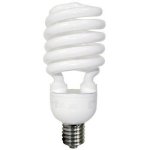
These bulbs are available at Home Depot, make sure you buy the TCP brand. $20 gets you a bulb and a socket. $16 gets you just the bulb. They use 68 watts, but put out 300 watts of light. And they can be turned on at -20F. I hate CFL's, but these are great. No noise, no hum. The only draw back is, (1) it takes a few minute for them to reach full brightness. But, they are as bright as a 100watt bulb when you turn them on. (2) They are about 10 inches long, which can be an issue if you have a low ceiling.
 

Attachments

  • TCP CFL.jpg
    TCP CFL.jpg
    7.5 KB · Views: 131
   / Spray Booth Ducting #16  
Good thread and info..
 
   / Spray Booth Ducting
  • Thread Starter
#17  
well, i went to the nearest home depot (50+ miles) and that store doesn't stock those bulbs. no big deal, i had to go there anyway.

so the closest thing they had were the phillips 150w Philips | 42 Watt Twister Daylight | Home Depot Canada

i like the look of these, they had one lit up in the store. Commercial Electric | 6-Light High Output Fluorescent High Bay | Home Depot Canada

i don't know if it's because i'm a welder or what, but the limited experience i have had with cfl's was that they hurt my eyes. i don't know if the tcp's would be different than the phillips or not.

i didn't buy any lights today but got the rest of the insulation and poly i need. the snag is i have to finish the ducting and wiring before insulating the roof and i have to figure out what i'm going to do for lighting before finishing the wiring.

guess i'll have to take a bit more time to think it through. btw, am considering giving up on the eaves/ducting idea... there just doesn't seem to be anything out there to do the job easily (cheaply). the weather is already fluctuating between +10 and -20 so there is some incentive to get things insulated sooner rather than later.
 
   / Spray Booth Ducting #18  
well, i went to the nearest home depot (50+ miles) and that store doesn't stock those bulbs. no big deal, i had to go there anyway.

so the closest thing they had were the phillips 150w Philips | 42 Watt Twister Daylight | Home Depot Canada

i like the look of these, they had one lit up in the store. Commercial Electric | 6-Light High Output Fluorescent High Bay | Home Depot Canada

i don't know if it's because i'm a welder or what, but the limited experience i have had with cfl's was that they hurt my eyes. i don't know if the tcp's would be different than the phillips or not.

i didn't buy any lights today but got the rest of the insulation and poly i need. the snag is i have to finish the ducting and wiring before insulating the roof and i have to figure out what i'm going to do for lighting before finishing the wiring.

guess i'll have to take a bit more time to think it through. btw, am considering giving up on the eaves/ducting idea... there just doesn't seem to be anything out there to do the job easily (cheaply). the weather is already fluctuating between +10 and -20 so there is some incentive to get things insulated sooner rather than later.
Glad the trip was not a total loss...
 
   / Spray Booth Ducting #19  
A high bay fixture is not made for a low ceiling.

We have those in some of our airplane hangers. They are hung at 20' and they still have lots of glare. They are super bright, and meant to be hung high. I can't imagine what it would be like at 8 or 10'.

If you have a local electrical supply house, they should have the large CFL's. My local store says they have a 400 watt output bulb now.

You can also get them online.

Lowe's also has a similar bulb.

I would not wast my money on the 42 watt Phillips bulbs. I have had very little luck with bulbs like that mounted base up. Most of them are not made for that. The large ones I suggested are.
 
   / Spray Booth Ducting #20  
I have a high output 4 lamp T5 high bay fixture mounted 12' above my work bench....LOVE IT. no more squinting to see my work now. Like working in daylight. This fixyure has four 52 watt T5 - 4 foot lamps with reflectors.
 

Tractor & Equipment Auctions

2010 CATERPILLAR 320DL RR EXCAVATOR (A60429)
2010 CATERPILLAR...
2007 Ford F-250 4x4 Crew Cab 7ft. Flatbed Truck (A59230)
2007 Ford F-250...
1745 (A60430)
1745 (A60430)
(2) UNUSED 31" X 8 MM EXCAVATOR TRACKS W/ PINS (A60432)
(2) UNUSED 31" X 8...
Tafe 45DI (A60462)
Tafe 45DI (A60462)
294 (A52706)
294 (A52706)
 
Top