Grid-tied solar

   / Grid-tied solar #61  
How is my conclusion flawed? I stated exactly what you stayed with regard to what is warranties. And, for what it's worth, the panels are not guaranteed to lose no more than 1% efficiency pet year. 100% of all panels produced have an efficiency of less than 100%. Losing 1% per year for 20 years would leave the panel at less than warranties levels prior to the end of the warranty.

A "couple" of your panels? How many panels do you currently have that are 20+ years old? How many that are that age are not producing at levels at or above 80%. How many panels at least that old are producing at below 80% our have already been replaced?

So when your warrenty on your tractor expires you just scrap it?
 
   / Grid-tied solar #62  
So when your warrenty on your tractor expires you just scrap it?

AGAIN... Comparing electrical products to mechanical products is not useful.

Additionally, there is SIGNIFICANT data that shows MOST tractors outlive their warranty. Since I am also able to perform periodic maintenance on the tractor, I am able to extend its serviceable life.

Lastly, this is not about "scrapping" something at the end of its warranty. I'll looking for empirical evidence that shows a PV solar system will significantly outlive its warranty in most cases. When that evidence its available, making a large investment into something like this becomes attractive.
 
   / Grid-tied solar #63  
AGAIN... Comparing electrical products to mechanical products is not useful.

Additionally, there is SIGNIFICANT data that shows MOST tractors outlive their warranty. Since I am also able to perform periodic maintenance on the tractor, I am able to extend its serviceable life.

Lastly, this is not about "scrapping" something at the end of its warranty. I'll looking for empirical evidence that shows a PV solar system will significantly outlive its warranty in most cases. When that evidence its available, making a large investment into something like this becomes attractive.

I see your point, but I don't get how you come to your conclusion, it also works the opposite in a number of key ways. I'm in the process of designing a new house that will be very close to net zero. I will be using electric hot water and electric baseboard heat, both of which are likely to outlast their on-site fossil fuel burning (or otherwise) equivalents because they are so simple., and are also very cheap to buy/install. I will pay only slightly more to install these appliances AND a 5-6kW PV array than I would to install an oil boiler and the plumbing associated with BBHW heat. So in my case, I'm almost at the break even point the first day, with one big exception, I don't ever have to fill an oil tank or pay an electric bill. I also will never have to replace an oil boiler, oil tank, etc, which will be offset by the occasional inverter etc.

In new construction it is easy to realize that the cost of the system comes into play in a major way, but the same logic applies to replacing an existing system if you wait until that system needs replacement. Again, at the end of the day solar is the only system that ever gives you free energy.
 
   / Grid-tied solar #64  
AGAIN... Comparing electrical products to mechanical products is not useful.

Additionally, there is SIGNIFICANT data that shows MOST tractors outlive their warranty. Since I am also able to perform periodic maintenance on the tractor, I am able to extend its serviceable life.

Lastly, this is not about "scrapping" something at the end of its warranty. I'll looking for empirical evidence that shows a PV solar system will significantly outlive its warranty in most cases. When that evidence its available, making a large investment into something like this becomes attractive.

I see your point, but I don't get how you come to your conclusion, it also works the opposite in a number of key ways. I'm in the process of designing a new house that will be very close to net zero. I will be using electric hot water and electric baseboard heat, both of which are likely to outlast their on-site fossil fuel burning (or otherwise) equivalents because they are so simple., and are also very cheap to buy/install. I will pay only slightly more to install these appliances AND a 5-6kW PV array than I would to install an oil boiler and the plumbing associated with BBHW heat. So in my case, I'm almost at the break even point the first day, with one big exception, I don't ever have to fill an oil tank or pay an electric bill. I also will never have to replace an oil boiler, oil tank, etc, which will be offset by the occasional inverter etc.

In new construction it is easy to realize that the cost of the system comes into play in a major way, but the same logic applies to replacing an existing system if you wait until that system needs replacement. Again, at the end of the day solar is the only system that ever gives you free energy.
 
   / Grid-tied solar #65  
How is my conclusion flawed? I stated exactly what you stayed with regard to what is warranties. And, for what it's worth, the panels are not guaranteed to lose no more than 1% efficiency pet year. 100% of all panels produced have an efficiency of less than 100%. Losing 1% per year for 20 years would leave the panel at less than warranties levels prior to the end of the warranty.

A "couple" of your panels? How many panels do you currently have that are 20+ years old? How many that are that age are not producing at levels at or above 80%. How many panels at least that old are producing at below 80% our have already been replaced?

- I have 2 panels over 20 years old.

- I was using worse case when I used 1% per year. I have had no panels that failed so far.

- This has nothing to do with panel efficiency. The warranty states that the panel will produce at least 80% of its rated wattage for 20 years. The site below addresses your concern.

Solar Panel Warranty | SRoeCo Solar

Solar Efficiency Losses Over Time


How much do solar panels decrease over time? The solar industry standard is a conservative estimate of 3% in the first year, and less than 1% per year after that. However, solar panel manufacturers are starting to realize that this is too conservative, and they are beginning to warranty their panels to more realistic degradation rates.


There are three points I want to make.
1.Use the solar panelç—´ warranty to compare output loss over time because that is the only output you are guaranteed.
2.Realistically expect less than a 3% decrease in output the first year, and about .5% decrease per year after that for most panels.
3.One solar panel from 1979 was tested in 2010 (after 30 years) and its output was better than the original factory specs.

-Also your statement that you won't invest until you are sure they will last long enough for your standards means that you will wait many years for the data. If you want a 50 year useful life it may be a long wait.

Loren
 
   / Grid-tied solar #66  
I see your point, but I don't get how you come to your conclusion, it also works the opposite in a number of key ways. I'm in the process of designing a new house that will be very close to net zero. I will be using electric hot water and electric baseboard heat, both of which are likely to outlast their on-site fossil fuel burning (or otherwise) equivalents because they are so simple., and are also very cheap to buy/install. I will pay only slightly more to install these appliances AND a 5-6kW PV array than I would to install an oil boiler and the plumbing associated with BBHW heat. So in my case, I'm almost at the break even point the first day, with one big exception, I don't ever have to fill an oil tank or pay an electric bill. I also will never have to replace an oil boiler, oil tank, etc, which will be offset by the occasional inverter etc.

In new construction it is easy to realize that the cost of the system comes into play in a major way, but the same logic applies to replacing an existing system if you wait until that system needs replacement. Again, at the end of the day solar is the only system that ever gives you free energy.

It's true that new construction does have to be looked at a little differently. And every region will have different needs from electrical in terms of both heating and A/C. If you're in a very "steady" region in terms of average daily temps, for example, your heating and A/C loads are very low for either. In very warm climates, there are more days that require A/C than those that require heat. Cooling with electricity is much less "efficient" than heating, so the load is much higher too. Fortunately, these also tend to be geographies where there's more intense sun available (hence, the more need for cooling).

If we assume all things to be equal, a "net zero" system for my house would mean that I pay nothing for electricity because I produce as much as I consume. I use about 20,000 KWh of electricity per year, or an average of 52KWh per day. In order to be able to have a net zero system, that's what I need to be able to produce on an "average" day (some days will need to be more, some less).

Using $5/Wh as a cost factor for building a solar system (it's going to be low in many cases, high in others, but you have to start somewhere), that would mean I would need to spend $250,000 for a system that would produce the amount of electricity I would need for a net zero system in my home. :shocked:

In order for me to build a net zero system that would pay itself back in 15 years, the cost of that system would have to come in at $50,000 or less, or a cost of less than $1/Wh installed.

There isn't a solar system out there that, for me, will guarantee me that my system will outlive its warranty -OR- will pay itself off in significantly less time than it's guaranteed to work for. FOR ME, there needs to be a guaranteed amount of time that the system will be able to be SAVING ME MONEY beyond my investment in order for it to be worth the time, energy, and general "effort" of having it installed.

Want the ROI on my tractor? Here it is... Heat my home with wood, assuming 5 cord per year. Based on "averages" of wood to oil (and my wood heating is EPA certified to be efficient, my oil furnace is similar in efficiency level, but the averages assume LOWER efficiency for wood and HIGHER for oil - so these estimates are short in terms of when I break even), I will burn about 875 gallons of oil -more- than I currently do in the heating season (I have oil-fired hot water in a separate tank / burner). At today's heating oil prices, that's roughly $3000 per heating season.

By using wood, I pay about $500 for the wood for a season and let's put in $200 worth of fuels for the saw, the splitter, and the tractor to move it around. That's $2,300 I save every year. In ten years, I've saved $23,000 - very similar to the cost of my tractor with a snowblower, loader, mower, bucket, ballast box, and forks. If I had bought the tractor solely for wood handling, I could have dropped my cost by about $5,000 and the payback would be in under 8 years.

With maintenance and small repairs, the tractor will absolutely outlast that time frame (I'll put on 500-600 hours in eight years) and then I will be a full mode of saving money.

When PV electric systems can show similar payback schedules and high reliability ratings beyond the payback date, I can be serious about investing in alternative energy sources like solar.

Some things I want to put out there to be sure people are not misinterpreting me...

- To the OP: If the system you have is valuable to you and you feel good about installing and using, I think that's great. I mean nothing disrespectful in my comments here.
- I am asking people about "new" systems (because there are very few people that post about "old" systems) questions similar to ones I've put in here or related to comments I've made. Everyone is excited to have their new item (car, house, solar system, etc) and will gladly tell folks they have it and are using it. I find it significantly more interesting to talk to the folks that have had those items for lengthy periods of time because I want to know what they've liked AND disliked about it over the years.
- We're all a group of people that likes to share and help... I see this thread as being in that spirit as well. If we can learn from what other folks have tried and succeeded / failed with, we all get a little smarter. Without asking "tough questions" sometimes, though, we won't have much chance to learn anything.
- I'm happy and eager to hear from folks that have more than anecdotal evidence that these systems a) work, b) last, and c) pay themselves off in "short" periods of time.
 
   / Grid-tied solar #67  
- I have 2 panels over 20 years old.

- I was using worse case when I used 1% per year. I have had no panels that failed so far.

- This has nothing to do with panel efficiency. The warranty states that the panel will produce at least 80% of its rated wattage for 20 years. The site below addresses your concern.

Solar Panel Warranty | SRoeCo Solar

Ok... 100% reliability rate - good. Low sample size (one consumer, small number of panels, etc) - not good. Not ideal, but useful to know.

The bolded section shows two contradictory statements... the "80%" *IS* the efficiency.

Solar Efficiency Losses Over Time


How much do solar panels decrease over time? The solar industry standard is a conservative estimate of 3% in the first year, and less than 1% per year after that. However, solar panel manufacturers are starting to realize that this is too conservative, and they are beginning to warranty their panels to more realistic degradation rates.

How you do the math here matters...

100% * 97% * 99% * 99% .... = 80.14% (JUST north of the guarantied rating).

100% -3 -1 -1 -1... = 77% (LESS than the rating)

There are three points I want to make.
1.Use the solar panelç—´ warranty to compare output loss over time because that is the only output you are guaranteed.
2.Realistically expect less than a 3% decrease in output the first year, and about .5% decrease per year after that for most panels.
3.One solar panel from 1979 was tested in 2010 (after 30 years) and its output was better than the original factory specs.

-Also your statement that you won't invest until you are sure they will last long enough for your standards means that you will wait many years for the data. If you want a 50 year useful life it may be a long wait.

Loren

My stance is that I would need to see empirical data that shows a) when the system will pay for itself after installation and b) the system will most likely continue to function for at least 1/3 of the payback schedule time in order to be an investment that I'm willing to take. I didn't say I needed 50 years of data, but this technology has not been in widespread enough use for well beyond the 20 year warranty period in order for me to believe that it is reasonable to expect the system to outlast warranty at all (let alone by a significant amount of time).

If systems become cost-effective enough to pay themselves back in 5 years, I'm only looking for 7-8 years minimum use to feel compelled to install, and the warranty is still 20 years, it's absolutely worth doing.
 
   / Grid-tied solar #68  
Our utility company (HELCO) is approved by the PUC for a 3.3% annual increase every year. That means that at the end of 30 years our utility bill will be 91% higher than it is today..
My math may be wrong but with a 3.3% annual increase over 30 years the cost will be more like 265% higher because it's compounded - Compound Interest Calculator.
 
   / Grid-tied solar #69  
Not sure how you got your result, but here's the rates by year, starting with year 0 and ending with year 20 (a 21 year window):

100
103.3
106.7089
110.2302937
113.8678934
117.6255339
121.5071765
125.5169133
129.6589715
133.9377175
138.3576622
142.923465
147.6399394
152.5120574
157.5449553
162.7439388
168.1144888
173.6622669
179.3931217
185.3130947
191.4284269

Each year's value is 1.033 times the previous year's value (a 3.3% increase).
 
   / Grid-tied solar #70  
Ok... 100% reliability rate - good. Low sample size (one consumer, small number of panels, etc) - not good. Not ideal, but useful to know.

The bolded section shows two contradictory statements... the "80%" *IS* the efficiency.

How you do the math here matters...

100% * 97% * 99% * 99% .... = 80.14% (JUST north of the guarantied rating).

100% -3 -1 -1 -1... = 77% (LESS than the rating)


My stance is that I would need to see empirical data that shows a) when the system will pay for itself after installation and b) the system will most likely continue to function for at least 1/3 of the payback schedule time in order to be an investment that I'm willing to take. I didn't say I needed 50 years of data, but this technology has not been in widespread enough use for well beyond the 20 year warranty period in order for me to believe that it is reasonable to expect the system to outlast warranty at all (let alone by a significant amount of time).

If systems become cost-effective enough to pay themselves back in 5 years, I'm only looking for 7-8 years minimum use to feel compelled to install, and the warranty is still 20 years, it's absolutely worth doing.
---------------------------------------
First bold - the 77% is less than the warranty but the warranty is still valid. Also you need to reduce by 3% of the original and then 1% of the new (yr 2 number) and then 1% of the year 3 number etc.....if you are trying to apply the sites generalization to the other company's warranty.

Second bold - 80% of original rated output after 20 years is not the efficiency of the panel. The efficiency is the portion of the suns energy on the panel that is converted to electricity.

The data is out there to get a decent handle on longevity and reliability though many gains have been made in construction techniques and efficiency over the 30+ years. Kind of like looking at how the Model A did to calculate the payback on a new auto. :thumbsup:
Loren
 
   / Grid-tied solar #71  
Not sure how you got your result, but here's the rates by year, starting with year 0 and ending with year 20 (a 21 year window):

100
103.3
106.7089
110.2302937
113.8678934
117.6255339
121.5071765
125.5169133
129.6589715
133.9377175
138.3576622
142.923465
147.6399394
152.5120574
157.5449553
162.7439388
168.1144888
173.6622669
179.3931217
185.3130947
191.4284269

Each year's value is 1.033 times the previous year's value (a 3.3% increase).

The formula is simple:

(1+i)ⁿ where i= rate of increase and n= number of years. Therefore a 3.3% increase over 30 years is:

1.033 to the power of 30 or 2.64855 times the initial rate or 264.855% increase over 30 years.
 
   / Grid-tied solar #72  
The formula is simple:

(1+i)ⁿ where i= rate of increase and n= number of years. Therefore a 3.3% increase over 30 years is:

1.033 to the power of 30 or 2.64855 times the initial rate or 264.855% increase over 30 years.

True.

The author of the original number stated 30 years but calculated for 20. For whatever reason, I read it at 20 and calculated for 20. At 30, you're dead-on.
 
   / Grid-tied solar #73  
Not sure how you got your result, but here's the rates by year, starting with year 0 and ending with year 20 (a 21 year window):
If you were responding to my post, if you had checked my link you wouldn't have had to make such a long post.

Links like Compound Interest Calculator (easily found by searching for compound interest calculator) make life so much simpler when the computer works. Don't even need the slide rule.
 
   / Grid-tied solar #74  
If you were responding to my post, if you had checked my link you wouldn't have had to make such a long post.

Links like Compound Interest Calculator (easily found by searching for compound interest calculator) make life so much simpler when the computer works. Don't even need the slide rule.

I did read your post, and I also read the link you supplied. See my previous post and you will see that I was showing the schedule for 20 years (which is what I *thought* you were quoting values for).
 
   / Grid-tied solar #75  
Perhaps I should have gone into a little more depth. When we fitted our solar we were entitled to a feed in tarrif for any excess power we fed back to the grid. This does help offset the high cost we pay for energy. (locked in for the next 16 years.) I wish I could have afforded a larger system than 4 Kwh but we are happy with what we managed. The tarrif is 44c subsidised by the Govt and the Energy company adds an additional 6 cents. We normally had a power bill close to $500 per quarter but our last bill (and first) under the tarrif system left us $4.78 cents in credit.
To us it was a no brainer to install solar due to our circumstances but everyone has different criteria and I find it pointless to argue the pros and cons when there are so many variables.
 
   / Grid-tied solar #76  
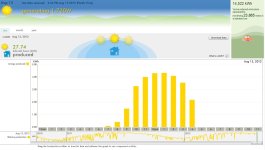
We have been bumping 32KWh for the last three months. Our 5KW system, has us hitting net zero for the year. We're an all electric house, but do a lot of heating in the winter, with a wood stove. solar.JPG

I have seen hinted, that many are comparing just todays electricity rates for the payback. Electricity rates keep rising, so the payback times shortens.
 
   / Grid-tied solar #77  
I have seen hinted, that many are comparing just todays electricity rates for the payback. Electricity rates keep rising, so the payback times shortens.

Very true. But cost increases are not always guaranteed to happen in any given year / quarter / month, nor are the amounts set in stone. Using "today's rate" gives you a known constant to work with, and it's better than nothing.

If deregulation *really* kicks in, or if the generation companies start using more efficient means of producing, we could actually see some reductions in costs from time to time. Going based on today's cost gives you a starting point that should seemingly be "worst case". Think of it this way... When you buy a car, and the label on the window shows a mileage rating for city and highway, do you base you estimated fuel usage solely on the highway mileage? That would be assuming "best case", and it isn't likely. If you base your usage on city driving, that's "worst case" and it can only get better. It's the mantra of "Plan for the worst, hope for the best."
 
   / Grid-tied solar #78  
Well if I had $.05/kwh rates my thought process would be different too, especially consuming at the rates you are. I'd probably build the same house and be doing swell with a sub $50 average monthly electric bill (including heat) instead of coughing up $15K on a PV system. It amazes me that power is that cheap anywhere, especially CT. The amount of power you consume would cost me $245/month here.

I wouldn't exactly consider Maine a mild place to live though, little cooling costs but lots of heating to do from Nov through April, even compared to CT.
 
   / Grid-tied solar #79  
Yes, we took all of that in to consideration before getting our solar hot water, and then solar electric. Don't count your chickens before the eggs hatch...

We're in sunny Kalifornia. I really do not see prices for electricity going down out here. Stable maybe on a lucky day. Up, yes.

Very true. But cost increases are not always guaranteed to happen in any given year / quarter / month, nor are the amounts set in stone. Using "today's rate" gives you a known constant to work with, and it's better than nothing.

If deregulation *really* kicks in, or if the generation companies start using more efficient means of producing, we could actually see some reductions in costs from time to time. Going based on today's cost gives you a starting point that should seemingly be "worst case". Think of it this way... When you buy a car, and the label on the window shows a mileage rating for city and highway, do you base you estimated fuel usage solely on the highway mileage? That would be assuming "best case", and it isn't likely. If you base your usage on city driving, that's "worst case" and it can only get better. It's the mantra of "Plan for the worst, hope for the best."
 
   / Grid-tied solar
  • Thread Starter
#80  
Well if I had $.05/kwh rates my thought process would be different too, especially consuming at the rates you are. I'd probably build the same house and be doing swell with a sub $50 average monthly electric bill (including heat) instead of coughing up $15K on a PV system. It amazes me that power is that cheap anywhere, especially CT. The amount of power you consume would cost me $245/month here.

I wouldn't exactly consider Maine a mild place to live though, little cooling costs but lots of heating to do from Nov through April, even compared to CT.

We put the sun to work for that too. Our house is direct-gain passive solar with full earth berms except the south side. Lots of south windows, lots of insulation, lots of concrete for thermal mass. We have a 3 ton soapstone masonry heater we fire most days, usually in the early evening. We use less than a cord of wood per year. In the gloomy time around the end of December, we turn on electric space heaters overnight in the bedroom if it hasn't been sunny. The bedroom is too far from the stove to benefit much.

It isn't for everybody, the temperature will hit 80 deg. on a clear winter day, we open windows a crack sometimes. Overnight, the temperature bottoms out around 68 degrees typically.
 

Tractor & Equipment Auctions

1660 (A59213)
1660 (A59213)
PNEUMATIC GREASE UNIT (A58214)
PNEUMATIC GREASE...
2012 DIAMOND T TRAILER TRAILER (A58214)
2012 DIAMOND T...
2017 CATERPILLAR 420F2 BACKHOE (A60429)
2017 CATERPILLAR...
JOHN DEERE 644K WHEEL LOADER (A58214)
JOHN DEERE 644K...
2015 VERMEER PD10 PILE DRIVER (A60429)
2015 VERMEER PD10...
 
Top